 Chat Live
 Contact Us
 sales@valuetronics.com



🎓 Request a Quote To Get An EDU Discount
Couldn't load pickup availability
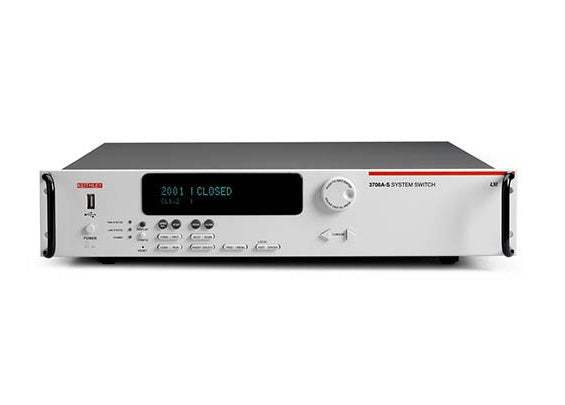
The Keithley Series 3700A is a family of scalable, instrument-grade system switch and multi-channel measurement solutions optimized for automated testing of electronic products and components. The series consists of four versions of the Model 3706A six-slot system switch mainframe together with a growing family of plug-in switch and control cards. When the Model 3706A mainframe is ordered with the high performance multimeter, the result is a tightly integrated switch and measurement system designed for the demanding requirements of functional test systems and stand-alone data acquisition applications.
Per the datasheet, the Series 3700A supports applications as diverse as design validation, accelerated stress testing, data acquisition, and functional testing. The platform is engineered for medium to high channel-count work: a fully loaded mainframe accommodates up to 576 two-wire multiplexer channels or up to 2,688 one-pole matrix crosspoints in a compact 2U (3.5 inch / 89 mm) enclosure. The plug-in card family covers dual multiplexers (3720, 3721, 3722, 3723, 3724), high-density matrix cards (3730, 3731, 3732), an isolated 32-channel switch card (3740), and a multifunction control card (3750).
Keithley Instruments was founded in 1946 in Cleveland, Ohio, and built its reputation around precision low-level electrical measurement — picoampere currents, nanovolt voltages, and source-measure unit (SMU) instrumentation for semiconductor and materials characterization. Keithley was acquired by Danaher Corporation in 2010 and subsequently became part of Fortive Corporation when Danaher spun off its industrial businesses in 2016. Tektronix, also part of Fortive, is Keithley's sibling brand, and the two share increasing distribution and support infrastructure. Today, Keithley operates as A Tektronix Company while retaining its product identity in precision DC, low-current, and switch/measurement system instrumentation.
The Series 3700A is offered in four mainframe configurations built around the same six-slot Model 3706A chassis. The two primary distinctions across the family are (1) whether the high performance 7½-digit multimeter is included or not, and (2) whether a front-panel display and keypad are fitted. All four mainframes share identical card-slot capacity, identical analog backplane wiring, identical remote interfaces (LXI/Ethernet, GPIB, USB), identical TSP and TSP-Link capability, and identical digital I/O resources.
Selection between the four configurations is driven by the deployment environment. System integrators building rack-mounted automated test platforms — where the instrument lives inside an enclosure and is operated exclusively from a host PC or TSP script — often select the no-front-panel (NFP) versions for cost and panel-real-estate reasons. Bench and laboratory users who interact with the instrument directly, or who value local readout for setup and troubleshooting, select the front-panel versions. The DMM-equipped versions add the integrated 7½-digit multimeter; the system-switch-only versions (3706A-S, 3706A-SNFP) are intended for applications where switching is the sole function or where an external measurement instrument is preferred.
Each new Series 3700A mainframe configuration is offered on its own dedicated product page with condition-matched pricing. The model links below let you compare available units, confirm which front-panel and DMM configuration fits your application, and review what is included with each listing.
The four mainframe SKUs differ along two binary axes: DMM-equipped versus switch-only, and front-panel-equipped versus NFP (no front panel display and keypad). The 3706A is the fully featured configuration — DMM installed, front panel fitted. The 3706A-NFP retains the DMM but removes the front-panel display and keypad. The 3706A-S keeps the front panel but ships without the DMM.
The comparison table below shows how the four configurations align across the two key axes. For applications that need integrated measurement alongside switching — RTD/thermocouple temperature scanning, multi-channel DCV characterization, mixed-signal data acquisition — the DMM-equipped 3706A or 3706A-NFP is the starting point. For applications where switching is the only function required (signal routing into an external instrument, large matrix configurations driven by a separate measurement engine), the 3706A-S or 3706A-SNFP avoids paying for the DMM. The NFP variants are typically chosen for rack-integrated systems where the front panel will not be operated and the cost or space savings of omitting the display is meaningful.
| Model | Configuration | DMM Included | Front Panel Display |
|---|---|---|---|
| 3706A-S | System Switch (No DMM) | No | Yes |
| 3706A | System Switch with High Performance DMM | Yes (7½-digit) | Yes |
| 3706A-NFP | System Switch with High Performance DMM (No Front Panel) | Yes (7½-digit) | No |
| 3706A-SNFP | System Switch (No DMM, No Front Panel) | No | No |
Additional differences in specifications beyond the few shown above are not listed here — see each model's full specifications below.
| Category | Specification |
|---|---|
| General | |
| Expansion Slots | 6 |
| Power Line | Universal, 100 V to 240 V |
| Line Frequency | 50 Hz and 60 Hz, automatically sensed at power-up |
| Power Consumption | 28 VA with DMM and display, up to 140 VA with six 37xx cards |
| Real Time Clock | Battery backed, 10 years typical life |
| EMC | Conforms to European Union EMC Directive |
| Safety | Conforms to European Union Low Voltage Directive |
| Vibration | MIL-PRF-28800F Class 3, Random |
| Warm-Up | 2 hours to rated accuracy |
| Digital I/O | 25-pin female D-shell, 14 lines |
| Triggering and Memory | |
| Window Filter Sensitivity | 0.01%, 0.1%, 1%, 10%, or full-scale of range (none) |
| Trigger Delay | 0 to 99 hrs (10 µs step size) |
| External Trigger Delay | <10 µs |
| Memory | Up to 650,000 time-stamped readings with Web page disabled. Additional memory available with external thumb drive. |
| Non-volatile Memory | Single user save setup, with up to 75 DMM configurations and ≥600 channel patterns |
| Math Functions | Rel, dB, Limit Test, %, 1/x, and mX+b with user-defined display |
| Remote Interface | |
| Ethernet | RJ-45 connector, LXI Class B Version 2, 10/100BT, no auto MDIX |
| GPIB | IEEE-488.1 compliant; supports IEEE-488.2 common commands and status model topology |
| USB Device (rear panel, type B) | Full speed, USBTMC compliant |
| USB Host (front panel, type A) | USB 2.0, support for thumb drives |
| LXI Compliance | |
| LXI Class | LXI Class B Version 2 with IEEE 1588 precision time protocol (LXI Core 2011) |
| Receive LAN[0-7] Event Delay | 800 µs typical |
| Alarm to Trigger Delay | 25 µs min., 50 µs typical |
| Generate LAN[0-7] Event | 800 µs typical |
| Clock Accuracy | 25 ppm |
| Synchronization Accuracy | <150 ns (95% confidence factor) |
| Timestamp Accuracy | 100 µs |
| Timestamp Resolution | 20 ns |
| Language and Control | |
| Language | Embedded Test Script Processor (TSP) accessible from any host interface |
| IP Configuration | Static or DHCP |
| Password Protection | 11 characters |
| PC and OS Requirements | |
| Minimum PC Hardware | Intel Pentium 3, 800 MHz, 512 Mbyte RAM, 210 Mbyte disk space or better |
| Operating Systems/Software | Windows 2000 and XP compatible; supports Web browsers with Java plug-in (requires Java plug-in 1.6 or higher) |
| Environment | |
| Operating Environment | 0° to 50°C, ≤80%RH at 35°C, altitude up to 2000 meters |
| Storage Environment | -40° to 70°C |
| Physical | |
| Rack Mounted Dimensions | 89 mm high × 483 mm wide × 457 mm deep (3.5 in. × 19 in. × 18 in.) |
| Bench Configuration Dimensions (with handle and feet) | 104 mm high × 483 mm wide × 457 mm deep (4.125 in. × 19 in. × 18 in.) |
| Shipping Weight | 13 kg (28 lbs) |
| High Performance DMM (DMM-equipped models only) | |
| Resolution | Up to 7½ digits (26-bit) |
| Built-in Measurement Functions | 13 functions: DCV, ACV, DCI, ACI, Frequency, Period, 2-Wire Ohms, 4-Wire Ohms, 3-Wire RTD, 4-Wire RTD, Thermocouple, Thermistor, Continuity |
| Reading Rate | >14,000 readings/second at 3½ digits; 60 readings/second at 7½ digits |
| DCV Ranges | 100 mV, 1 V, 10 V, 100 V, 300 V |
| DCV Best Accuracy (1 Year, 10 V range) | ±(25 ppm of reading + 2 ppm of range) |
| Resistance Ranges (2W/4W) | 1 Ω to 100 MΩ |
| Dry Circuit Resistance Ranges | 1 Ω to 2 kΩ |
| DC Current Ranges | 10 µA, 100 µA, 1 mA, 10 mA, 100 mA, 1 A, 3 A |
| AC Voltage Ranges | 100 mV, 1 V, 10 V, 100 V, 300 V |
| AC Current Ranges | 1 mA, 10 mA, 100 mA, 1 A, 3 A |
| Frequency / Period Range | 3 Hz to 500 kHz / 2 µs to 333 ms |
| Temperature - Thermocouple Range | -200°C to +1820°C (type-dependent) |
| Temperature - RTD Range | -200°C to +630°C |
| Temperature - Thermistor Range | -80°C to +150°C |
| Input Protection (DCV) | 300 V all ranges |
| Common Mode Voltage | 300 V DC or 300 Vrms (425 V peak for AC waveforms) |
| Channel Capacity (Fully Loaded Mainframe) | |
| Two-Wire Multiplexer Channels | Up to 576 |
| One-Wire Multiplexer Channels | Up to 720 |
| One-Pole Matrix Crosspoints | Up to 2,688 |
Please review the Manufacturer's Data Sheet to verify published specifications. Feedback on this webpage is always welcome — please reach out to your Test Architect at any time for questions or concerns. Thank you, we truly appreciate you being our customer.
Model No
Keithley
Condition
New
Manufacturer
Keithley


30+ Years in Business

Secure Payments

Sell Test Equipments

Knowledgeable Staff

On-site Lab
30+ Years in Business
Secure Payments
Sell Test Equipments
Knowledgeable Staff
On-site Lab
Request A Quote


