Chat Live
 Contact Us
 sales@valuetronics.com


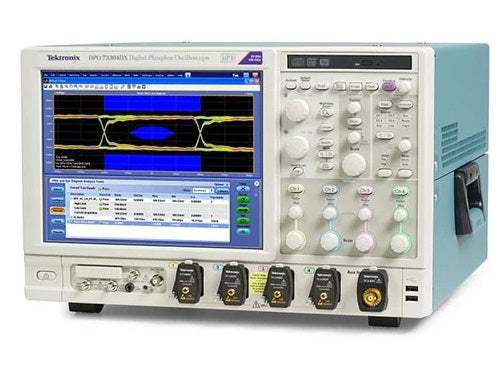
The MSO/DPO70000 Series is a family of Tektronix digital and mixed signal oscilloscopes built for engineers working through the full design cycle, from prototype turn-on to production testing. The series combines high analog bandwidth with high real-time sample rates and deep acquisition memory to capture and analyze fast signals on the bench. DPO (Digital Phosphor Oscilloscope) models provide four analog channels, while MSO (Mixed Signal Oscilloscope) models add 16 integrated logic channels for combined analog and digital debug.
An oscilloscope captures voltage waveforms over time, letting an engineer see a signal's amplitude, frequency, timing, and shape. The MSO/DPO70000 Series is applied to design verification — including signal integrity, jitter, and timing analysis — and to design characterization of high-speed, sophisticated designs. Additional uses include certification testing of serial data streams for industry standards, memory bus analysis and debug, prototype turn-on and power supply verification, research and investigation of transient phenomena, production testing of complex systems, and spectral analysis of transient or wide-bandwidth RF signals.
ValueTronics stocks and holds its own inventory in a 20,000 square foot secure warehouse at 1675 Cambridge Drive in Elgin, Illinois, and has specialized in new and used test and measurement equipment since 1992. Every pre-owned unit is inspected and functionally verified in-house before it ships, while new units ship factory-sealed exactly as received from the manufacturer. That combination lets buyers source the right instrument, in the condition they need, from a seller that physically handles and verifies the used equipment it sells.
The MSO/DPO70000 Series is a single oscilloscope family offered in two configurations across a range of bandwidth tiers. DPO models are digital phosphor oscilloscopes with four analog channels; MSO models add 16 integrated logic channels for mixed-signal work. Across the series, analog bandwidth is offered from 4 GHz through 33 GHz, with four analog channels on every model.
Within the family, the MSO70000 models are configured to address high-speed serial design challenges, encapsulating serial-domain features that are standard on MSO models and available as options on the DPO models. The selection guide below maps each model's bandwidth, sample rate, record length, and channel configuration.
Each model in the series links to its own dedicated product page with condition-matched pricing. Select the pre-owned listing that matches the model and configuration you need; bandwidth, sample rate, and memory differ by model, so confirm the specific model number against the comparison table before ordering.
The MSO70000 models are configured as a dedicated solution for high-speed serial data designs: real-time serial pattern triggering and protocol decode with built-in clock recovery, DPOJET jitter and eye diagram analysis, communications mask testing with over 150 masks, and 62.5 M record length on all four channels come standard. These same capabilities are offered as options on the DPO70000 models.
The models differ primarily in analog bandwidth, which ranges from 4 GHz to 33 GHz, and in maximum real-time sample rate: the 4, 6, and 8 GHz models provide 25 GS/s on all channels, while the 12.5 GHz through 33 GHz models provide 100 GS/s on two channels and 50 GS/s on all four. Standard record length is 31.25 M points per channel on DPO models and 62.5 M points on MSO models, with optional extensions up to 500 M points on the highest-bandwidth models.
The DPO and MSO designations distinguish the two configurations: MSO models add 16 logic channels and include serial-domain features as standard that are options on DPO models, while the C and DX suffixes indicate the bandwidth and performance tier. See the comparison table for each model's exact bandwidth, sample rate, record length, and channel count.
| Model | Bandwidth | Sample Rate | Standard Record Length |
|---|---|---|---|
| MSO70804C | 8 GHz | 25 GS/s | 62 MS |
| MSO70404C | 4 GHz | 25 GS/s | 62 MS |
| DPO70404C | 4 GHz | 25 GS/s | 31 MS |
| MSO70604C | 6 GHz | 25 GS/s | 62 MS |
Additional differences in specifications beyond the few shown above are not listed here — see each model's full specifications below.
| Specification | Value |
|---|---|
| Model Overview (per model; DPO / MSO where they differ) | |
| Analog channels (all models) | 4 |
| Digital channels (MSO70000 Series only) | 16 |
| Analog bandwidth (user-selectable DSP enhance) (–3 dB) | DPO70404C/MSO70404C: 4 GHz; DPO70604C/MSO70604C: 6 GHz; DPO70804C/MSO70804C: 8 GHz; DPO71254C/MSO71254C: 12.5 GHz; DPO71604C/MSO71604C: 16 GHz; DPO72004C/MSO72004C: 20 GHz; DPO72304DX/MSO72304DX: 23 GHz (2 Ch), 23 GHz (4 Ch); DPO72504DX/MSO72504DX: 25 GHz (2 Ch), 23 GHz (4 Ch); DPO73304DX/MSO73304DX: 33 GHz (2 Ch), 23 GHz (4 Ch) |
| Hardware analog bandwidth (–3 dB) | 4 GHz; 6 GHz; 8 GHz; 12.5 GHz; 16 GHz (typical); 16 GHz (typical); 23 GHz; 25 GHz; 33 GHz |
| Rise time (typical), 10% to 90% / 20% to 80% | 4 GHz: 98 ps/68 ps; 6 GHz: 65 ps/45 ps; 8 GHz: 49 ps/34 ps; 12.5 GHz: 32 ps/22 ps; 16 GHz: 24.5 ps/17 ps; 20 GHz: 18 ps/14 ps; 23 GHz: 17 ps/13 ps; 25 GHz: 16 ps/12 ps; 33 GHz: 13 ps/9 ps |
| Sample rate (1, 2 ch) | 4/6/8 GHz: 25 GS/s; 12.5 GHz and above: 100 GS/s |
| Sample rate (3, 4 ch) | 4/6/8 GHz: 25 GS/s; 12.5 GHz and above: 50 GS/s |
| Sample rate (ET/IT mode) | 4/6/8 GHz: 5 TS/s; 12.5 GHz and above: 10 TS/s |
| Record length, points (each channel, standard) | DPO70000 Series: 31.25 M; MSO70000 Series: 62.5 M |
| Record length (each channel, Opt. 5XL, DPO70000 Series) | 62.5 M |
| Record length (each channel, Opt. 10XL) | 125 M |
| Record length (each channel, Opt. 20XL) | 12.5 GHz and above: 250 M (N/A on 4/6/8 GHz) |
| Record length (each channel, Opt. 50XL) | 23/25/33 GHz: 500 M each channel, 1 G on 2 channels (N/A below 23 GHz) |
| Timing resolution | 4/6/8 GHz: 40 ps (25 GS/s); 12.5 GHz and above: 10 ps (100 GS/s) |
| Duration at highest sample rate (standard) | 4/6/8 GHz: 1.25 ms (DPO), 2.5 ms (MSO); 12.5 GHz and above: 0.31 ms (DPO), 0.61 ms (MSO) |
| Duration at highest sample rate (Opt. 5XL, DPO70000 Series) | 4/6/8 GHz: 2.5 ms; 12.5 GHz and above: 0.63 ms |
| Duration at highest sample rate (Opt. 10XL) | 4/6/8 GHz: 5.0 ms; 12.5 GHz and above: 1.3 ms |
| Duration at highest sample rate (Opt. 20XL) | 12.5 GHz and above: 2.5 ms |
| Duration at highest sample rate (Opt. 50XL) | 23/25/33 GHz: 5 ms each channel, 10 ms on 2 channels |
| Vertical noise (% of full scale) (50 mV/div, bandwidth filter on, max sample rate) (typical) | 4 GHz: 0.28%; 6 GHz: 0.32%; 8 GHz: 0.35%; 12.5 GHz: 0.36%; 16 GHz: 0.36%; 20 GHz: 0.56%; 23 GHz: 0.58%; 25 GHz: 0.58%; 33 GHz: 0.58% |
| Time base range (Auto mode) | 4/6/8 GHz: 20 ps/div to 1000 s/div; 12.5 GHz and above: 10 ps/div to 1000 s/div |
| Timing resolution (ET/IT mode) | 4/6/8 GHz: 200 fs; 12.5 GHz and above: 100 fs |
| Delta time measurement accuracy (RMS over <100 ns; single shot; 100 mV/div, BW filter on, max sample rate) | 4 GHz: 1.48 ps; 6 GHz: 1.33 ps; 8 GHz: 1.24 ps; 12.5 GHz: 1.23 ps; 16 GHz: 1.15 ps; 20 GHz: 1.43 ps; 23 GHz: 639 fs; 25 GHz: 639 fs; 33 GHz: 555 fs |
| Jitter noise floor (with BWE enabled) (typical) | 4 GHz: 340 fs; 6 GHz: 300 fs; 8 GHz: 300 fs; 12.5 GHz: 270 fs; 16 GHz: 270 fs; 20 GHz: 290 fs; 23 GHz: <380 fs; 25 GHz: <365 fs; 33 GHz: <325 fs |
| Vertical System – Analog Channels | |
| Bandwidth limit | Depending on instrument model: 33 GHz to 1 GHz in 1 GHz steps, or 500 MHz. Hardware-only bandwidth settings at 33, 25, 23, 20, 16, 12.5, 8, 6, and 4 GHz |
| Channel-to-Channel isolation (any two channels at equal vertical scale) | 0 GHz to 10 GHz: ≥120:1; >10 GHz to 12 GHz: ≥80:1; >12 GHz to 15 GHz: ≥50:1; >15 GHz to 20 GHz: ≥25:1; >20 GHz to 33 GHz: ≥20:1 |
| DC gain accuracy | ±2% (of reading) |
| Channel delay (typical) | ≤10 ps for any two channels at equal V/div and coupling on C models; ≤1 ps on DX models |
| Effective number of bits (typical) | 5.5 bits at 50 mV/div, bandwidth filter on, max bandwidth up to 13 GHz, max sample rate |
| Signal-to-Noise ratio (typical) | 34 dB |
| Input coupling | DC (50 Ω), GND |
| Input resistance selection | 50 Ω ±3%, 1 MΩ with TCA-1MEG adapter |
| Input sensitivity range | 23/25/33 GHz models: 6.25 mV/div to 600 mV/div (62.5 mV to 6 V full scale); 20 GHz models: 20 to 500 mV/div (200 mV to 5 V full scale), 10 mV/div at 18 GHz (100 mV full scale); All other models: 10 mV/div to 500 mV/div (100 mV to 5 V full scale) |
| Maximum input voltage, 50 Ω (also determined by TekConnect accessory) | 23/25/33 GHz models: ≤1.2 VFS: ±1.5 V relative to the termination bias (30 mA maximum), ±5 V absolute maximum input; >1.2 VFS: 8.0 V. All other models: <5.0 VRMS for ≥100 mV/div; 1.0 VRMS for <100 mV/div |
| Termination voltage range | 23/25/33 GHz models: ≤1.2 VFS: -3.5 V to +3.5 V; >1.2 VFS: 0 V. All other models: 0 V only |
| Offset accuracy | 10 mV/div to 99.5 mV/div: ±(0.35% (offset value-position) + 1.5 mV + 1% of full scale); 100 mV/div to 500 mV/div: ±(0.35% (offset value-position) + 7.5 mV + 1% of full scale) |
| Offset range | 23/25/33 GHz models: +3.4 V to ‒3.4 V. All other models: 10 mV/div: ±450 mV; 20 mV/div: ±400 mV; 50 mV/div: ±250 mV; 100 mV/div: ±2.0 V; 200 mV/div: ±1.5 V; 500 mV/div: ±0.0 V |
| Passband flatness (20, 50, 100, 250 mV/div) (typical) | ±0.5 dB to 50% of nominal bandwidth |
| Position range | ±5 div |
| Vertical resolution | 8 bit (11 bit with averaging) |
| Vertical System – Digital Channels | |
| Digital bandwidth | With P6780 logic probe: 2.5 GHz; with P6750 or P6717A logic probe: 1 GHz |
| Input resistance selection | With P6780: 20 kΩ to ground per side or 40 kΩ differential mode ±2.0%, 0.5 pF; with P6750/P6717A: 20 kΩ ±1.0%, 3 pF |
| Trigger clock/qualifier input | 1 |
| Vertical resolution | 1 bit |
| Thresholds | One per channel, independently set |
| Threshold accuracy | ±75 mV + 3% of threshold setting |
| Threshold resolution | 5 mV |
| Threshold voltage range | With P6780: –2 to +4.5 V; with P6750/P6717A: –1.5 to +4.0 V |
| Minimum voltage swing | 300 mVp-p |
| Maximum input voltage | ±15 V nondestruct |
Important: MSO/DPO70000C instruments include TekProtect circuitry designed to stop EOS/ESD events from reaching the analog channel preamp inputs while allowing normal signals to pass; check it regularly with the TF-TEKPROTECT ESD Protection Tester.
Important: Real-time serial pattern triggering, clock recovery, and the DPOJET Advanced Jitter and Eye Diagram application come standard on the MSO70000 Series instruments but are options (e.g., Option ST6G, Option DJA) on the DPO70000 Series.
Important: TriMode probing systems (P7700, P7600, P7500 series) and logic probes (P6780, P6750) are listed under Recommended accessories and are not included with the base oscilloscope; the appropriate probe(s) for your signal connections must be ordered separately. (The MSO70000 Series base configuration does include one P6717A General Purpose Logic Probe and a Logic Probe Deskew Fixture.)
Important: Certain recommended test fixtures and cables (e.g., TF-USB3-AB-KIT, TF-XGbT) are not updated to comply with RoHS 2 Directive 2011/65/EU and will not be shipped to the EU.
Recommended pairing: the P7700, P7600, and P7500 TriMode probing systems have bandwidths matched to the MSO/DPO70000 Series and switch among differential, single-ended, and common-mode measurements without moving the probe.
This pre-owned unit is inspected and functionally verified in-house before it ships and is backed by our pre-owned warranty. To confirm its exact condition, firmware revision, installed options, or included accessories for your application before ordering, contact our Test Architects.
ValueTronics supplies both new and used test and measurement equipment. New units ship factory-sealed, exactly as received from the manufacturer; every used unit is inspected and functionally verified in-house at our 20,000 sq ft secure facility in Elgin, Illinois before it ships. Our Test Architects can help you select the condition, calibration, and configuration that fit your application.
Please review the Manufacturer's Data Sheet to verify published specifications. Feedback on this webpage is always welcome — please reach out to your Test Architect at any time for questions or concerns. Thank you, we truly appreciate you being our customer.
Model No
Tektronix
Condition
Pre-Owned
Manufacturer
Tektronix
Osc_ch
4
Osc_freq
8 GHz
Osc_r
50 Ω
Osc_sampl
25 GS/s


30+ Years in Business

Secure Payments

Sell Test Equipments

Knowledgeable Staff

On-site Lab
30+ Years in Business
Secure Payments
Sell Test Equipments
Knowledgeable Staff
On-site Lab
Request A Quote