 Chat Live
 Contact Us
 sales@valuetronics.com


🎓 Request a Quote To Get An EDU Discount
Couldn't load pickup availability
6 FlexChannel® inputs · 1 GHz bandwidth · 12-bit ADC (16-bit High Res) · 15.6" HD touchscreen · 62.5 Mpoints standard record length.
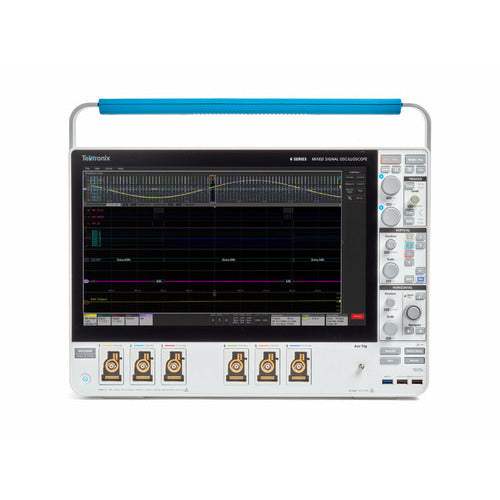
In summary, the Tektronix MSO66B-6-BW-1000 is a 6-channel mixed signal oscilloscope with 1 GHz of analog bandwidth, a 12-bit ADC (extended to 16 bits in High Res mode), a 15.6-inch 1920×1080 capacitive touchscreen, and FlexChannel® inputs that let each channel be used as one analog input or eight digital logic inputs. It is part of the Tektronix 6 Series B MSO family — the current flagship mid-range Tektronix platform — designed for embedded systems debug, power electronics, high-speed serial validation, three-phase power analysis, and RF-adjacent mixed-domain work.
The MSO66B-6-BW-1000 is used to capture, visualize, and analyze time-domain and frequency-domain signals on electronic systems with clock speeds and bus rates up to 1 GHz. Typical applications include embedded firmware and hardware debug across I²C, SPI, UART, CAN/CAN FD, LIN, FlexRay, USB 2.0, Ethernet, and MIPI buses; switching power supply and three-phase inverter characterization; DDR3/LPDDR3 memory debug and compliance; PAM3 and high-speed serial signal-integrity analysis; and Spectrum View frequency-domain analysis on every analog input.
6 analog channels lets you observe more nodes of a system at once without the trigger-alignment and documentation overhead of running two scopes in parallel. Three-phase power conversion, polyphase motor drives, multi-rail power integrity, and complex embedded systems frequently require simultaneous observation of more than four analog signals to verify and characterize device performance. Per Tektronix, six-channel models typically cost only about 25% more than four-channel models, and eight-channel models about 67% more — far less than the doubling that older single-purpose channel-count economics would imply.
Analog bandwidth is 1 GHz on all analog channels, with a 12-bit ADC that delivers 16 times the vertical resolution of traditional 8-bit oscilloscopes. Real-time sample rate is 50 GS/s on 2 channels, 25 GS/s on 4 channels, and 12.5 GS/s on more than 4 channels; this 6-channel configuration tops out at 12.5 GS/s when all channels are active. Standard record length is 62.5 Mpoints on every channel, expandable to 1 Gpoint per channel as an option. Random noise is specified as low as 51.8 µV RMS at 1 mV/div with 1 GHz bandwidth — among the lowest in this class — enabled by the TEK061 front-end ASIC. Waveform capture rate exceeds 500,000 wfms/s in Peak Detect / Envelope modes.
The 6 Series B MSO platform supports automated TekExpress compliance test solutions for USB 2.0, Ethernet (10/100/1000BASE-T and 2.5/5/10GBASE-T), Automotive Ethernet (100BASE-T1, 1000BASE-T1, 10BASE-T1S, 10BASE-T1L), MIPI D-PHY 1.2, and DDR3/LPDDR3, with calibration data documenting traceability to National Metrology Institutes and ISO 9001 / ISO/IEC 17025 quality system registration. Option 6-SEC adds password-protected I/O lockdown and BIOS protection developed in compliance with NISPOM DoD 5220.22-M Chapter 8 — important for classified and controlled-environment labs. The instrument is LXI Core 2011 compatible and supports IVI-COM drivers, TekVISA, USBTMC, and LAN/USB programmatic control.
Against the prior Tektronix DPO7000C and MSO/DPO70000C platforms, the 6 Series B improves most on noise floor and channel architecture. At 1 GHz / 10 mV/div, typical 50 Ω input-referred noise is 82.9 µV RMS versus 279 µV RMS on the DPO7000C — roughly 3.4× better. At 4 GHz / 100 mV/div, noise is 1.73 mV RMS versus 4.3 mV RMS on the MSO/DPO70000C. FlexChannel® inputs replace fixed analog/digital channel allocation: each input carries one analog, eight digital (TLP058), or a simultaneous spectrum view, in any combination. Vertical resolution is 12-bit native (16-bit in High Res) versus 8-bit on legacy platforms. Typical workloads include embedded debug across I²C, SPI, I3C, UART, CAN/CAN FD, LIN, FlexRay, USB 2.0, eUSB2, and SPMI; power-electronics analysis with 6-PWR; three-phase work with 6-IMDA (MSO66B / MSO68B only); high-speed serial validation with 6-DJA; and mixed-domain RF work using Spectrum View on every channel.
Each new instrument ships with one TPP1000 1 GHz passive voltage probe per FlexChannel® input (high dynamic range, 3.9 pF capacitive loading), a front cover with integrated accessory pouch, a USB mouse, a country-specific power cord (selected at order via the A0–A99 option codes), an installation and safety manual in English, Japanese, and Simplified Chinese, the embedded context-sensitive help system, and a calibration certificate documenting traceability to National Metrology Institute(s) under Tektronix's ISO 9001 and ISO/IEC 17025 registered quality system. The standard one-year warranty covers all parts and labor on both the instrument and the included probes.
Bandwidth is the single most important specification on any oscilloscope: capturing clean square-wave edges requires capturing the harmonics at 3×, 5×, and 7× the fundamental. The MSO66B-6-BW-1000 delivers 1 GHz of analog bandwidth across all 6 channels, and bandwidth is field-upgradeable to higher tiers with only a software license and a new front-panel label.
Sample rate on the 6 Series B is tiered by active channel count: 50 GS/s on two channels, 25 GS/s on four channels, and 12.5 GS/s on more than four. In this 6-channel configuration, the architecture supports 12.5 GS/s when all channels are active. Standard record length is 62.5 Mpoints on every channel; Capture Duration = Memory ÷ Sample Rate, so even the standard memory captures several milliseconds at full rate. Customers running long compliance sequences, power-supply startup analysis, or rare-event capture should add 6-RL-1 / -2 / -3 / -4 to extend record length up to 1 Gpoint per channel.
Where the 6 Series B genuinely differentiates is noise performance and channel architecture. The TEK061 front-end ASIC delivers as low as 51.8 µV RMS at 1 mV/div / 1 GHz — roughly 3× lower than the prior DPO7000C generation — and FlexChannel® inputs let every channel be used as one analog signal, eight digital logic inputs (with TLP058 probe), or a simultaneous analog + Spectrum View pair with independent time- and frequency-domain controls.
| Parameter | Specification |
|---|---|
| FlexChannel® inputs | 6 |
| Maximum analog channels | 6 |
| Maximum digital channels (with TLP058 probes) | 48 |
| Analog bandwidth | 1 GHz |
| ADC resolution | 12-bit (16-bit in High Res mode) |
| Max sample rate (this config, all ch) | 12.5 GS/s |
| Sample rate, full architecture | 50 GS/s (2 ch); 25 GS/s (4 ch); 12.5 GS/s (>4 ch); interpolated 2.5 TS/s |
| Standard record length | 62.5 Mpoints / channel |
| Optional record length | 125 M / 250 M / 500 M / 1 Gpoint / ch (6-RL-1 to -4) |
| Waveform capture rate | >500,000 wfms/s (Peak Detect / Envelope); >30,000 wfms/s otherwise; FastFrame™ >5,000,000 wfms/s |
| Time base range | 40 ps/div to 1,000 s/div |
| Timebase accuracy | ±1.0 × 10⁻⁷ over ≥1 ms; ±12 ppb factory tolerance; ±20 ppb temp stability (0–50 °C); ±300 ppb crystal aging/year |
| Aperture uncertainty (typical) | 80 fs (<1 µs); 130 fs (<1 ms) |
| Acquisition modes | Sample, Peak Detect (160 ps glitch), Averaging (2–10,240), Envelope, High Res, FastAcq®, Roll, FastFrame™ |
| Input coupling | DC, AC |
| Input impedance | 1 MΩ ±1% DC; 50 Ω ±3% DC |
| Input capacitance (1 MΩ, typical) | 14.5 pF ±1.5 pF |
| Sensitivity range | 1 MΩ: 500 µV/div–10 V/div; 50 Ω: 1 mV/div–1 V/div (1-2-5) |
| Max input voltage (1 MΩ) | 300 V RMS (derated above 4.5 MHz; 5.5 V RMS above 450 MHz) |
| Max input voltage (50 Ω) | 2.3 V RMS at <100 mV/div; 5.5 V RMS at ≥100 mV/div; peaks ≤ ±20 V (DF ≤ 6.25%) |
| DC gain accuracy | ±2.0% at >2 mV/div; ±1.0% of full scale at >2 mV/div |
| Position range | ±5 divisions |
| Vertical resolution (High Res) | 12-bit @ 12.5 GS/s · 13 @ 6.25 GS/s · 14 @ 3.125 GS/s · 15 @ 1.25 GS/s · 16 @ ≤625 MS/s |
| Vertical resolution (Sample) | 8-bit @ 50 GS/s (2 ch) · 8 @ 25 GS/s (4 ch) · 12 @ 12.5 GS/s |
| Crosstalk (typical) | ≥50 dB to 2 GHz; ≥45 dB to 5 GHz; ≥40 dB to 10 GHz |
| Deskew range | −125 ns to +125 ns; 1 ps resolution |
Each TLP058 logic probe adds 8 digital inputs (D7–D0) at the cost of one analog channel, allowing this 6-channel model to scale up to 48 digital channels with the right probe complement. Maximum input toggle rate is 500 MHz, with a minimum detectable pulse width of 1 ns (typical). Threshold range is ±40 V in 10 mV resolution; accuracy is ±[100 mV + 3% of threshold setting] after calibration. Typical input dynamic range is 30 V p-p for Fin ≤ 200 MHz and 10 V p-p above 200 MHz; absolute maximum input voltage is ±42 V peak. Probe loading is 2 pF / 100 kΩ (typical).
Trigger modes are Auto, Normal, and Single. Coupling supports DC, HF Reject (attenuates >50 kHz), LF Reject (attenuates <50 kHz), and Noise Reject. Standard trigger types include Edge, Pulse Width, Runt, Timeout, Window, Logic, Setup & Hold, Rise/Fall Time, Parallel Bus, Sequence, and Visual Trigger; Video (optional 6-VID) and RF Magnitude / Frequency vs. Time (optional 6-SV-RFVT) are also available. Auxiliary trigger input accepts ≤5 V RMS into 50 Ω at 400 MHz (Edge trigger only). Holdoff range is 0 ns to 10 s. Typical trigger jitter is ≤1.5 ps RMS in Sample-mode edge triggering, ≤2 ps RMS in FastAcq edge mode, and ≤80 ps p-p for non-edge trigger types. An 8-digit trigger frequency counter is included free with product registration.
Tektronix-patented frequency-domain analysis with independent time- and frequency-domain controls per channel. Span 74.5 Hz – 1.25 GHz standard (2 GHz with option 6-SV-BW-1); RBW 93 µHz to 62.5 MHz (100 MHz with 6-SV-BW-1). Center frequency is limited by instrument bandwidth (1 GHz). Window types include Blackman-Harris, Flat-Top 2, Hamming, Hanning, Kaiser-Bessel, and Rectangular. Reference level −42 dBm to +44 dBm; vertical units dBm, dBµW, dBmV, dBµV, dBmA, dBµA. Option 6-SV-RFVT adds RF Magnitude / Frequency / Phase vs. Time traces and hardware trigger on RF vs. time events.
The optional 6-AFG arbitrary / function generator delivers 50 MHz output across Sine, Square, Pulse, Ramp/Triangle, DC level, Gaussian, Lorentz, Exponential Rise/Fall, Sin(x)/x, Random Noise, Haversine, Cardiac, and Arbitrary waveforms, with 128 k arbitrary waveform memory at a 250 MS/s arb sample rate; compatible with Tektronix ArbExpress. A 4-digit Digital Voltmeter (DC, AC RMS, DC+AC RMS on any analog input) and an 8-digit Trigger Frequency Counter are both included free with product registration.
| Parameter | Specification |
|---|---|
| Display | 15.6 in (396 mm) TFT, 1920 × 1080 HD, capacitive multi-touch |
| USB | Front: 2× USB 2.0 + 1× USB 3.0 Host. Rear: 2× USB 2.0 + 2× USB 3.0 Host + 1× USB 3.0 Device (USBTMC) |
| LAN / video | 10/100/1000BASE-T Ethernet (LXI Core 2011); DisplayPort, DVI-I, VGA |
| Remote control | e*Scope® web, TekVISA, IVI-COM, USBTMC; Windows Remote Desktop with 6-WIN |
| Operating system | Closed embedded OS on removable SSD; optional 6-WIN adds Windows 10 SSD |
| Power | 500 W max; 100–240 V ±10% at 50–60 Hz; 115 V ±10% at 400 Hz |
| Dimensions / weight | 12.2 in H × 17.9 in W × 8.0 in D (309 × 454 × 204 mm); <28.4 lb (12.88 kg) |
| Environmental | 0 to +50 °C operating; 5–90% RH (≤+40 °C), 5–55% RH (+40 to +50 °C); up to 3,000 m |
| Regulatory | CE (EU), UL (US/Canada), RoHS, ISO 9001 / ISO 14001 registered |
The 6 Series B supports a deep library of factory-installed and field-upgradeable options. Node-locked licenses permanently enable features on a single instrument; floating licenses move between compatible instruments. Bandwidth itself is software-upgradeable — moving from 1 GHz to a higher tier later requires only a license and a new front-panel label, no hardware swap.
Instrument functions: 6-RL-1, 6-RL-2, 6-RL-3, 6-RL-4 (extend record length to 125 M, 250 M, 500 M, or 1 Gpoint/ch); 6-AFG (50 MHz arbitrary/function generator, 13 waveform types); 6-WIN (Windows 10 SSD); 6-SEC (NISPOM DoD 5220.22-M Ch. 8 enhanced security — order with instrument, not available as later upgrade).
Power, motor & jitter analysis: 6-PWR (harmonics, switching loss, SOA, dv/dt, di/dt, ripple, magnetics, efficiency, Bode plot, PSRR); 6-PS2 (power solution bundle — 6-PWR + THDP0200 + TCP0030A + 067-1686-XX deskew fixture); 6-DPM (Digital Power Management); 6-DJA (Advanced Jitter and Eye Analysis — TJ@BER, RJ-δδ, DJ-δδ, PJ, NPJ, eye mask); 6-PAM3. 6-IMDA and 6-IMDA-DQ0 add Inverter Motor Drive Analysis with DQ0 transform.
Spectrum & specialty: 6-SV-BW-1 (Spectrum View to 2 GHz); 6-SV-RFVT (RF vs. Time, IQ data for SignalVu-PC); 6-MTM (Mask & Limit Testing); 6-VID (NTSC/PAL/SECAM video trigger); 6-DBDDR3 + 6-CMDDR3 (DDR3/LPDDR3 debug and compliance — ≥4 GHz required, 8 GHz recommended); 6-DBLVDS.
Serial protocol decode & trigger: 6-SRAERO (MIL-STD-1553, ARINC 429); 6-SRAUDIO (I²S/LJ/RJ/TDM); 6-SRAUTO (CAN, CAN FD, LIN, FlexRay); 6-SRAUTOEN1 (100BASE-T1); 6-SRAUTOSEN (SENT); 6-SRCOMP (RS-232/422/485/UART); 6-SRDPHY (MIPI D-PHY); 6-SREMBD (I²C, SPI); 6-SRENET (10/100BASE-T); 6-SREUSB2; 6-SRI3C; 6-SRMANCH; 6-SRMDIO; 6-SR8B10B; 6-SRNRZ; 6-SRPM (SPMI); 6-SRPSI5; 6-SRSPACEWIRE; 6-SRSVID; 6-SRUSB2 (USB 2.0 LS/FS/HS).
Automated compliance test (TekExpress): 6-CMAUTOEN (Automotive Ethernet 100/1000BASE-T1); 6-CMAUTOEN10 (10BASE-T1S); 6-CMINDUEN10 (10BASE-T1L); 6-CMDPHY (MIPI D-PHY 1.2); 6-CMENET (10/100/1000BASE-T); 6-CMNBASET (2.5/5GBASE-T); 6-CMUSB2 (USB 2.0); 6-CMXGBT (10GBASE-T).
MSO66B R3 and R5 extend the standard warranty to 3 or 5 years, covering parts, labor, and 2-day in-country shipping, with all repairs including calibration and firmware updates. MSO66B T3 and T5 add a 3- or 5-year Total Protection Plan covering wear-and-tear, accidental damage, ESD/EOS, plus preventative maintenance, 5-day turnaround, and priority support. MSO66B C3 and C5 provide 3- or 5-year traceable calibration or functional verification, including the initial calibration. MSO66B D1, D3, and D5 add a one-time, 3-year, or 5-year calibration data report (D3 paired with C3, D5 paired with C5).
The 6 Series B MSO uses the TekVPI® probe interface, which delivers up to 80 W of front-panel power for active, current, and isolated probes without a separate supply. The supported probe ecosystem includes TPP passive probes, TAP single-ended active probes, TDP differential probes, TDP7700 TriMode™ probes (4 / 6 / 8 GHz), THDP / TMDP high-voltage differential probes, TCP / TRCP current probes, TIVH / TIVM IsoVu™ isolated probes, and TPR power-rail probes; the TPA-BNC adapter accepts legacy TekProbe-BNC instruments. Differential serial bus work requires a matching differential probe — consult your Test Architect to confirm probe fit for your application.
This webpage was written by a human with an A.I. "Intern", which may contain errors. Please review the Manufacturer's Data Sheet to verify published specifications. Feedback on this webpage is always welcome — please reach out to your Test Architect at any time for questions or concerns. Thank you, we truly appreciate you being our customer.
Model No
MSO66B-6-BW-1000
Condition
New
Manufacturer
Tektronix
Channels
6
Frequency
1 GHz
Record length
62.5 MPts
Sampling rate
12.5 GS/s
6-AFG
Arbitrary Function Generator
6-CMDDR3
Automated Compliance Test
6-CMDDR3-FL
Compliance Test.
6-CMENET
Compliance Solution
6-DPM
Digital Power Management Analysis
6-DPM-FL
Software
6-PWR
Power Measurement
6-RL-3
Extend Record Length
6-SRAERO
Aerospace Serial Triggering
6-SRAERO-FL
Aerospace Serial Triggering
6-SRAUDIO
Audio Serial Triggering
6-SRAUTO
Automotive Serial Triggering
6-SRCOMP
Computer Serial Triggering
6-SREMBD
Embedded Serial Triggering
6-SRUSB2
USB Serial Triggering
6-SV-RFVT
Spectrum View RF VS Time Analysis
6-WIN
Removable SSD with Windows


30+ Years in Business

Secure Payments

Sell Test Equipments

Knowledgeable Staff

On-site Lab
30+ Years in Business
Secure Payments
Sell Test Equipments
Knowledgeable Staff
On-site Lab
Request A Quote

