Chat Live
 Contact Us
 sales@valuetronics.com


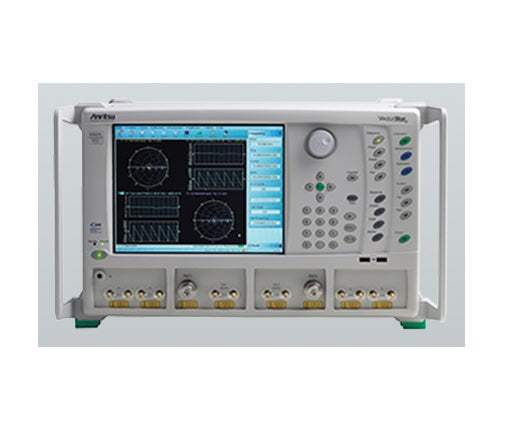
The Anritsu MS4640B Series VectorStar is a family of high-performance microwave vector network analyzers offered in three base configurations: the MS4642B covering 70 kHz to 20 GHz, the MS4644B covering 10 MHz to 40 GHz, and the MS4647B covering 10 MHz to 70 GHz. The MS4644B and MS4647B can be extended to a 70 kHz low-end start frequency through Option 70. The MS4640B Series is designed for broadband network analysis applications where wide frequency coverage, low noise floor, and flexible calibration methodologies are required in a single instrument platform.
These VNAs are used for the characterization of RF and microwave components, subsystems, and active devices. Application areas explicitly addressed in the datasheet include S-parameter measurement of passive and active devices, noise figure measurement (with Option 41 or differential noise figure with Option 48), intermodulation distortion analysis (with IMDView Option 44), mixer and frequency-translated device characterization (with Receiver Offset Option 7 and Dual Source Option 31), pulsed RF measurements (with PulseView Option 42 and IF Digitizer Option 35), differential device characterization (with DifferentialView Option 43), eye diagram generation from measured trace data (Option 47), and time-domain reflectometry-style analysis (Option 2). The optional MN4765B O/E Calibration Module extends the platform to electro-optical and opto-electronic device measurements at common telecom wavelengths.
Anritsu is a Japanese precision measurement company with roots extending to 1895. The VectorStar microwave VNA line traces in part to Anritsu's 1993 acquisition of Wiltron Company, which brought significant RF and microwave network analysis technology and a North American commercial presence into the Anritsu portfolio. Instruments and accessories carrying historical Wiltron model numbers are part of the same engineering lineage as today's Anritsu VNA products.
The VectorStar MS4640B Series is a three-model family of microwave vector network analyzers that share a common platform, calibration system, optional capability set, and accessory ecosystem, but differ in maximum operating frequency. The shared platform means that a measurement procedure, calibration kit relationship, or automation script developed on one model in the family generally transfers directly to the others within their respective frequency limits.
The base models — MS4642B, MS4644B, and MS4647B — are distinguished primarily by the upper frequency limit they support and, for the two higher-frequency models, by whether the optional 70 kHz low-end frequency extension (Option 70) has been installed. Most of the platform's optional capabilities, including Time Domain, Receiver Offset, Dual Source Architecture, Noise Figure, PulseView, IMDView, and the Active Measurements Suite, are available across all three models per the datasheet's compatibility tables.
Each pre-owned MS4640B Series VNA listed below is its own product page with condition-matched pricing and configuration detail. Because installed options materially affect what an MS4640B VNA can measure, every listing should be reviewed for the specific option set present on that unit before finalizing a purchase.
The MS4642B covers 70 kHz to 20 GHz at the base configuration and is the entry point to the family for applications that do not require coverage above 20 GHz. The MS4644B extends the upper frequency limit to 40 GHz with a base coverage of 10 MHz to 40 GHz, and the MS4647B further extends to 70 GHz with a base coverage of 10 MHz to 70 GHz. The MS4644B and MS4647B can both be ordered with Option 70 to bring the low-end start frequency down to 70 kHz (extendable to 40 kHz per the datasheet), matching the standard low-end of the MS4642B.
System dynamic range and noise floor specifications scale somewhat with the model's frequency reach, particularly above 38 GHz on the MS4647B where additional band coverage introduces band-specific specifications. The comparison table that follows lists each available unit with its installed configuration, condition grade, and option set as documented at the time of grading.
| Model | Frequency Range | Test Port Connector | Default Output Power |
|---|---|---|---|
| MS4644B | 10 MHz to 40 GHz (70 kHz with Option 70) | K (male) | +5 dBm (Standard or Option 51/61/62) |
| MS4642B | 70 kHz to 20 GHz | K (male) | +5 dBm (with Option 51, 61, or 62) |
| MS4647B | 10 MHz to 70 GHz (70 kHz with Option 70) | V (male) | -3 dBm Standard / -10 dBm with Option 51, 61, or 62 |
Additional differences in specifications beyond the few shown above are not listed here — see each model's full specifications below.
| Specification | Value |
|---|---|
| Channels, Display, and Traces | |
| Channels and Traces | 16 channels, each with up to 16 traces |
| Display | Color touch screen LCD, 26.4 cm (10.4 in) diagonal |
| Measurement Data Points | 2 to 25,000 points in up to 16 channels; 2 to 100,000 points in single channel |
| Markers | 12 markers per trace (x 16 traces x 16 channels, total 3,072) |
| IF Bandwidth | |
| IF Bandwidth Range | 1, 2, 3, 5, 7, 10, 20, 30, 50, 70, 100, 200, 300, 500, 700 Hz; 1, 2, 3, 5, 7, 10, 20, 30, 50, 70, 100, 200, 300, 500, 700 kHz; 1 MHz |
| Frequency Resolution, Accuracy, and Stability | |
| Resolution | 1 Hz |
| Accuracy | ± 5 x 10⁻⁷ Hz/Hz (at time of calibration) |
| Stability | < 5 x 10⁻⁹/°C over 0 °C to 50 °C; < 1 x 10⁻⁹/day aging |
| Power Accuracy, Linearity, and Resolution | |
| Accuracy (70 kHz to 0.01 GHz) | ± 1.5 dB |
| Accuracy (0.01 to 40 GHz) | ± 1.5 dB |
| Accuracy (40 to 67 GHz) | ± 3.0 dB |
| Accuracy (67 to 70 GHz) | ± 4.0 dB (± 3.0 typical) |
| Power Resolution | 0.01 dB |
| Remote Operability | |
| GPIB | IEEE 488.2, 1 MB/s data transfer |
| LAN | VXI-11 protocol, 2.5 MB/s data transfer |
| USB | USBTMC protocol, 5.5 MB/s data transfer |
| CPU, OS, Memory, and Security | |
| CPU | Intel Core i5 |
| Operating System | Microsoft Windows 7 |
| Storage | Serial-ATA (SATA) Solid State Drive (SSD), > 30 GB |
| Front Panel Connections | |
| Test Ports (MS4642B, MS4644B) | K (male), Universal Test Port Connectors |
| Test Ports (MS4647B) | V (male), Universal Test Port Connectors |
| Damage Input Levels | +27 dBm maximum, 40 VDC maximum |
| USB Ports | Four type A USB 2.0 (two front, two rear) |
| Rear Panel Connections | |
| AC Power Input | 350 VA maximum, 90 to 264 VAC, 47 to 63 Hz (power factor controlled) |
| LAN Port | 10/100BaseT Ethernet |
| GPIB Ports | Type D-24, female, IEEE 488.2 compatible (Talker/Listener and Dedicated Controller) |
| 10 MHz Reference In/Out | BNC (female); In: -10 dBm to +3 dBm; Out: 0 ± 5 dBm sinusoidal, 50 Ω |
| Mechanical | |
| Height | 267 mm body (6U); 286 mm between feet outer edges |
| Width | 426 mm body; 487 mm between front panel handle outer edges |
| Depth | 502 mm body; 591 mm between handle and foot outer edges |
| Weight | < 30 kg (< 66 lb), typical for fully-loaded MS4647B |
| Environmental – Operating | |
| Specification | Conforms to MIL-PRF-28800F (class 3) |
| Temperature Range | 0 °C to +50 °C |
| Relative Humidity | 5 % to 90 % at +30 °C, Non-condensing |
| Altitude | 4,600 m (15,000 ft) |
| Environmental – Non-Operating | |
| Temperature Range | -40 °C to +71 °C |
| Relative Humidity | 0 % to 95 % at +30 °C, Non-condensing |
| Altitude | 4,600 m (15,000 ft) |
| Regulatory Compliance | |
| European Union | EMC 2014/30/EU, EN 61326:2013; Low Voltage Directive 2014/35/EU; Safety EN 61010-1:2010; RoHS 2011/65/EU |
| Australia/New Zealand | RCM AS/NZS 4417:2012 |
| South Korea | KCC-REM-A21-0004 |
| Warranty | |
| Instrument and Built-In Options | 3 years from date of shipment (standard warranty) |
| Calibration Kits | Typically 1 year from date of shipment |
| Test Port Cables | Typically 1 year from date of shipment |
| Calibration | |
| Recommended Calibration Cycle | 12 months |
Please review the Manufacturer's Data Sheet to verify published specifications. Feedback on this webpage is always welcome — please reach out to your Test Architect at any time for questions or concerns. Thank you, we truly appreciate you being our customer.
Model No
Anritsu
Condition
Used
Manufacturer
Anritsu
Frequency
40 GHz


30+ Years in Business

Secure Payments

Sell Test Equipments

Knowledgeable Staff

On-site Lab
30+ Years in Business
Secure Payments
Sell Test Equipments
Knowledgeable Staff
On-site Lab
Request A Quote