Chat Live
 Contact Us
 sales@valuetronics.com


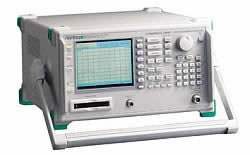
The Anritsu MS2668C is a portable, high-performance spectrum analyzer covering 9 kHz to 40 GHz, built for microwave and millimeter wave measurements. It provides a range of radio evaluation functions for microwave and millimeter wave devices and systems, combining a synthesized local oscillator, a high-stability crystal oscillator supplied as standard, and a built-in high-precision calibration signal source in a compact 15 kg standard configuration.
Within its coverage, the instrument addresses evaluation of radio equipment and the testing of digital mobile communication equipment. Built-in Measure functions support performance evaluation of radio equipment through measurement of power levels, frequencies, adjacent channel power, occupied bandwidth, burst average power, and mask and time-template pass/fail checks. For TDMA-type radio equipment, the optional high-speed time domain (zero-span) capability addresses antenna power, transient response of burst transmissions, and transmission timing.
ValueTronics holds and stocks its own inventory in a 20,000-square-foot secure warehouse at 1675 Cambridge Drive in Elgin, Illinois.
| Specification | Value |
|---|---|
| Frequency | |
| Frequency range | 9 kHz to 40 GHz |
| Frequency band | Band 0: 0 kHz to 3.2 GHz (n = 1), Band 1–: 3.1 to 5.6 GHz (n = 1), Band 1+: 5.4 to 8.1 GHz (n = 1), Band 1+: 8.0 to 14.3 GHz (n = 2), Band 2–: 14.1 to 26.5 GHz (n = 4), Band 3–: 26.2 to 40 GHz (n = 6); n: local harmonic order |
| Pre-selector range | 3.1 to 40 GHz |
| Frequency setting resolution | (1 × n) Hz |
| Frequency display accuracy | ±(display frequency × reference frequency accuracy + span × span accuracy) |
| Marker frequency display accuracy | Normal marker: Same as display frequency accuracy; Delta marker: Same as frequency span accuracy |
| Frequency counter | Resolution: 1 Hz, 10 Hz, 100 Hz, 1 kHz; Accuracy: Display frequency × reference frequency accuracy ±1 LSD (at S/N: ≥20 dB) |
| Frequency span | Setting range: 0 Hz, (100 × n) Hz to 40.0 GHz; Accuracy: ±5% |
| Resolution bandwidth (RBW, 3 dB bandwidth) | 1 kHz, 3 kHz, 10 kHz, 30 kHz, 100 kHz, 300 kHz, 1 MHz, 3 MHz (manually settable, or automatically settable according to frequency span); Bandwidth accuracy: ±20% (1 kHz to 1 MHz), ±30% (3 MHz); Selectivity (60 dB : 3 dB): ≤15:1 |
| Video bandwidth (VBW) | 1 Hz to 3 MHz (1-3 sequence), OFF |
| Signal Purity and Stability | |
| Noise sidebands | ≤–95 dBc/Hz + 20 log n (1 MHz to 40 GHz, 10 kHz offset); n: local harmonic order |
| Residual FM | ≤20 Hzp-p/0.1 s (1 GHz, span: 0 Hz) |
| Frequency drift | ≤200 × n Hz/min (span: ≤10 kHz, sweep time: ≤100 s), after 1-hour warm-up at constant ambient temperature |
| Reference Oscillator | |
| Frequency | 10 MHz |
| Start-up characteristics | ≤5 × 10⁻⁸/year (after 10 minutes warm-up, referenced to frequency after 24 hours warm-up) |
| Aging rate | ≤1 × 10⁻⁷/year, ≤1 × 10⁻⁸/day |
| Temperature characteristics | ±5 × 10⁻⁸ (0° to 50°C, referenced to frequency at 25°C) |
| Amplitude (Level Measurement) | |
| Measurement range | Average noise level to +30 dBm |
| Maximum input level | +30 dBm (CW average power, RF ATT: ≥10 dB), ±0 Vdc |
| Average noise level | ≤–115 dBm (1 MHz to 1 GHz), ≤–115 dBm + 1.5f [GHz] dB (1 to 3.1 GHz), ≤–114 dBm (3.1 to 8.1 GHz), ≤–113 dBm (8.0 to 14.3 GHz), ≤–105 dBm (14.1 to 26.5 GHz), ≤–101 dBm (26.2 to 40 GHz); RBW: 1 kHz, VBW: 1 Hz, RF ATT: 0 dB |
| Residual response | ≤–90 dBm (RF ATT: 0 dB, input: 50 Ω terminated, 1 MHz to 8.1 GHz) |
| Setting range | Log scale: –100 to +30 dBm; Linear scale: 224 µV to 7.07 V |
| Unit | Log scale: dBm, dBµV, dBmV, V, dBµVemf, W; Linear scale: V |
| Reference level accuracy | ±0.4 dB (–49.9 to 0 dBm), ±0.75 dB (–69.9 to –50 dBm, 0.1 to +30 dBm), ±1.5 dB (–80 to –70 dBm) |
| RBW switching uncertainty | ±0.3 dB (1 kHz to 1 MHz), ±0.4 dB (3 MHz); referenced to RBW: 3 kHz |
| Input attenuator (RF ATT) | Setting range: 0 to 70 dB (10 dB steps); Switching uncertainty: ±0.3 dB (0 to 50 dB), ±1.0 dB (0 to 70 dB) |
| Frequency response (Relative) | ±1.5 dB (9.0 kHz to 3.2 GHz), ±1.0 dB (100 kHz to 3.2 GHz), ±1.5 dB (3.1 to 8.1 GHz), ±3.0 dB (8.0 to 14.3 GHz), ±4.0 dB (14.1 to 26.5 GHz), ±4.0 dB (26.2 to 40 GHz) |
| Frequency response (Absolute) | ±5.0 dB (9 kHz to 40 GHz, RF ATT: 10 dB, referenced to 100 MHz) |
| Scale (10 div.) | Log scale: 10, 5, 2, 1 dB/div; Linear scale: 10, 5, 2, 1%/div |
| Linearity (after calibration) | Log scale: ±0.4 dB (0 to –20 dB, RBW: ≤1 MHz), ±1.0 dB (0 to –70 dB, RBW: ≤100 kHz), ±1.5 dB (0 to –85 dB, RBW: ≤3 kHz), ±2.5 dB (0 to –90 dB, RBW: ≤3 kHz); Linear scale: ±4% (compared to reference level) |
| Marker level resolution | Log scale: 0.01 dB; Linear scale: 0.02% of reference level |
| Spurious Response | |
| 2nd harmonic distortion | ≤–60 dBc (10 to 200 MHz, mixer input: –30 dBm), ≤–70 dBc (0.2 to 1.55 GHz, mixer input: –30 dBm), ≤–90 dBc or noise level (1.55 to 20 GHz, mixer input: –10 dBm) |
| Two signal 3rd order intermodulation distortion | ≤–70 dBc (10 to 100 MHz), ≤–80 dBc (0.1 to 8.1 GHz), ≤–75 dBc or average noise level (8.1 to 26.5 GHz), ≤–75 dBc or average noise level (typical, 26.5 to 40 GHz); frequency difference of two signals: ≥50 kHz, mixer input: –30 dBm |
| Image response | ≤–65 dBc (≤18 GHz), ≤–60 dBc (≤22 GHz), ≤–55 dBc (≤40 GHz) |
| Multiple/out of band response | ≤–70 dBc (≤14 GHz), ≤–60 dBc (≤26 GHz), ≤–55 dBc (≤40 GHz) |
| 1 dB gain compression | ≥–5 dBm (≥100 MHz, at mixer input) |
| Sweep | |
| Sweep time | Setting range: 20 ms to 1000 s (manually settable, or automatically settable according to span, RBW, and VBW); Accuracy: ±15% (20 ms to 100 s), ±25% (110 to 1000 s), ±1% (time domain sweep: digital zero span mode) |
| Sweep mode | Continuous, single |
| Time domain sweep mode | Analog zero span, digital zero span |
| Zero sweep | Sweeps only in frequency range indicated by zone marker |
| Tracking sweep | Sweeps while tracing peak points within zone marker (zone sweep also possible) |
| Number of data points | 501 |
| Detection mode | NORMAL: Simultaneously displays max. and min. points between sample points; POS PEAK: Displays max. point between sample points; NEG PEAK: Displays min. point between sample points; SAMPLE: Displays momentary value at sample points; Detection mode switching uncertainty: ±0.5 dB (at reference level) |
| Display | |
| Display | Color TFT-LCD, Size: 5.5”, Number of colors: 17 (RGB, each 64-scale settable), Intensity adjustment: 5 steps settable |
| Display functions | Trace A: frequency spectrum; Trace B: frequency spectrum; Trace Time: time domain waveform at center frequency; Trace A/B: Trace A and B simultaneously; Trace A/BG: background and object band with zone marker; Trace A/Time: spectrum and time domain waveform simultaneously; Trace move/calculation: A→B, B→A, A←→B, A + B→A, A — B→A, A — B + DL→A |
| Storage functions | NORMAL, VIEW, MAX HOLD, MIN HOLD, AVERAGE, CUMULATIVE, OVER WRITE |
| FM Demodulation Waveform Display | |
| Demodulation range | 2, 5, 10, 20, 50, 100, 200 kHz/div |
| Accuracy | ±5% of full scale (referenced to center frequency, DC-coupled, RBW: 3 MHz, VBW: 1 Hz, CW) |
| Demodulation frequency response | DC (50 Hz at AC-coupled) to 100 kHz (range: ≤20 kHz/div, VBW: off, at 3 dB bandwidth); DC (50 Hz at AC-coupled) to 500 kHz (range: ≤50 kHz/div, VBW: off, at 3 dB bandwidth); RBW: ≥1 kHz to 3 MHz usable |
| Inputs and Outputs | |
| Input connector | K-J, 50 Ω |
| IF OUTPUT | –10 dBm (typical, 100 MHz, upper edge of scale, 50 Ω terminated), 10.69 MHz, BNC connector |
| VIDEO OUTPUT (Y) | 0 to 0.5 V ± 0.1 V (typical, from lower edge to upper edge at 10 dB/div); 0 to 0.4 V ± 0.1 V (typical, from lower edge to upper edge at 10%/div), BNC connector |
| COMPOSITE OUTPUT | For NTSC, 1 Vp-p (75 Ω terminated), BNC connector |
| EXT REF INPUT | 10 MHz ± 10 Hz, –10 to +2 dBm (50 Ω terminated), BNC connector |
| REF BUFFERED OUTPUT | ≥0 dBm (50 Ω terminated), BNC connector |
| 1ST LOCAL OUTPUT | 4 to 7 GHz, ≥+8 dBm, 50 Ω, SMA-J connector |
| Interfaces | |
| RS-232C (standard) | Outputs data to printer and plotter; control from external computer (excluding power switch) |
| GPIB (standard) | Meets IEEE488.2; SH1, AH1, T6, L4, SR1, RL1, PP0, DC1, DT1, C1, C2, C3, C4, C28 |
| Memory card interface (standard) | SRAM, EPROM, Flash EPROM (only SRAM writable; card capacity: 2 MB max.); PCMCIA Rel. 2.0, 2 slots |
| PTA (Built-in Controller) | |
| Language | PTL (interpreter based on BASIC) |
| Programming capacity | 192 KB |
| External Mixer (Millimeter Wave) | |
| Frequency range | 18 to 110 GHz |
| Frequency band configuration | Band K: 18 to 26.5 GHz (n = 4), Band A: 26.5 to 40 GHz (n = 6), Band Q: 33 to 50 GHz (n = 8), Band U: 40 to 60 GHz (n = 9), Band V: 50 to 75 GHz (n = 11), Band E: 50 to 90 GHz (n = 13), Band W: 75 to 110 GHz (n = 16) |
| Mixer conversion loss setting range | 15 to 85 dB |
| Reference level setting range | –100 dBm to (–25 to M) dBm; Log scale, M: mixer conversion loss |
| Suitable mixer | 2-port mixer only (local frequency: 4 to 7 GHz, IF frequency: 689.31 MHz) |
| Display gain | 0 ± 2 dB (external mixer input: –10 dBm, when the mixer conversion loss is 15 dB) |
Important: GPIB interface and the Centronics interface (Option 10) cannot be installed simultaneously.
Important: Maximum input level is +30 dBm (CW average power, RF ATT: ≥10 dB), with a maximum DC input of ±0 V; exceeding these limits can damage the input.
Important: Millimeter-wave coverage up to 110 GHz requires an external mixer (MA2740A–MA2746A series), which is ordered separately and is not included with the base unit; the suitable mixer is a 2-port mixer only (local frequency 4 to 7 GHz, IF frequency 689.31 MHz).
Important: Option 04 High-speed time domain sweep must be used together with Option 06 Trigger/gate circuit.
Important: Specifications were obtained after warming up the equipment for 30 minutes at a constant ambient temperature and then performing calibration; typical values are given for reference and are not guaranteed.
Recommended pairing: add an Anritsu external mixer (MA2740A through MA2746A) to extend coverage beyond 40 GHz, up to 110 GHz, for millimeter wave measurements.
This pre-owned unit is inspected and functionally verified in-house before it ships and is backed by our pre-owned warranty. To confirm its exact condition, firmware revision, installed options, or included accessories for your application before ordering, contact our Test Architects.
ValueTronics supplies both new and used test and measurement equipment. New units ship factory-sealed, exactly as received from the manufacturer; every used unit is inspected and functionally verified in-house at our 20,000 sq ft secure facility in Elgin, Illinois before it ships. Our Test Architects can help you select the condition, calibration, and configuration that fit your application.
Please review the Manufacturer's Data Sheet to verify published specifications. Feedback on this webpage is always welcome — please reach out to your Test Architect at any time for questions or concerns. Thank you, we truly appreciate you being our customer.
Model No
Anritsu
Condition
Pre-Owned
Manufacturer
Anritsu
Spec_ana_freq
9 kHz to 40 GHz


30+ Years in Business

Secure Payments

Sell Test Equipments

Knowledgeable Staff

On-site Lab
30+ Years in Business
Secure Payments
Sell Test Equipments
Knowledgeable Staff
On-site Lab
Request A Quote