Chat Live
 Contact Us
 sales@valuetronics.com


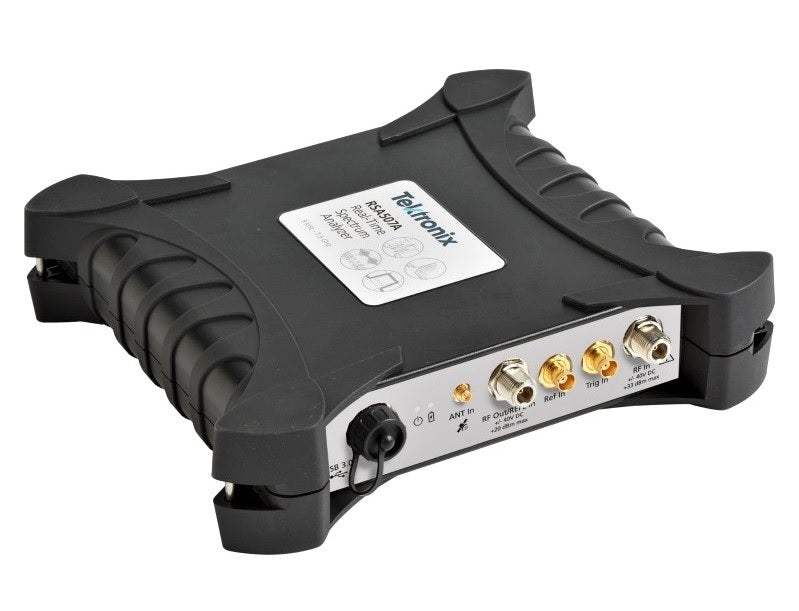
The Tektronix RSA500A Series is a line of USB-based real-time spectrum analyzers that deliver high-performance portable spectrum analysis in a rugged, battery-powered package. The series places the RF acquisition hardware in a compact instrument that connects over USB to a Windows tablet or laptop, moving the weight of the instrument off the operator's hands while the lightweight PC handles display, record-keeping, and communication. Two models make up the series: the RSA503A covering 9 kHz to 3 GHz and the RSA507A covering 9 kHz to 7.5 GHz, both with 40 MHz of acquisition bandwidth.
The RSA500A Series is built for spectrum management, interference hunting, and the maintenance, installation, and repair of radio networks. It is aimed at spectrum managers, interference hunters, and network maintenance personnel who need to track down hard-to-find interferers, maintain RF networks, and keep records of their efforts in the field.
ValueTronics stocks and holds its own inventory in a 20,000 sq ft secure warehouse at 1675 Cambridge Drive in Elgin, Illinois. Every pre-owned unit we sell is inspected and functionally verified in-house before it ships, while new units ship factory-sealed exactly as received from the manufacturer. Holding the inventory ourselves lets us match the right instrument and condition to your application and stand behind what we deliver.
The RSA500A Series consists of USB real-time spectrum analyzers that share a common architecture: 40 MHz of acquisition bandwidth, a 14-bit digitizer running at 112 Ms/s, real-time DPX processing, a standard GPS/GLONASS/BeiDou receiver, and operation with SignalVu-PC software on a Windows tablet or laptop. The two models in the series differ primarily in their upper frequency limit.
Both models are housed in the same rugged package built to Mil-Std 28800 Class 2 environmental, shock, and vibration specifications, and both run from an internal Li-Ion battery for field operation. The optional tracking generator (Option 04) is available on either model for cable, antenna, and network-element measurements.
Each pre-owned model in the series below is its own dedicated product page with condition-matched pricing. Select the model whose frequency coverage and options match your application; the comparison table that follows summarizes how the models differ.
The principal difference between the models is frequency range: the RSA503A covers 9 kHz to 3 GHz, while the RSA507A extends coverage to 7.5 GHz. Both provide the same 40 MHz acquisition bandwidth. Several specifications spanning the higher frequencies apply specifically to the RSA507A's extended range, including preamp gain figures (30 dB at 2 GHz, 24 dB at 6 GHz on the RSA507A), additional third-order intercept and DANL values above 3 GHz, and second-harmonic distortion above 1.5 GHz.
The optional tracking generator's frequency range tracks the model as well: 10 MHz to 3 GHz on the RSA503A and 10 MHz to 7.5 GHz on the RSA507A. LTE downlink ACLR figures are specified for the RSA507A. Refer to the comparison table that follows for the model-by-model breakdown.
| Model | Frequency Range | Acquisition Bandwidth | Preamp Gain |
|---|---|---|---|
| RSA507A | 9 kHz to 7.5 GHz | 40 MHz | 30 dB at 2 GHz; 24 dB at 6 GHz |
| RSA503A | 9 kHz to 3 GHz | 40 MHz | 30 dB at 2 GHz |
Additional differences in specifications beyond the few shown above are not listed here — see each model's full specifications below.
| Specification | Value |
|---|---|
| Frequency | |
| Frequency range (RSA503A) | 9 kHz to 3 GHz |
| Frequency range (RSA507A) | 9 kHz to 7.5 GHz |
| Frequency marker readout accuracy | ±(RE × MF + 0.001 × Span) Hz (RE: Reference Frequency Error; MF: Marker Frequency [Hz]) |
| Reference frequency accuracy, initial at Cal (30 min warm-up) | ±1 x 10⁻⁶ |
| Reference frequency, first year aging, typical | ±1 x 10⁻⁶ (1 year) |
| Reference frequency cumulative error (initial + temperature + aging), typical | 3 x 10⁻⁶ (1 year) |
| Reference frequency temperature drift | ±0.9 x 10⁻⁶ (-10 to 60 °C) |
| External reference input | BNC connector, 50 Ω nominal |
| External reference input frequency | Every 1 MHz from 1 to 20 MHz plus: 1.2288 MHz, 2.048 MHz, 2.4576 MHz, 4.8 MHz, 4.9152 MHz, 9.8304 MHz, 13 MHz, and 19.6608 MHz |
| External reference input range | ± 5 ppm |
| External reference input level | -10 to +10 dBm |
| RF Input | |
| RF input impedance | 50 Ω |
| RF VSWR (RF Attn = 20 dB), typical | < 1.2 (10 MHz to 3 GHz); < 1.5 (>3 GHz to 7.5 GHz) |
| RF VSWR preamp ON, typical | < 1.5 (10 MHz to 6 GHz, RF ATT=10 dB, preamp on); < 1.7 (> 6 GHz to 7.5 GHz, RF ATT=10 dB, preamp on) |
| Maximum DC voltage | ±40 V (RF input) |
| Maximum safe input power | +33 dBm (RF input, 10 MHz to 7.5 GHz, RF Attn ≥ 20 dB); +13 dBm (9 kHz to 10 MHz); +20 dBm (RF Attn < 20 dB) |
| Maximum safe input power (Preamp On) | +33 dBm (RF input, 10 MHz to 7.5 GHz, RF Attn ≥ 20 dB); +13 dBm (9 kHz to 10 MHz); +20 dBm (RF Attn < 20 dB) |
| Maximum measurable input power | +30 dBm (RF input, ≥10 MHz to Fmax, RF ATT Auto); +20 dBm (RF input, <10 MHz, RF ATT Auto) |
| Input RF attenuator | 0 dB to 51 dB (1 dB step) |
| Amplitude and RF Flatness | |
| Reference level setting range | -170 dBm to +40 dBm, 0.1 dB step (Standard RF input) |
| Frequency response, 9 kHz ≤ 3.0 GHz (18 °C to 28 °C, 10 dB RF Atten) | ±0.8 dB (±0.2 dB typical-S95; ±1.0 dB typical -10 °C to 55 °C) |
| Frequency response, >3 to 7.5 GHz (18 °C to 28 °C, 10 dB RF Atten) | ±1.5 dB (±0.6 dB typical-S95; ±2.0 dB typical -10 °C to 55 °C) |
| Amplitude accuracy preamp ON, 100 kHz to ≤3.0 GHz (18 °C to 28 °C, 10 dB RF Atten) | ±1.0 dB (±0.5 dB typical-S95; ±1.0 dB typical) |
| Amplitude accuracy preamp ON, >3 to 7.5 GHz (18 °C to 28 °C, 10 dB RF Atten) | ±1.75 dB (±0.75 dB typical-S95; ±3.0 dB typical) |
| Preamp gain | 30 dB at 2 GHz; 24 dB at 6 GHz (RSA507A) |
| Channel response, 9 kHz to 40 MHz (span ≤40 MHz), typical | Amplitude flatness ±1.0 dB; RMS 0.60 dB |
| Channel response, >40 MHz to 4.0 GHz (span ≤20 MHz), typical | Amplitude flatness ±0.10 dB; RMS 0.08 dB; phase linearity RMS 0.3° |
| Channel response, >4 GHz to 7.5 GHz (span ≤20 MHz), typical | Amplitude flatness ±0.35 dB; RMS 0.20 dB; phase linearity RMS 0.7° |
| Channel response, >40 MHz to 4 GHz (span ≤40 MHz), typical | Amplitude flatness ±0.15 dB; RMS 0.08 dB; phase linearity RMS 0.6° |
| Channel response, >4 GHz to 7.5 GHz (span ≤40 MHz), typical | Amplitude flatness ±0.40 dB; RMS 0.20 dB; phase linearity RMS 1.0° |
| Trigger | |
| Trigger/Sync input, typical | Voltage range: TTL, 0.0 V to 5.0 V; Positive-going threshold 1.6 V min, 2.1 V max; Negative-going threshold 1.0 V min, 1.35 V max; Impedance 10 kΩ with schottky clamps to 0 V, +3.4 V |
| External trigger timing uncertainty | >20 MHz to 40 MHz acquisition bandwidth: ±250 ns (uncertainty increases as acquisition bandwidth is decreased) |
| Power trigger, typical | Range: 0 dB to -50 dB from reference level, for trigger levels > 30 dB above the noise floor; Type: rising or falling edge; Trigger re-arm time: ≤ 100 μsec |
| Power trigger position timing uncertainty | >20 MHz to 40 MHz acquisition bandwidth: ±250 ns |
| Power trigger level accuracy | ±1.5 dB for CW signal at tuned center frequency for trigger levels > 30 dB above the noise floor |
| Noise and Distortion | |
| 3rd Order IM intercept (TOI) | +12 dBm at 2.130 GHz |
| TOI, preamp off, typical | +10 dBm (9 kHz to 25 MHz); +15 dBm (25 MHz to 3 GHz); +15 dBm (3 GHz to 4 GHz, RSA507A); +8 dBm (4 GHz to 6 GHz, RSA507A); +10 dBm (6 GHz to 7.5 GHz, RSA507A) |
| TOI, preamp on, typical | -20 dBm (9 kHz to 25 MHz); -15 dBm (25 MHz to 3 GHz); -15 dBm (3 GHz to 4 GHz, RSA507A); -20 dBm (4 GHz to 6 GHz, RSA507A); -20 dBm (6 GHz to 7.5 GHz, RSA507A) |
| 3rd Order inter-modulation distortion | -74 dBc at 2.130 GHz (each signal level -25 dBm at RF input, 2 MHz tone separation, Attenuator = 0, Reference level = -20 dBm) |
| 3rd Order IMD, preamp off, typical | < -70 dBc (10 kHz to 25 MHz); < -80 dBc (25 MHz to 3 GHz); < -80 dBc (3 GHz to 4 GHz); < -70 dBc (4 GHz to 6 GHz, RSA507A); < -70 dBc (6 GHz to 7.5 GHz, RSA507A) |
| 3rd Order IMD, preamp on, typical | < -70 dBc (9 kHz to 25 MHz); < -80 dBc (25 MHz to 3 GHz); < -80 dBc (3 GHz to 4 GHz); < -70 dBc (4 GHz to 6 GHz, RSA507A); < -70 dBc (6 GHz to 7.5 GHz, RSA507A) |
| 2nd Harmonic distortion, typical | < -75 dBc (40 MHz to 1.5 GHz); < -75 dBc (1.5 GHz to 3.75 GHz, RSA507A) |
| 2nd Harmonic distortion, preamp on | < -60 dBc, 40 MHz to 13.5 GHz, input frequency |
| 2nd Harmonic distortion intercept (SHI) | +35 dBm, 40 MHz to 1.5 GHz; +35 dBm, 1.5 GHz to 3.75 GHz, input frequency |
| 2nd Harmonic distortion intercept (SHI), preamp on | +15 dBm, 40 MHz to 3.75 GHz, input frequency |
| Displayed Average Noise Level (DANL) (Normalized to 1 Hz RBW, log-average detector) | |
| 500 kHz to 1 MHz | Preamp on -138 dBm/Hz; preamp on typ -145 dBm/Hz; preamp off typ -130 dBm/Hz |
| 1 MHz to 25 MHz | Preamp on -153 dBm/Hz; preamp on typ -158 dBm/Hz; preamp off typ -130 dBm/Hz |
| >25 MHz to 2 GHz | Preamp on -161 dBm/Hz; preamp on typ -164 dBm/Hz; preamp off typ -141 dBm/Hz |
| >2 GHz to 3 GHz | Preamp on -158 dBm/Hz; preamp on typ -162 dBm/Hz; preamp off typ -138 dBm/Hz |
| >3 GHz to 4.2 GHz (RSA507A) | Preamp on -155 dBm/Hz; preamp on typ -159 dBm/Hz; preamp off typ -138 dBm/Hz |
| >4.2 GHz to 6 GHz (RSA507A) | Preamp on -160 dBm/Hz; preamp on typ -163 dBm/Hz; preamp off typ -147 dBm/Hz |
| >6 GHz to 7.5 GHz (RSA507A) | Preamp on -157 dBm/Hz; preamp on typ -160 dBm/Hz; preamp off typ -145 dBm/Hz |
| Phase Noise | |
| 10 kHz offset | 1 GHz CF -94 dBc/Hz; 1 GHz CF typ -97 dBc/Hz; 2 GHz CF typ -96 dBc/Hz; 6 GHz CF typ (RSA507A) -94 dBc/Hz; 10 MHz typ -120 dBc/Hz |
| 100 kHz offset | 1 GHz CF -94 dBc/Hz; 1 GHz CF typ -98 dBc/Hz; 2 GHz CF typ -97 dBc/Hz; 6 GHz CF typ (RSA507A) -96 dBc/Hz; 10 MHz typ -124 dBc/Hz |
Important: Maximum DC voltage: ±40 V (RF input). Maximum safe input power: +33 dBm (RF input, 10 MHz to 7.5 GHz, RF attenuator ≥ 20 dB).
Important: The RSA500 requires a PC with Windows 7, Windows 8/8.1, or Windows 10, 64-bit operating system. A USB 3.0 connection is required for operation of the RSA500. 8 GB RAM and 20 GB free drive space is required for installation of SignalVu-PC. (A host PC is not included with the analyzer.)
Important: For full performance of the real time features of the RSA500, an Intel Core i7 4th generation processor is required. Processors of lower performance can be used, with reduced real-time performance.
Important: Storage of streaming data requires that the PC be equipped with a drive capable of streaming storage rates of 300 MB/sec.
Important: The tracking generator is Option 04 and is required for gain/loss, cable and antenna (VSWR, return loss, distance to fault, cable loss) measurements; it is not included in the base configuration.
Important: The Panasonic FZ-G1 tablet controller and the Alaris DF-A0047 smart antenna are available in limited geographies; see ordering information for details.
Recommended pairing: use the Tektronix open/short/load calibration kits (for example CALSOLTNM) and rugged phase-stable cables when making cable and antenna measurements with the optional tracking generator.
This pre-owned unit is inspected and functionally verified in-house before it ships and is backed by our pre-owned warranty. To confirm its exact condition, firmware revision, installed options, or included accessories for your application before ordering, contact our Test Architects.
ValueTronics supplies both new and used test and measurement equipment. New units ship factory-sealed, exactly as received from the manufacturer; every used unit is inspected and functionally verified in-house at our 20,000 sq ft secure facility in Elgin, Illinois before it ships. Our Test Architects can help you select the condition, calibration, and configuration that fit your application.
Please review the Manufacturer's Data Sheet to verify published specifications. Feedback on this webpage is always welcome — please reach out to your Test Architect at any time for questions or concerns. Thank you, we truly appreciate you being our customer.
Model No
Tektronix
Condition
Pre-Owned
Manufacturer
Tektronix
Spec_ana_freq
9 kHz to 7.5 GHz


30+ Years in Business

Secure Payments

Sell Test Equipments

Knowledgeable Staff

On-site Lab
30+ Years in Business
Secure Payments
Sell Test Equipments
Knowledgeable Staff
On-site Lab
Request A Quote