Chat Live
 Contact Us
 sales@valuetronics.com


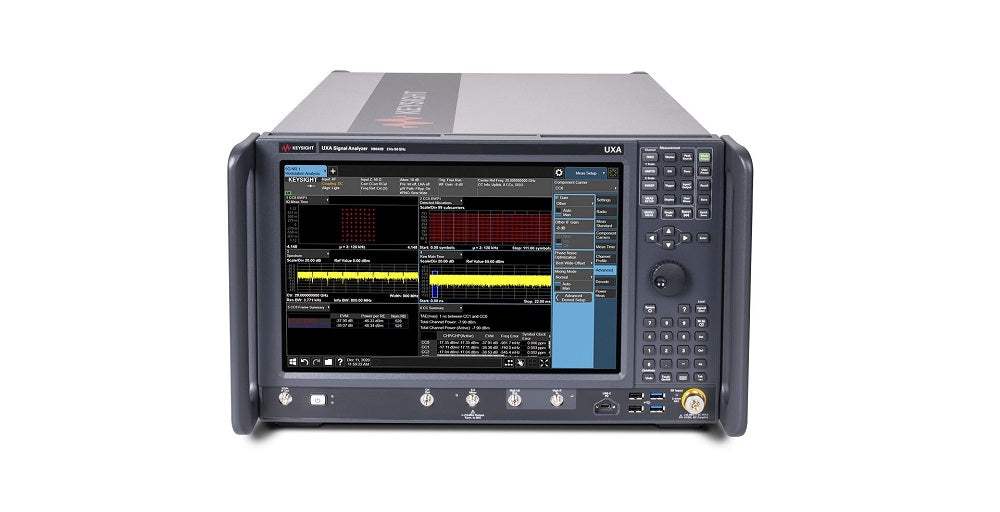
The Keysight N9042B UXA X-Series Signal Analyzer is a multi-touch microwave signal analyzer covering 2 Hz to 26.5, 44, or 50 GHz, depending on the installed frequency option (526, 544, or 550). Built on the UXA platform, it pairs swept spectrum analysis with wideband vector signal analysis and an optional real-time spectrum analyzer in a single instrument, and operates with PathWave X-Series measurement applications and PathWave Vector Signal Analysis software.
The analyzer's front-end paths are described for specific measurement tasks: the standard preselected path is suited to harmonics, intermodulation distortion, and spurious measurements in the presence of large signals; preamplifier and low-noise-amplifier paths lower the noise floor for distortion measurements and for finding low-level spurs and oscillations near the noise floor; and the microwave preselector bypass and full bypass paths are intended for wideband digitizer, FFT, and digital demodulation measurements. With Option N90EMEMCB or N6141EM0E, CISPR 16-1-1 and MIL-STD-461 EMI bandwidths and quasi-peak/EMI-average detectors are added.
ValueTronics stocks and holds its own inventory in a 20,000 sq ft secure warehouse at 1675 Cambridge Drive in Elgin, Illinois. Every used unit is inspected and functionally verified in-house before it ships, while new units ship factory-sealed exactly as received from the manufacturer. That combination lets engineers and labs source the right instrument, in verified condition, directly from stock.
Keysight Technologies traces its test and measurement heritage to Hewlett-Packard, whose instrument and measurement business was spun off as Agilent Technologies in 1999 and then established as the independent Keysight Technologies in 2014.
The N9042B UXA is configured through a frequency option that sets its upper frequency limit—Option 526 reaches 26.5 GHz, Option 544 reaches 44 GHz, and Option 550 reaches 50 GHz—while all configurations share the same 2 Hz lower limit and core UXA architecture. Layered on top of the frequency option is a ladder of analysis-bandwidth options that determine wideband IQ and real-time performance.
Because the platform is common across configurations, the multi-touch interface, embedded Intel i7 computing platform, swept-analysis engine, and front-end path structure (preselected, low-noise, microwave preselector bypass, and full bypass) are present regardless of the frequency or bandwidth options selected. The configuration choices determine reach and wideband capability rather than the underlying measurement architecture.
Each configuration below is its own dedicated product page with condition-matched pricing for the pre-owned unit. Select the frequency and bandwidth configuration that matches your application, then choose the page that reflects the condition you need.
On the N9042B, headline UXA specifications include ±0.34 dB total absolute amplitude accuracy at 50 MHz, +21 dBm typical third-order intercept from 1.1 to 3.0 GHz, and -132 dBc/Hz phase noise at a 10 kHz offset, with optional two-stage preamplification and Noise Floor Extension available to lower the displayed average noise level.
The primary differences across configurations are the frequency option ceiling (26.5, 44, or 50 GHz) and the installed analysis-bandwidth option, which ranges from the 10 MHz standard path through 25, 40, and 255 MHz options and up to 1, 1.5, 2, and 4 GHz options, with an 11 GHz path via Option EDC. Each bandwidth option includes and enables the lesser-bandwidth paths beneath it.
Preamplifier options (P26, P44, P4L, P50, P5L) and Noise Floor Extension (Option NF2) further affect achievable noise floor by configuration, and EMI measurement bandwidths require a separate option. The comparison table that follows lists the frequency, bandwidth, and option differences for each configuration.
| Model | Frequency Range | Maximum Frequency | Standard Analysis BW |
|---|---|---|---|
| N9042B | 2 Hz to 26.5 GHz | 26.5 GHz | 10 MHz |
Additional differences in specifications beyond the few shown above are not listed here — see each model's full specifications below.
| Specification | Value |
|---|---|
| Frequency and Time | |
| Frequency range (Option 526) | 2 Hz to 26.5 GHz |
| Frequency range (Option 544) | 2 Hz to 44 GHz |
| Frequency range (Option 550) | 2 Hz to 50 GHz |
| Minimal frequency, PA off / LNA off | 2 Hz |
| Minimal frequency, PA on | 9 kHz |
| Minimal frequency, LNA on | 30 MHz |
| Frequency reference aging rate | ± 3 x 10⁻⁸ / year |
| Temperature stability, full temperature range | ± 4.5 x 10⁻⁹ |
| Achievable initial calibration accuracy | ± 3.1 x 10⁻⁸ |
| Example frequency reference accuracy (1 year after last adjustment) | ± 6.6 x 10⁻⁸ |
| Marker frequency counter accuracy | ± (marker frequency x frequency reference accuracy + 0.100 Hz) |
| Marker counter resolution | 0.001 Hz |
| Frequency span range | 0 Hz (zero span), 10 Hz to maximum frequency of instrument |
| Span resolution | 2 Hz |
| Sweep time range (Span = 0 Hz) | 1 ms to 4000 s |
| Sweep (trace) point range, all spans | 3 to 100,001 |
| Resolution bandwidth (RBW) range, –3 dB, standard | 1 Hz to 3 MHz (10% steps), 4, 5, 6, 8, 10 MHz |
| Selectivity (-60 dB/-3 dB) | 4.1:1 (nominal) |
| EMI bandwidths (CISPR 16-1-1; requires N90EMEMCB or N6141EM0E) | 200 Hz, 9 kHz, 120 kHz, 1 MHz |
| EMI bandwidths (MIL-STD-461; requires N90EMEMCB or N6141EM0E) | 10 Hz, 100 Hz, 1 kHz, 10 kHz, 100 kHz, 1 MHz |
| Video bandwidth (VBW) range | 1 Hz to 3 MHz (10% steps), 4, 5, 6, 8 MHz, and wide open (labeled 50 MHz) |
| Detector types | Normal, peak, sample, negative peak, log power average, RMS average, and voltage average |
| Amplitude Accuracy and Range | |
| Measurement range (preamp off) | Displayed average noise level (DANL) to +30 dBm |
| Measurement range (frequency opts > 526 with preamp on) | DANL to +20 dBm |
| Input mechanical attenuator range (2 Hz to 50 GHz) | 0 to 70 dB in 2 dB steps |
| Electronic attenuator range (Option EA3, 2 Hz to 3.6 GHz) | 0 to 24 dB, 1 dB steps |
| Full attenuation range (mechanical + electronic) | 0 to 94 dB, 1 dB steps |
| Maximum safe input, average total power (with and without preamp) | +30 dBm (1 W) |
| Maximum safe input, peak pulse power | +50 dBm (100 W) |
| DC bias at RF input (DC coupled) | 0 VDC max; ± 0.2 Vdc DC coupled (0.2 VDC max in full bypass path) |
| Display range, log scale | 0.1 to 1 dB/division in 0.1 dB steps; 1 to 20 dB/division in 1 dB steps |
| Total absolute amplitude accuracy at 50 MHz, Path 1a Std | ± 0.34 dB (full range) / ± 0.32 dB (20 to 30 °C) / ± 0.12 dB (typical) / ± 0.18 dB (AutoAlign = Light, nominal) |
| Total absolute amplitude accuracy at 50 MHz, Path 1b Std (LNA on) | ± 0.44 dB / ± 0.40 dB / ± 0.16 dB / ± 0.19 dB |
| Total absolute amplitude accuracy at 50 MHz, Path 1c Std (PA on) | ± 0.42 dB / ± 0.38 dB / ± 0.12 dB / ± 0.17 dB |
| Wide range absolute amplitude accuracy, 10 Hz to 3.6 GHz, 10 dB attenuation | ± 0.25 dB, 95th percentile |
| Resolution bandwidth switching uncertainty, 1 Hz to 1.5 MHz RBW (rel. 30 kHz) | < ± 0.03 dB |
| Resolution bandwidth switching uncertainty, 4, 5, 6, 8, 10 MHz RBW | ± 0.3 dB |
| Reference level range, log scale | –170 to +30 dBm in 0.01 dB steps |
| Reference level range, linear scale | 707 pV to 7.07 V with 0.11% (0.01 dB) resolution |
| VSWR, standard path, 10 dB input attenuation, 50 MHz | 1.07:1 (nominal) |
| Preamplifiers | |
| Low-Noise Amplifier (LNA), Option P44/P4L | 20 MHz to 44 GHz |
| Pre-Amplifier (PA), Option P44/P4L | 9 kHz to 44 GHz |
| Low-Noise Amplifier (LNA), Option P50/P5L | 20 MHz to 50 GHz |
| Pre-Amplifier (PA), Option P50/P5L | 9 kHz to 50 GHz |
| LNA noise figure | 4 to 8 dB (nominal) |
| PA noise figure | 10 dB (nominal) |
| LNA gain | 20 dB (nominal) |
| PA gain | 30 dB (nominal) |
| LNA + PA combined gain | 40 dB (nominal) |
| 1a. Standard Path Frequency Response (swept, preselector on, LNA off, PA off, 10 dB attenuation, ref 50 MHz) | |
| 9 kHz to 20 MHz | ± 0.54 dB (full) / ± 0.50 dB (20 to 30 °C) / ± 0.15 dB (typ) |
| > 20 MHz to 50 MHz | ± 0.44 dB / ± 0.40 dB / ± 0.12 dB |
| > 50 MHz to 3.6 GHz | ± 0.58 dB / ± 0.52 dB / ± 0.22 dB |
| > 3.6 to 5.2 GHz | ± 2.70 dB / ± 1.90 dB / ± 0.98 dB |
| > 5.2 GHz to 8.4 GHz | ± 2.50 dB / ± 1.40 dB / ± 0.58 dB |
| > 8.4 to 13.6 GHz | ± 2.00 dB / ± 1.50 dB / ± 0.54 dB |
| > 13.6 to 17.1 GHz | ± 2.00 dB / ± 1.70 dB / ± 0.68 dB |
| > 17.1 to 26.5 GHz | ± 2.32 dB / ± 1.90 dB / ± 0.74 dB |
| > 26.5 to 34.5 GHz | ± 2.70 dB / ± 2.30 dB / ± 0.94 dB |
| > 34.5 to 50 GHz | ± 4.35 dB / ± 3.00 dB / ± 1.22 dB |
Important: Maximum safe input at the RF input connector: +30 dBm (1 W) average total power and +50 dBm (100 W) peak pulse power. DC bias at the RF input: 0 VDC max (DC coupled).
Important: More than one person is required to safely lift or carry this instrument. Alternately a mechanical lift can be used to eliminate the risk of personal injury.
Important: WARNING: EMBEDDED CLASS 1 INVISIBLE LASER RADIATION. DO NOT EXPOSE USERS OR VIEW DIRECTLY WITH TELESCOPES. (This symbol indicates the presence of a class 1 Laser device.)
Important: This is a sensitive measurement apparatus by design and may have some performance loss (up to 25 dBm above the Spurious Responses, Residual specification of –100 dBm) when exposed to 3 V/m ambient continuous electromagnetic phenomenon in the range of 80 MHz to 6 GHz (similar to those used in testing per IEC 61000-4-3).
Important: Caution: This equipment is not intended for use in residential environments and may not provide adequate protection to radio reception in such environments. (CISPR 11 Group 1, Class A)
Important: For signal frequencies < 10 MHz, DC coupling must be applied for the analyzer to meet its specifications.
Important: The analyzer must be turned on at least 30 minutes (AutoAlign set to Normal) and have been in its operating environment at least 2 hours before being turned on to meet specifications.
Important: This product is designed for use in INSTALLATION CATEGORY II and POLLUTION DEGREE 2 and MEASUREMENT CATEGORY NONE per IEC 61010-1.
Important: Above 50 GHz coverage (50.0 to 110 GHz) requires the Keysight V3050A frequency extender, sold separately; over-range tuning to 50.5 GHz is allowed but performance is not specified without corrections.
Recommended pairing: the Keysight V3050A frequency extender works with the N9042B to provide a preselected, unbanded frequency range up to 110 GHz.
This pre-owned unit is inspected and functionally verified in-house before it ships and is backed by our pre-owned warranty. To confirm its exact condition, firmware revision, installed options, or included accessories for your application before ordering, contact our Test Architects.
ValueTronics supplies both new and used test and measurement equipment. New units ship factory-sealed, exactly as received from the manufacturer; every used unit is inspected and functionally verified in-house at our 20,000 sq ft secure facility in Elgin, Illinois before it ships. Our Test Architects can help you select the condition, calibration, and configuration that fit your application.
Please review the Manufacturer's Data Sheet to verify published specifications. Feedback on this webpage is always welcome — please reach out to your Test Architect at any time for questions or concerns. Thank you, we truly appreciate you being our customer.
Model No
Keysight
Condition
Pre-Owned
Manufacturer
Keysight
Spec_ana_freq
2 Hz to 26.5 GHz


30+ Years in Business

Secure Payments

Sell Test Equipments

Knowledgeable Staff

On-site Lab
30+ Years in Business
Secure Payments
Sell Test Equipments
Knowledgeable Staff
On-site Lab
Request A Quote