Chat Live
 Contact Us
 sales@valuetronics.com


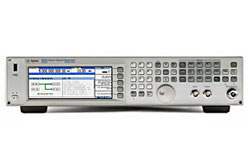
The Agilent N5182A MXG and N5162A MXG ATE are vector signal generators optimized for performance and speed. They provide both vector and analog signal generation, with a frequency range that extends to 3 GHz or 6 GHz depending on the installed frequency option. The product line emphasizes fast switching speeds, high output power with strong linearity, and adjacent-channel power performance, and supports simplified self-maintenance and Signal Studio software for signal creation.
Published application material for these generators covers accurate amplifier ACLR and ACPR testing and testing of CDMA base station amplifiers. The instruments can simultaneously enable multiple modulation types from independent sources — for example the baseband generator, AM, and FM running concurrently to modulate the output RF — which is useful for simulating signal impairments.
ValueTronics stocks and holds its own inventory in a 20,000-square-foot secure warehouse at 1675 Cambridge Drive in Elgin, Illinois. Every pre-owned unit is inspected and functionally verified in-house before it ships, while new units ship factory-sealed exactly as received from the manufacturer.
Hewlett-Packard's test and measurement business was spun off as Agilent Technologies in 1999. That test and measurement business was subsequently established as Keysight Technologies in 2014.
The MXG vector signal generator line covered here consists of the N5182A MXG and the N5162A MXG ATE. Both share the same RF and baseband architecture and the same frequency options — Option 503 for coverage to 3 GHz and Option 506 for coverage to 6 GHz.
The N5162A MXG ATE is the automated-test-equipment configuration, with its connectors located on the rear panel for rack-based test system integration. The N5182A MXG presents its primary connectors on the front panel.
Each pre-owned model linked below is its own product page with condition-matched pricing. Select the configuration and frequency option that matches your measurement requirements.
The N5162A MXG ATE relocates the RF output and I/Q connectors to the rear panel and ships with two SMB-to-BNC adapters, configuring the instrument for automated test environments. Option 1EM, which moves the RF output to the rear panel on the N5182A, is not available on the N5162A MXG ATE because its connectors are already rear-mounted.
Within the family the primary differences are connector placement and frequency coverage. The N5182A MXG presents RF output and I/Q connectors on the front panel, with Option 1EM available to move the RF output to the rear, while the N5162A MXG ATE locates all connectors on the rear panel.
Frequency coverage is set by option: Option 503 reaches 3 GHz and Option 506 reaches 6 GHz across both models. The comparison table below summarizes these configuration differences.
| Model | Frequency Range | Max Output Power | RF I/O Location |
|---|---|---|---|
| N5182A | 100 kHz to 6 GHz | +23 dBm | Front panel |
| N5162A | 100 kHz to 6 GHz | +23 dBm | Rear panel |
Additional differences in specifications beyond the few shown above are not listed here — see each model's full specifications below.
Important: Maximum reverse power: 2 W (nominal); maximum DC voltage 50 VDC (nominal).
Important: Performance below 250 kHz is unspecified except as indicated. For units with serial number prefixes lower than 4742xxxx, refer to the datasheet Archive Section for the applicable output power, SWR, and level accuracy specifications.
Important: Analog modulation (AM, FM, and phase modulation) requires Option UNT; pulse modulation requires Option UNU or Option UNW; the internal baseband generator (vector modulation) requires Option 651, 652, or 654.
Important: Option 1EM (move RF output to rear panel) is not available on the N5162A MXG ATE; all N5162A MXG ATE connectors are located on the rear panel.
Usage tip: the USB 2.0 port supports Agilent U2000 Series USB average power sensors for direct power-meter control during user flatness correction.
This pre-owned unit is inspected and functionally verified in-house before it ships and is backed by our pre-owned warranty. To confirm its exact condition, firmware revision, installed options, or included accessories for your application before ordering, contact our Test Architects.
ValueTronics supplies both new and used test and measurement equipment. New units ship factory-sealed, exactly as received from the manufacturer; every used unit is inspected and functionally verified in-house at our 20,000 sq ft secure facility in Elgin, Illinois before it ships. Our Test Architects can help you select the condition, calibration, and configuration that fit your application.
Please review the Manufacturer's Data Sheet to verify published specifications. Feedback on this webpage is always welcome — please reach out to your Test Architect at any time for questions or concerns. Thank you, we truly appreciate you being our customer.
Model No
Agilent
Condition
Pre-Owned
Manufacturer
Agilent Technologies
Rf_gen_freq
100 kHz to 6 GHz
["6
Instrument Security-Memory sanitizing
memory sanitizing on power on and display blanking
9
Expanded license key upgradeability 2
12
LO In/Out for phase coherency
19
Upgrade baseband generator memory to 64 MSa
99
Expanded license key upgradeability
1EA
High output power
1EL
Differential I/Q outputs
1EM
Move RF output to rear panel
1EQ
Low power (<–110 dBm)
1ER
Flexible reference input (1 to 50 MHz)
221
Waveform License 5-Pack
320
Pulse Train Generator
403
Calibrated AWGN
430
Multitone and two-tone
432
Phase noise impairments
501
100 kHz to 1 GHz Frequency range
503
100 kHz to 3 GHz Frequency range
506
100 kHz to 6 GHz Frequency range
520
Frequency range from 100kHz to 20GHz
532
100 kHz to 31.8 GHz Frequency range
540
Frequency range from 100kHz to 40GHz
651
Internal baseband generator (30 MSa/s
8 MSa)
652
100 Sa/s to 60 MSa/ 48 MHz
654
Internal baseband generator (125 MSa/s
8 MSa)
ALB
LXI Class B functionality
N7602B
Signal Studio for GSM/EDGE/Evo software
U01
Internal channel correction
U02
CONNECTED POWER METERS REF FREQ = CURRENT SOURCE FREQ
U03
CORE FIRMWARE ENHANCEMENT
U04
Firmware Enhancement- Adds limited SCPI Compatibility
UNT
AM
FM
phase modulation
unu
Pulse modulation
UNV
Enhanced dynamic range
UNZ
Fast switching"]


30+ Years in Business

Secure Payments

Sell Test Equipments

Knowledgeable Staff

On-site Lab
30+ Years in Business
Secure Payments
Sell Test Equipments
Knowledgeable Staff
On-site Lab
Request A Quote