Chat Live
 Contact Us
 sales@valuetronics.com


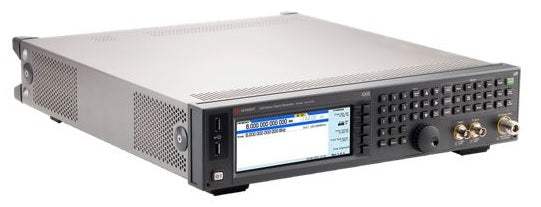
The Keysight X-Series RF signal generators span a 9 kHz to 6 GHz frequency range and are offered in analog and vector configurations across three performance tiers: the pure and precise MXG (N5181B analog, N5182B vector), the cost-effective EXG (N5171B analog, N5172B vector), and the general-purpose CXG (N5166B vector). Keysight positions the X-Series to produce signals from simple to complex and from clean to dirty, so engineers can test a design within and beyond its limits.
Application coverage differs by tier. The MXG is fine-tuned as a "golden transmitter" for R&D: testing radar receiver sensitivity, characterizing ADC or mixer SNR, finding receiver out-of-band rejection, and driving power amplifiers to characterize nonlinear behavior, including multicarrier power amplifiers and wideband receivers used in 802.11ax WLAN designs. The EXG is optimized for manufacturing test, covering basic parametric testing of components and functional verification of receivers. The CXG serves as a local oscillator, golden transmitter, or interference signal for IoT and general-purpose R&D and design validation, as well as educator teaching labs.
ValueTronics stocks test and measurement equipment directly from its own 20,000-square-foot secure warehouse at 1675 Cambridge Drive in Elgin, Illinois. Every pre-owned unit is inspected and functionally verified in-house before it ships, while new units leave factory-sealed exactly as received from the manufacturer.
Keysight Technologies traces its roots to Hewlett-Packard's test and measurement business, which was spun out as Agilent Technologies in 1999 and then established as Keysight Technologies in 2014. The X-Series carries that measurement heritage forward.
The X-Series RF signal generators are a single family covering 9 kHz to 6 GHz, available in both analog and vector configurations and organized into three tiers that share a common platform but target different performance and cost points. Keysight describes the line as ranging from the pure and precise MXG, to the cost-effective EXG, to the general-purpose CXG, all built to generate signals from simple to complex and from clean to dirty.
Across the family, the models share PathWave Signal Generation software compatibility, the same 1000Base-T LAN, GPIB, and USB control interfaces, and a common panel layout within each group: the MXG and EXG analog units share one connector layout, and the MXG and EXG vector units share another. That consistency keeps test-system integration uniform as you move between tiers.
Each model in the comparison below links to its own dedicated product page with condition-matched pricing. Select the specific MXG, EXG, or CXG model and the pre-owned configuration that fits your requirement; the specifications and options shown apply to that individual unit.
The tiers separate primarily on spectral purity, power, bandwidth, and memory. Phase noise at 1 GHz (20 kHz offset) improves from -119 dBc/Hz on the CXG to -122 dBc/Hz on the EXG to -146 dBc/Hz on the MXG, while nonharmonic spurious at 1 GHz is -72 dBc on the CXG and EXG and -96 dBc on the MXG. Output power at 1 GHz is +18 dBm on the CXG and +27 dBm on the EXG and MXG.
On the vector side, modulation bandwidth is 120 MHz on the CXG and 160 MHz on the EXG and MXG, while arbitrary waveform memory is 512 MSa on the CXG and EXG and 1024 MSa on the MXG; ACPR (-73 dBc, W-CDMA 64 DPCH) and EVM (0.4 percent, 802.11ac/LTE) are common across the vector models. The comparison table below lists these per-model values side by side.
| Model | Frequency Range | Phase Noise (1 GHz, 20 kHz offset) | Max Output Power (1 GHz) |
|---|---|---|---|
| N5166B | 9 kHz to 6 GHz | –119 dBc/Hz | +18 dBm |
| N5181B | 9 kHz to 6 GHz | –146 dBc/Hz | +27 dBm |
| N5182B | 9 kHz to 6 GHz | –146 dBc/Hz | +27 dBm |
| N5171B | 9 kHz to 6 GHz | –122 dBc/Hz | +27 dBm |
Additional differences in specifications beyond the few shown above are not listed here — see each model's full specifications below.
| Specification | Value |
|---|---|
| Summary of Key Specifications | |
| Frequency range | 9 kHz to 6 GHz |
| Phase noise at 1 GHz, 20 kHz offset | –119 dBc/Hz |
| Spurious at 1 GHz (nonharmonics) | –72 dBc |
| Output power at 1 GHz | +18 dBm |
| ACPR (W-CDMA 64 DPCH) | –73 dBc |
| EVM (802.11ac/LTE) | 0.4 percent |
| Modulation bandwidth | 120 MHz |
| Arbitrary waveform memory | 512 MSa |
Important: Option SD0 is not compatible with Option 009 and Option 660.
Important: Power meter functionality is provided through an external Keysight USB power sensor (connected via USB 2.0 Type-A); the power sensor is not part of the instrument and must be obtained separately.
Important: The RF output provides up to 50 W reverse power protection.
Usage tip: pair the vector models with the Keysight N5106A PXB for channel emulation (fading) in receiver test setups.
This pre-owned unit is inspected and functionally verified in-house before it ships and is backed by our pre-owned warranty. To confirm its exact condition, firmware revision, installed options, or included accessories for your application before ordering, contact our Test Architects.
ValueTronics supplies both new and used test and measurement equipment. New units ship factory-sealed, exactly as received from the manufacturer; every used unit is inspected and functionally verified in-house at our 20,000 sq ft secure facility in Elgin, Illinois before it ships. Our Test Architects can help you select the condition, calibration, and configuration that fit your application.
Please review the Manufacturer's Data Sheet to verify published specifications. Feedback on this webpage is always welcome — please reach out to your Test Architect at any time for questions or concerns. Thank you, we truly appreciate you being our customer.
Model No
Keysight
Condition
Pre-Owned
Manufacturer
Keysight Technologies
Rf_gen_freq
9 kHz to 6 GHz


30+ Years in Business

Secure Payments

Sell Test Equipments

Knowledgeable Staff

On-site Lab
30+ Years in Business
Secure Payments
Sell Test Equipments
Knowledgeable Staff
On-site Lab
Request A Quote