Chat Live
 Contact Us
 sales@valuetronics.com


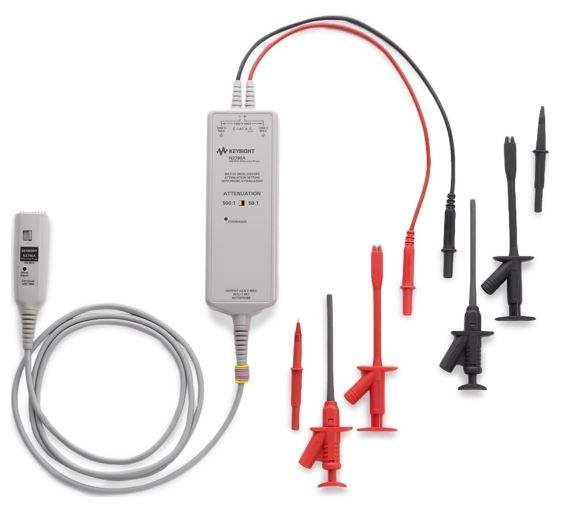
The N2790A, N2791A and N2891A are high-voltage differential probes that let conventional earth-grounded oscilloscopes make floating signal measurements — measurements where neither point is at earth ground. A differential amplifier in the probe head provides the dynamic range and bandwidth needed to make these floating measurements safely and accurately. The three models span 100 MHz, 25 MHz and 70 MHz of probe bandwidth respectively, each with user-selectable attenuation that makes it highly versatile across a broad range of applications.
Oscilloscope users often need to make floating measurements where neither point of the measurement is at earth ground. These high-voltage differential probes are intended for exactly that task — making the floating measurements found in power electronics circuits safely and accurately. Each probe ships with probe tip accessories designed for use with both small and large components in tight places, so the same instrument adapts to different physical test points.
ValueTronics stocks and holds its own inventory in a 20,000 sq ft secure warehouse at 1675 Cambridge Drive in Elgin, Illinois, which keeps fulfillment and accountability under one roof. That combination lets buyers source the right high-voltage differential probe with confidence in both its condition and its provenance.
The probes carry the Keysight Technologies brand, the product of a corporate lineage that runs from Hewlett-Packard to Agilent to Keysight. Hewlett-Packard's test and measurement business was established as Agilent Technologies in 1999, and Agilent's electronic measurement business became Keysight Technologies in 2014. The brand traces its measurement heritage to 1939.
The N2790A, N2791A and N2891A make up a family of high-voltage differential probes that allow conventional earth-grounded oscilloscopes to be used for floating signal measurements. All three share the same core approach — a differential amplifier in the probe head, user-selectable attenuation, and probe tip accessories for small or large components — while differing in bandwidth, attenuation ratios and voltage rating.
Each probe is built for the floating measurements found in power electronics circuits, offering sufficient dynamic range and bandwidth for that work. The models below are positioned by their bandwidth and voltage class rather than by any tier labels, so the right choice follows directly from the signal bandwidth and voltage you need to measure.
Each new model below is its own dedicated product page with condition-matched pricing. Select the model whose bandwidth and voltage rating fit your application, then choose the listing that matches the condition you need.
The three models differ primarily in bandwidth, attenuation and voltage rating. The N2790A provides ≥100 MHz bandwidth with 50:1/500:1 attenuation and a differential rating up to ±1,400 V, connecting through the Keysight AutoProbe interface. The N2791A provides ≥25 MHz bandwidth with 10:1/100:1 attenuation and a differential rating up to ±700 V. The N2891A provides ≥70 MHz bandwidth with 100:1/1000:1 attenuation and a differential rating up to ±7,000 V or 5,000 Vrms.
Power and connection also vary: the N2791A and N2891A accept any 1 MΩ BNC input and run on included AA batteries or USB power, while the N2790A draws power from the oscilloscope's AutoProbe interface. The N2790A and N2891A add an overrange indicator. See the comparison table for the per-model bandwidth, rise time, attenuation, voltage, impedance and environmental figures.
| Model | Bandwidth | Attenuation | Max Differential Voltage |
|---|---|---|---|
| N2790A | ≥ 100 MHz | 50:1/500:1 | ± 1400 V at 500:1 |
| N2791A | ≥ 25 MHz | 10:1/100:1 | ± 700 V at 100:1 |
| N2891A | ≥ 70 MHz | 100:1/1000:1 | ± 7000 V or 5000 Vrms at 1000:1 |
Additional differences in specifications beyond the few shown above are not listed here — see each model's full specifications below.
| Specification | Value |
|---|---|
| Performance Characteristics | |
| Bandwidth (—3 dB) | ≥ 100 MHz probe bandwidth |
| Rise time (calculated) | ≤ 3.5 ns |
| Attenuation | 50:1/500:1 |
| Gain accuracy (% of reading) | ± 2% at 20 to 30 ºC; ± 4% at 0 to 20 ºC and 30 to 50 ºC |
| DC CMRR | –70 dB at 500 VDC |
| AC CMRR | –80 dB at 50/60 Hz; –50 dB at 1 kHz; –50 dB at 1 MHz |
| Propagation delay | 14 nsec at 50:1; 2.8 nsec at 500:1 |
| Input R//C (each input to ground) | 4 Mohm // 7 pF |
| Input R//C (between inputs) | 8 Mohm // 3.5 pF |
| Max differential operating voltage (DC+PeakAC or RMS) | ± 1400 V at 500:1; ± 140 V at 50:1 |
| Max common mode operating voltage (DC+PeakAC or RMS) | ± 1000 V (CAT II); ± 600 V (CAT III) |
| Max nondestructive voltage | ± 1500 VDC + Peak AC differential mode; ± 1000 Vrms (CAT II) differential and common mode |
| Output maximum voltage range | ± 2.8 V into 1 Mohm (500:1) |
| Scope’s input impedance | 1 Mohm AutoProbe interface |
| Output offset | Adjustable |
| Noise referenced to input | < 300 mVrms at 500:1; < 50 mVrms at 50:1 |
| Environmental | |
| Temperature - operating | –10 to 50 ºC |
| Temperature - non-operating | –51 to 71 ºC |
| Humidity - operating | 80% RH at 40 ºC |
| Humidity - non-operating | 90% RH at 65 ºC |
| Operating altitude | 2,000 m |
| Nonoperating altitude | 15,300 m |
| Vibration | Keysight class GP and MIL-PRF-28800F class 3 random |
| Shock | Tip end: 400g 1/2 sine wave AutoProbe BNC End: 50g 1/2 sine wave Probe circuit box: Keysight class B1 and MIL-PRF-28800F class 3 |
| Safety | |
| Safety specifications | IEC61010-031 |
Important: The N7013A extreme temperature kit is compatible with the N2790A and N2791A at de-rated bandwidths. It is mechanically compatible with the N2891A, but de-rated bandwidths are not available and specifications are not guaranteed for the N2891A.
Important: The N7013A extreme temperature extension kit is compatible with the N2790A and N2791A differential probes at de-rated bandwidths; its 70 cm differential cable set and accessories operate from -40 °C to +85 °C.
Usage tip: for probing differential signals inside environmental chambers at extreme temperatures, pair the N2790A or N2791A with the N7013A extreme temperature extension kit listed in the ordering information.
Important: Bandwidth (and gain accuracy) is a warranted specification after a 20 minute warm-up; all other specifications are typical.
This is a brand-new, factory-sealed unit, supplied exactly as it arrives from the manufacturer and backed by the full manufacturer warranty. For the exact configuration, available options, included accessories, or current lead time for your application, our Test Architects can confirm the details before you order.
ValueTronics supplies both new and used test and measurement equipment. New units ship factory-sealed, exactly as received from the manufacturer; every used unit is inspected and functionally verified in-house at our 20,000 sq ft secure facility in Elgin, Illinois before it ships. Our Test Architects can help you select the condition, calibration, and configuration that fit your application.
Please review the Manufacturer's Data Sheet to verify published specifications. Feedback on this webpage is always welcome — please reach out to your Test Architect at any time for questions or concerns. Thank you, we truly appreciate you being our customer.
Model No
Keysight
Condition
Factory New
Manufacturer
Keysight Technologies, Inc.
Diff_probe_freq
100 MHz


30+ Years in Business

Secure Payments

Sell Test Equipments

Knowledgeable Staff

On-site Lab
30+ Years in Business
Secure Payments
Sell Test Equipments
Knowledgeable Staff
On-site Lab
Request A Quote