Chat Live
 Contact Us
 sales@valuetronics.com


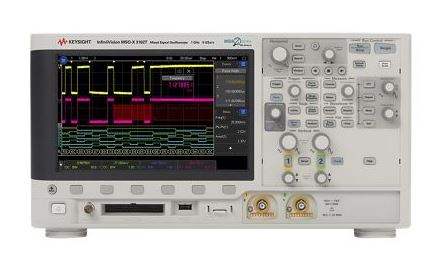
The Keysight InfiniiVision 3000T X-Series is a family of mixed-signal and digital-storage oscilloscopes built around an 8.5-inch capacitive touch display, a designed-for-touch user interface, and Keysight's MegaZoom IV smart memory technology. The series spans ten model configurations covering 100 MHz, 200 MHz, 350 MHz, 500 MHz, and 1 GHz bandwidth tiers, each available in 2-channel and 4-channel versions, with an optional MSO upgrade that adds 16 time-correlated digital channels. The datasheet positions the platform as a general-purpose oscilloscope that combines a touch-driven workflow with the discovery tools and analysis options needed to identify and resolve hard-to-find signal problems.
Per the datasheet, the 3000T X-Series is applied to hardware design and debug, embedded systems work involving serial buses such as I²C, SPI, UART, CAN, CAN FD, LIN, FlexRay, SENT, CXPI, MIL-STD 1553, ARINC 429, USB PD, and I²S, as well as power electronics characterization, frequency response (Bode) analysis of filters and switch-mode power supply loop response, mask and limit testing, and HDTV/enhanced video triggering and analysis. The 7-in-1 integration places oscilloscope channels, optional MSO digital channels, an optional 20 MHz WaveGen function/arbitrary generator, optional frequency response analysis, a standard 3-digit DVM, a standard 8-digit counter and totalizer, and optional protocol analysis into a single instrument.
ValueTronics keeps Keysight InfiniiVision 3000T X-Series oscilloscopes and the surrounding accessory ecosystem — passive and active probes, current and differential probes, the N7020A power rail probe, MSO cables, rack kits, and calibration documentation — stocked and managed at our 20,000 sq ft secure warehouse at 1675 Cambridge Drive in Elgin, Illinois. Every {{CONDITION}} instrument routed through Elgin is handled by our in-house team rather than drop-shipped from a third party, so the unit you order is the unit our technicians have physically had in front of them. That direct handling is what separates a verified instrument purchase from a pass-through broker transaction.
Keysight Technologies is the present-day home of the test and measurement business that originated at Hewlett-Packard. HP spun out its measurement businesses as Agilent Technologies in 1999, and Agilent in turn separated its electronic measurement operations into Keysight Technologies in 2014. Oscilloscopes branded HP, Agilent, and Keysight share a continuous engineering and product-line heritage across that history.
The InfiniiVision 3000T X-Series is a ten-configuration oscilloscope family that scales across five bandwidth tiers — 100 MHz, 200 MHz, 350 MHz, 500 MHz, and 1 GHz — with each tier available in 2-channel and 4-channel form. Every model in the family shares the same MegaZoom IV smart memory architecture, the 8.5-inch capacitive touch display, the designed-for-touch user interface, and the Zone Touch Trigger described in the datasheet. The differences between models are concentrated in bandwidth, calculated rise time, and the timebase range, while sample rate (5 GSa/s half channels, 2.5 GSa/s all channels), maximum memory depth (4 Mpts half channels, 2 Mpts all channels), and waveform update rate (>1,000,000 wfm/s) are constant across the series.
Each base model can be expanded along three axes the datasheet documents explicitly: an MSO upgrade adds 16 digital channels, a WaveGen upgrade adds the 20 MHz function/arbitrary waveform generator, and a set of bandwidth upgrades (license-only between adjacent tiers up to 500 MHz, or return-to-Keysight service for upgrades reaching 1 GHz) lets the same chassis grow into a higher-bandwidth model. Application software for embedded, automotive, aerospace, power, and NFC analysis is delivered as separately licensed packages and adds the corresponding decode, trigger, and analysis capability to the base instrument.
Each pre-owned 3000T X-Series model linked below is its own product page with condition-matched pricing and inventory. The product pages share this family overview because the architecture, update rate, MegaZoom memory behavior, and capacitive touch workflow are identical across the series — the per-model pages carry the specific bandwidth, channel count, calculated rise time, timebase range, and installed options applicable to that configuration.
Across the series, the datasheet specifies bandwidth and calculated rise time as follows: the 3012T/3014T at 100 MHz with a calculated rise time of ≤3.5 ns, the 3022T/3024T at 200 MHz with ≤1.75 ns, the 3032T/3034T at 350 MHz with ≤1 ns, the 3052T/3054T at 500 MHz with ≤700 ps, and the 3102T/3104T at 1 GHz with ≤450 ps. Timebase range scales with bandwidth as well: 5 ns/div minimum on 100 MHz models, 2 ns/div on 200 MHz models, 1 ns/div on 350 and 500 MHz models, and 500 ps/div on 1 GHz models, with all models extending out to 50 s/div. On 1 GHz models, the 50 Ω input sensitivity range is 1 mV/div to 1 V/div, versus 1 mV/div to 5 V/div on lower-bandwidth models.
The 2-channel vs. 4-channel choice and the optional MSO upgrade together determine total observable signals: a 2-channel DSO provides two analog channels, a 4-channel DSO provides four, and an MSO version of either adds 16 digital channels (D0–D15) for time-correlated mixed-signal acquisition. All other capabilities — Zone Touch Trigger, segmented memory, search/navigate, frequency response analysis (optional), gated FFT, the 38 automatic measurements, advanced math, the standard DVM and counter/totalizer, and the WaveGen option — are available across the series regardless of bandwidth or channel count. The comparison table on the family product page summarizes bandwidth, calculated rise time, channel count, and MSO availability for each model so the buyer can match application bandwidth requirements to the correct tier.
| Model | Bandwidth | Analog Channels | Digital Channels |
|---|---|---|---|
| MSOX3102T | 1 GHz | 2 | 16 |
| DSOX3012T | 100 MHz | 2 | 0 |
| DSOX3014T | 100 MHz | 4 | 0 |
| MSOX3012T | 100 MHz | 2 | 16 |
Additional differences in specifications beyond the few shown above are not listed here — see each model's full specifications below.
| Category | Specification | Value |
|---|---|---|
| Acquisition | Maximum sample rate | 5 GSa/s half channels, 2.5 GSa/s all channels |
| Acquisition | Maximum memory depth | 4 Mpts half channels, 2 Mpts all channels |
| Acquisition | Maximum digital channel sample rate | 1.25 GSa/s all pods |
| Acquisition | Maximum digital channel record length | 2 Mpts (with digital channels only) |
| Acquisition | Acquisition modes | Normal, Peak detect, Averaging (2 to 65,536), High resolution (12 bits), Segmented (max 1000 segments), Digitizer |
| Display | Display | 8.5-inch capacitive touch/gesture enabled TFT LCD |
| Display | Resolution | 800 (H) x 480 (V) pixel format |
| Display | Graticules | 8 vertical divisions by 10 horizontal divisions |
| Display | Format | YT, XY, and Roll |
| Display | Maximum waveform update rate | > 1,000,000 wfms/s |
| Display | Persistence | Off, infinite, variable persistence (100 ms to 60 s) |
| Display | Intensity gradation | 64 intensity levels |
| Vertical (Analog) | Hardware bandwidth limits | Approximately 20 MHz (selectable) |
| Vertical (Analog) | Input coupling | AC, DC |
| Vertical (Analog) | Input impedance | Selectable: 1 MΩ ± 1% (14 pF), 50 Ω ± 1.5% |
| Vertical (Analog) | Vertical resolution | 8 bits (12 bits with averaging) |
| Vertical (Analog) | Maximum input voltage | 135 Vrms; 190 Vpk |
| Vertical (Analog) | DC vertical gain accuracy | ± 2.0% full scale |
| Vertical (Analog) | DC vertical offset accuracy | ± 0.1 div ± 2 mV ± 1% of offset setting |
| Vertical (Analog) | Channel-to-channel isolation | > 100:1 from DC to maximum specified bandwidth |
| Vertical (Analog) | Offset range | ± 2 V (1 mV/div to 200 mV/div); ± 50 V (> 200 mV/div to 5 V/div) |
| Vertical (Digital) | Digital input channels | 16 digital (D0 to D15) |
| Vertical (Digital) | Threshold selections | TTL (+1.4 V), 5 V CMOS (+2.5 V), ECL (–1.3 V), user-defined (selectable by pod) |
| Vertical (Digital) | User-defined threshold range | ± 8.0 V in 10 mV steps |
| Vertical (Digital) | Maximum input voltage | ± 40 V peak CAT I |
| Vertical (Digital) | Threshold accuracy | ± (100 mV + 3% of threshold setting) |
| Vertical (Digital) | Maximum input dynamic range | ± 10 V about threshold |
| Vertical (Digital) | Minimum voltage swing | 500 mVpp |
| Vertical (Digital) | Input impedance | 100 kΩ ± 2% at probe tip |
| Vertical (Digital) | Input capacitance | ~8 pF |
| Horizontal | Time base accuracy | ± 1.6 ppm + aging factor (1st year: ± 0.5 ppm) |
| Horizontal | Time base delay range (pre-trigger) | Greater of 1 screen width or 250 μs |
| Horizontal | Time base delay range (post-trigger) | 1 s to 500 s |
| Horizontal | Channel-to-channel deskew range | ± 100 ns |
| Horizontal | Modes | Main, Zoom, Roll, XY |
| Horizontal (Digital) | Minimum detectable pulse width | 5 ns |
| Horizontal (Digital) | Channel-to-channel skew | 2 ns (typical); 3 ns (maximum) |
| Trigger | Trigger sources | Analog channel (1~4), digital channel (D0~D15), line, external, WaveGen |
| Trigger | Trigger modes | Normal, Auto, Single, Force |
| Trigger | Trigger coupling | DC, AC, HF reject, LF reject, Noise reject |
| Trigger | Trigger holdoff range | 40 ns to 10.00 s |
Please review the Manufacturer's Data Sheet to verify published specifications. Feedback on this webpage is always welcome — please reach out to your Test Architect at any time for questions or concerns. Thank you, we truly appreciate you being our customer.
Model No
Keysight
Condition
Used
Manufacturer
Keysight


30+ Years in Business

Secure Payments

Sell Test Equipments

Knowledgeable Staff

On-site Lab
30+ Years in Business
Secure Payments
Sell Test Equipments
Knowledgeable Staff
On-site Lab
Request A Quote