Chat Live
 Contact Us
 sales@valuetronics.com


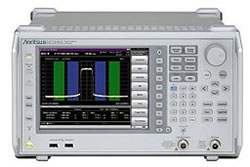
The Anritsu MS269xA Signal Analyzer combines the general level accuracy, dynamic range, and performance of a high-end spectrum analyzer with easy operability and an extensive set of built-in functions suited to transmitter (Tx) characteristic testing. Beyond capturing wideband signals, its FFT-based architecture supports multifunction signal analysis in both the time and frequency domains, so behavior that a sweep-type spectrum analyzer cannot resolve in the time domain can be examined in the frequency domain. A wide frequency span can be swept using spectrum-analyzer functions while detailed analysis of a specific band is supported in parallel.
Built around transmitter and receiver evaluation, the MS269xA acts as a reference signal source for testing the Tx characteristics of parts and, with the optional vector signal generator function installed, as a signal source for evaluating Rx characteristics. Its dynamic range supports true-performance measurements of devices such as base stations that require wideband instruments, and it addresses the industry move toward wireless communications above 3 GHz and wider bandwidths. With the microwave preselector bypass installed on the 26.5 GHz model, the instrument also supports wideband analysis at the higher frequencies used for satellite communications.
ValueTronics supports the MS269xA from our own 20,000-square-foot secure warehouse at 1675 Cambridge Drive in Elgin, Illinois, where we stock and hold our inventory on hand. Each pre-owned unit is inspected and functionally verified in-house by our technical team before it ships, while new units ship factory-sealed exactly as received — so every order arrives matched to its stated condition from a source that keeps real stock on the shelf.
The MS269xA family is a single signal-analyzer platform offered in three models that share a common architecture and differ principally in their upper frequency limit: the MS2690A reaches 6.0 GHz, the MS2691A reaches 13.5 GHz, and the MS2692A reaches 26.5 GHz, with all three starting at 50 Hz. Each model carries the same ±0.3 dB (typ.) total level accuracy and the same suite of built-in spectrum- and signal-analyzer measurement functions.
Because the models share interfaces, display, analysis-bandwidth options, and the optional vector-signal-generator function, the choice between them is driven mainly by the highest frequency a given application must reach. The comparison table below sets out the per-model frequency coverage and the options each model supports.
Each model in the family is listed as its own dedicated product page with condition-matched pricing, so the pre-owned price you see corresponds to that specific model and its condition. Use the links below to move to the exact model that fits your frequency requirement.
The clearest difference across the family is upper frequency limit — 6.0 GHz, 13.5 GHz, and 26.5 GHz for the MS2690A, MS2691A, and MS2692A respectively. The MS2690A reaches its full 6 GHz on a basic band without a preselector, while the MS2691A and MS2692A use a preselector above 5.9 GHz for their higher bands.
Option availability also tracks the model. The extension of the preselector's lower limit to 3 GHz (Opt. 003) applies to the MS2691A and MS2692A, and the Microwave Preselector Bypass (Opt. 067), which supports 125 MHz wideband measurement up to 26.5 GHz, can be installed only in the MS2692A. The bandwidth-extension, reference-oscillator, preamplifier, vector-signal-generator, and measurement-software options are common across the three models. See the comparison table for a model-by-model breakdown.
| Model | Frequency Range | Preselector Range | DANL |
|---|---|---|---|
| MS2692A | 50 Hz to 26.5 GHz | 5.9 GHz to 26.5 GHz (Frequency band mode: Normal) | –155 dBm/Hz (30 MHz to 2.4 GHz) |
| MS2690A | 50 Hz to 6.0 GHz | None (6 GHz basic band) | –155 dBm/Hz (30 MHz to 2.4 GHz) |
| MS2691A | 50 Hz to 13.5 GHz | 5.9 GHz to 13.5 GHz (Frequency band mode: Normal) | –155 dBm/Hz (30 MHz to 2.4 GHz) |
Additional differences in specifications beyond the few shown above are not listed here — see each model's full specifications below.
| Specification | Value |
|---|---|
| Frequency (MS2692A) | |
| Frequency Range | 50 Hz to 26.5 GHz |
| Frequency Setting Range | 0 Hz to 26.5 GHz (Setting resolution: 1 Hz) |
| Span Range (Spectrum Analyzer) | 0 Hz, 300 Hz to 26.5 GHz |
| Preselector Range (Frequency band mode: Normal) | 5.9 GHz to 26.5 GHz |
| Preselector Range (Frequency band mode: Spurious) | 3.0 GHz to 26.5 GHz |
| Total Level Accuracy (after Preselector tuning) | ±1.8 dB (6.0 GHz < Frequency ≤ 13.5 GHz, Frequency band mode: Normal); ±3.0 dB (13.5 GHz < Frequency ≤ 26.5 GHz) |
| Microwave Preselector Bypass (Opt. MS2692A-067) | 6.0 GHz to 26.5 GHz; supports 125 MHz wideband signal analyzer measurements up to 26.5 GHz |
Important: Published specifications apply after a 30-minute warm-up at a constant ambient temperature.
Important: The MS2692A-067 Microwave Preselector Bypass can only be installed in the MS2692A and cannot be installed simultaneously with the MS2692A-003 or MS2692A-008 options.
Important: The MS269xA-003 Extension of Preselector Lower Limit to 3 GHz can only be installed in the MS2691A/MS2692A.
Important: The MS269xA-078 Analysis Bandwidth Extension to 125 MHz requires the MS269xA-077 Analysis Bandwidth Extension to 62.5 MHz.
Important: The J1373A AUX Conversion Adapter is not a standard accessory for the MS269xA-020 Vector Signal Generator option and must be ordered separately; it is required to use the rear-panel Aux connector (BER measurement Clock/Data/Enable, marker outputs, pulse modulation input).
Important: Noise Figure measurement (Opt. MS269xA-017) uses the Y-factor method and requires an external noise source (Noisecom NC346 series), which is not supplied.
Important: The Power Meter function requires a compatible USB power sensor (e.g., MA24106A/MA24108A/MA24118A/MA24126A); the MA24104A has been discontinued.
Important: The MX705010A Wi-SUN PHY Measurement Software and MX705110A Wi-SUN Protocol Monitor are PC software and cannot be installed in the MS269xA; MX705010A also requires MX269017A, MS269xA-020 and MX269902A.
Recommended pairing: connect an Anritsu USB power sensor such as the MA24106A (50 MHz to 6 GHz) to use the instrument's built-in Power Meter function.
This pre-owned unit is inspected and functionally verified in-house before it ships and is backed by our pre-owned warranty. To confirm its exact condition, firmware revision, installed options, or included accessories for your application before ordering, contact our Test Architects.
ValueTronics supplies both new and used test and measurement equipment. New units ship factory-sealed, exactly as received from the manufacturer; every used unit is inspected and functionally verified in-house at our 20,000 sq ft secure facility in Elgin, Illinois before it ships. Our Test Architects can help you select the condition, calibration, and configuration that fit your application.
Please review the Manufacturer's Data Sheet to verify published specifications. Feedback on this webpage is always welcome — please reach out to your Test Architect at any time for questions or concerns. Thank you, we truly appreciate you being our customer.
Model No
Anritsu
Condition
Pre-Owned
Manufacturer
Anritsu
Spec_ana_freq
50 Hz to 26.5 GHz


30+ Years in Business

Secure Payments

Sell Test Equipments

Knowledgeable Staff

On-site Lab
30+ Years in Business
Secure Payments
Sell Test Equipments
Knowledgeable Staff
On-site Lab
Request A Quote