 Chat Live
 Contact Us
 sales@valuetronics.com


🎓 Request a Quote To Get An EDU Discount
Couldn't load pickup availability
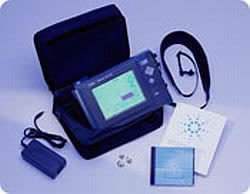
The Agilent E6000C Mini-OTDR is a modular, field-portable optical time domain reflectometer designed for fiber installation, commissioning, and maintenance work. The platform accepts a family of plug-in OTDR modules covering different wavelengths and dynamic range tiers, along with sub-modules for optical power measurement and visual fault finding — letting a single instrument adapt to the wavelength and link-length requirement at hand.
An optical time domain reflectometer characterizes a fiber link by launching a light pulse into the fiber and measuring the backscattered and reflected light that returns. From that signature, the instrument maps connectors, splices, bends, breaks, and segment attenuation along the link from a single access point. The E6000C is positioned for fiber installation acceptance documentation, splice and connector loss characterization, multi-fiber qualification of high-count cables, and preventive maintenance and repair across metropolitan, trunk, undersea, and LAN networks.
ValueTronics stocks and ships {{CONDITION}} Agilent E6000C Mini-OTDR mainframes, modules, and sub-modules from our 20,000 sq ft secure warehouse at 1675 Cambridge Drive, Elgin, Illinois. Every unit moves through our in-house inspection and test process before shipment — a level of accountability that distinguishes professional T&M distribution from drop-ship or pass-through brokerage. For fiber installation and maintenance teams who need an OTDR on a defined schedule, our domestic inventory and same-facility test workflow shorten the gap between order and operational use.
The E6000C Mini-OTDR was developed under Agilent Technologies, the test and measurement company that was spun out of Hewlett-Packard in 1999. In 2014, Agilent's electronic measurement business was separated as Keysight Technologies, which is the current corporate successor for the test and measurement product lines. Agilent-branded fiber test instruments remain in active service worldwide and continue to be supported through the secondary market and third-party calibration channels.
The E6000C Mini-OTDR is a modular platform: a single mainframe accepts plug-in OTDR modules at different wavelengths and dynamic range tiers, plus optional power meter and visual fault finder sub-modules. The mainframe characteristics — display, storage, battery, boot time, weight, and user interface — are common across the family. The module determines wavelength coverage, dynamic range, dead zones, and the recommended application class.
Module selection follows two questions: which wavelength does the fiber require (1310 nm and 1550 nm for most single-mode telecom, 1625 nm for in-service monitoring on a live link, 850/1300 nm for multimode LAN), and how much dynamic range is needed for the link length and acceptable averaging time. The datasheet groups recommended modules by link length tier from metropolitan (50 km) through trunk (100–150 km) to undersea (200 km and beyond).
Each pre-owned E6000C Mini-OTDR configuration listed below is its own product page with condition-matched pricing. Module model numbers (E6001A through E6012A, plus the E6005A and E6009A multimode units) identify the wavelength and dynamic range tier the customer needs. Mainframe and module are quoted together so the full measurement capability is captured on a single order.
Single-mode telecom modules span a wide dynamic range envelope. The E6001A (1310 nm, 30 dB) and E6004A (1310/1550 nm, 30/30 dB) are positioned for metropolitan single-mode work. The E6003A (35/34 dB) extends into metropolitan and trunk. The E6003B (40/39 dB) is the metropolitan-and-trunk workhorse.
Multimode coverage is provided by the E6009A (850/1300 nm, 18/23 dB) for general LAN work and the E6005A (850/1300 nm, 26/34 dB) for more demanding multimode characterization. All single-mode and multimode modules share the 3 m event dead zone specification. The recommended-application matrix on the datasheet pairs module dynamic range with link length and test time: shorter averaging requires more dynamic range, and longer links require more dynamic range — selection is the intersection of those two requirements.
Additional differences in specifications beyond the few shown above are not listed here — see each model's full specifications below.
| Specification | Value |
|---|---|
| Weight | 2.9 kg (6.4 lb) |
| Construction | Modular |
| Boot-up Time | 15 seconds |
| Battery Operation | 8 hours |
| Flash Disk Storage | 13,000 OTDR traces |
| Maximum Dynamic Range (with module) | 45 dB |
| Connector/Splice Loss Localization | Within 8 cm, even at a distance of 150 km |
| Display | Brilliant, high-resolution color display for indoor and outside plant use |
| Data Transfer Standard | Bellcore/Telcordia GR-196-CORE certified |
| Languages Available | 16 languages on support CD; up to 4 loaded simultaneously on instrument including help text |
| Calibration Warranty | Standard 2 year guarantee; optional 3-year or 5-year calibration warranty |
| Housing | Rugged, weather-tolerant; no internal hard-disk |
Please review the Manufacturer's Data Sheet to verify published specifications. Feedback on this webpage is always welcome — please reach out to your Test Architect at any time for questions or concerns. Thank you, we truly appreciate you being our customer.
Model No
Agilent
Condition
Used
Manufacturer
Agilent
3
Color screen VGA LCD


30+ Years in Business

Secure Payments

Sell Test Equipments

Knowledgeable Staff

On-site Lab
30+ Years in Business
Secure Payments
Sell Test Equipments
Knowledgeable Staff
On-site Lab
Request A Quote


