Chat Live
 Contact Us
 sales@valuetronics.com


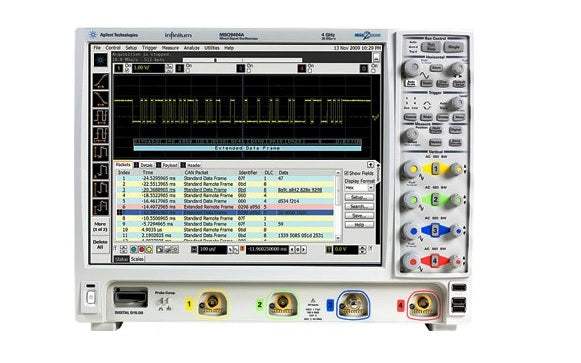
The Agilent Infiniium 9000 Series is a family of mixed-signal and digital storage oscilloscopes engineered for the broadest measurement capability across hardware design, debug, and compliance test workflows. The series spans four bandwidth tiers — 600 MHz, 1 GHz, 2.5 GHz, and 4 GHz — with each model available as a DSO (four analog channels) or MSO configuration adding sixteen high-speed digital channels. All models share a common platform: a 15-inch XGA touchscreen display, a 9-inch deep chassis, 26 lb weight, and Windows-based operation with standard USB, LAN, and DVI/XGA video output.
Engineers use Infiniium 9000 Series oscilloscopes for hardware design and debug, embedded systems development, serial bus analysis, and compliance testing against industry standards. The datasheet identifies application coverage including I2C and SPI bus debug, RS-232/UART decode, CAN/LIN/FlexRay automotive bus analysis, USB 2.0 compliance, DDR1/DDR2/DDR3 and LPDDR memory characterization, Ethernet compliance, MIPI D-Phy validation, PCI Express analysis, SATA testing, JTAG scan chain decode, and jitter analysis with the EZJIT, EZJIT Plus, and EZJIT Complete software families. FPGA developers can use the dynamic probe application for Altera and Xilinx internal-signal visibility.
Agilent Technologies was spun off from Hewlett-Packard in 1999, inheriting HP's test and measurement business including the Infiniium oscilloscope platform. In 2014, Agilent's electronic measurement division was separated into a new company, Keysight Technologies, which now holds the Infiniium product line. Instruments sold under the Agilent brand — including the Infiniium 9000 Series — are supported through Keysight's service infrastructure.
The Infiniium 9000 Series is a single oscilloscope platform offered across four analog bandwidth tiers — 600 MHz, 1 GHz, 2.5 GHz, and 4 GHz — with each tier available in DSO (four analog channels) and MSO (four analog plus sixteen digital channels) configurations. All eight models share the same chassis dimensions, the same 15-inch XGA touchscreen, the same Windows-based operating system, the same I/O ports, and the same software application ecosystem. The differences between models are bandwidth, maximum sample rate at the lower bandwidth tier, and the inclusion of digital channels on MSO variants.
Because the platform is shared, an Infiniium 9000 Series oscilloscope at any bandwidth tier supports the same advanced triggering, the same segmented memory architecture, the same protocol decode software options, and the same compliance application suite. Selecting between models is primarily a matter of matching the oscilloscope's analog bandwidth and sample rate to the highest signal frequencies present in the device under test, and deciding whether the integrated logic analysis of the MSO configuration is required for the application.
Each pre-owned Infiniium 9000 Series model below is listed on its own product page with condition-matched pricing. Click through to the specific model that matches your bandwidth, channel configuration, and digital-channel requirement to see the current quote, included accessories, and installed software options for that exact unit.
The DSO9104A / MSO9104A occupies the 1 GHz position in the Infiniium 9000 Series. At this bandwidth tier, the oscilloscope delivers 20 GSa/s maximum real-time sample rate in 2-channel mode (10 GSa/s in 4-channel mode), with a typical rise time of 253 ps (10%–90% at 50 Ω). This model is the entry point in the series for high-speed USB 2.0 compliance testing, which the datasheet identifies as supported on 2.5 GHz and higher models for high-speed USB but supported on the 1 GHz analog channels for low- and full-speed USB.
Bandwidth and sample rate are the primary differentiators across the Infiniium 9000 Series. The 600 MHz models (DSO9064A / MSO9064A) provide 10 GSa/s in 2-channel mode and 5 GSa/s in 4-channel mode. The 1 GHz, 2.5 GHz, and 4 GHz models all share the same 20 GSa/s / 10 GSa/s sample rate architecture, with the bandwidth specification driving the analog front-end design and rise-time performance. Typical rise times documented in the datasheet are 540 ps on the 600 MHz model, 253 ps on the 1 GHz model, 142 ps on the 2.5 GHz model, and 85 ps on the 4 GHz model.
Software application compatibility varies by bandwidth tier. The datasheet notes that USB 2.0 compliance testing is supported on 2.5 GHz and 4 GHz models, MIPI D-Phy serial decode requires the 4 GHz analog channels, PCI Express serial trigger and protocol viewer requires the 4 GHz model, and SATA triggering and decode requires the 4 GHz model. All other documented software options — including I2C/SPI, RS-232/UART, CAN/LIN/FlexRay, JTAG, low/full-speed USB, EZJIT family jitter analysis, InfiniiScan, and the DDR memory compliance applications — are supported across all four bandwidth tiers. See the comparison table below for the full bandwidth, sample rate, and channel configuration of each model in the series.
| Model | Bandwidth | Max Sample Rate (2-ch) | Analog Channels |
|---|---|---|---|
| DSO9404A | 4 GHz | 20 GSa/s | 4 |
| DSO9064A | 600 MHz | 10 GSa/s | 4 |
| MSO9064A | 600 MHz | 10 GSa/s | 4 |
| DSO9104A | 1 GHz | 20 GSa/s | 4 |
Additional differences in specifications beyond the few shown above are not listed here — see each model's full specifications below.
| Category | Specification | Value |
|---|---|---|
| Vertical: Scope Channels | Input channels | DSO9000 – 4 analog; MSO9000 – 4 analog + 16 digital |
| Vertical: Scope Channels | Analog bandwidth (−3 dB) at 1 MΩ | 500 MHz (all models) |
| Vertical: Scope Channels | Input impedance | 50 Ω ± 2.5%, 1 MΩ ± 1% (11 pF typical) |
| Vertical: Scope Channels | Input sensitivity | 1 MΩ: 1 mV/div to 5 V/div; 50 Ω: 1 mV/div to 1 V/div |
| Vertical: Scope Channels | Input coupling | 1 MΩ: AC (3.5 Hz), DC; 50 Ω: DC |
| Vertical: Scope Channels | Bandwidth limit | 20 MHz on 1 MΩ input; 500 MHz up to full scope bandwidth in increments of 500 MHz |
| Vertical: Scope Channels | Vertical resolution | 8 bits, ≥12 bits with averaging |
| Vertical: Scope Channels | Channel-to-channel isolation | DC to 50 MHz: 50 dB; >50 MHz to 2.5 GHz: 40 dB; >2.5 GHz to 4 GHz: 25 dB |
| Vertical: Scope Channels | DC gain accuracy | ± 2% of full scale at full resolution on channel scale ± 5 °C from cal temp |
| Vertical: Scope Channels | Maximum input voltage | 1 MΩ: 150 V RMS or DC, CAT I; ± 250 V (DC + AC) in AC coupling; 50 Ω: 5 Vrms |
| Vertical: Scope Channels | Offset accuracy | ± (1.25% of channel offset + 1% of full scale + 1 mV) |
| Vertical: Scope Channels | Dynamic range | 1 MΩ: ± 8 div from center screen; 50 Ω: ± 8 div from center screen |
| Vertical: Digital Channels (MSO) | Input channels | 16 digital channels |
| Vertical: Digital Channels (MSO) | Threshold groupings | 16 digital channels Pod 2: D15–D8 |
| Vertical: Digital Channels (MSO) | Threshold selections | TTL (1.4 V), CMOS (5.0 V, 3.3 V, 2.5 V), ECL (−1.3 V), PECL (3.7 V), user defined (±8.00 V in 100 mV increments) |
| Vertical: Digital Channels (MSO) | Maximum input voltage | ±40 V peak CAT I |
| Vertical: Digital Channels (MSO) | Threshold accuracy | ±(100 mV + 3% of threshold setting) |
| Vertical: Digital Channels (MSO) | Input dynamic range | ±10 V about threshold |
| Vertical: Digital Channels (MSO) | Minimum input voltage swing | 500 mV peak-to-peak |
| Vertical: Digital Channels (MSO) | Input impedance (flying leads) | 100 kΩ ± 2% (~ 8 pF) at probe tip |
| Vertical: Digital Channels (MSO) | Resolution | 1 bit |
| Vertical: Digital Channels (MSO) | Analog bandwidth | 400 MHz |
| Horizontal | Channel-to-channel skew (digital) | 2 ns typical |
| Horizontal | Glitch detect (digital) | ≥ 2.0 ns |
| Horizontal | Main time base range | 5 ps/div to 20 s/div |
| Horizontal | Horizontal position range | 0 to ± 200 s |
| Horizontal | Delayed sweep range | 1 ps/div to current main time base setting |
| Horizontal | Resolution | 1 ps |
| Horizontal | Modes | Main, delayed, roll (200 ms to 20 sec) |
| Horizontal | Reference positions | Left, center, right |
| Horizontal | Channel deskew | -1 ms to +1 ms range |
| Acquisition | Memory depth per channel (standard) | 20 Mpts on 4 channels, 40 Mpts on 2 channels |
| Acquisition | Memory depth (Option 50M) | 50 Mpts on 4 channels, 100 Mpts on 2 channels |
| Acquisition | Memory depth (Option 100) | 100 Mpts on 4 channels, 200 Mpts on 2 channels |
| Acquisition | Memory depth (Option 200) | 200 Mpts on 4 channels, 400 Mpts on 2 channels |
| Acquisition | Memory depth (Option 500) | 500 Mpts/250 Mpts on 4 channels, 1 Gpts/500 Mpts on 2 channels (single/repetitive mode) |
| Acquisition | Sampling Modes | Real-time; Real-time with peak detect; Real-time with high resolution (9-, 10-, 11-, or 12-bits); Real-time with roll mode (200 ms to 20 sec); Equivalent-time (1.0 ps fine interpolator resolution, max effective 1,000 GSa/s); Segmented memory |
| Acquisition | Segmented memory segments | Up to 8192 for 20 Mpts standard memory, up to 131,072 with Option 500 |
| Acquisition | Re-arm time | 4.5 µs with analog channels, 5.8 µs with digital channels on |
| Acquisition: Digital Channels | Maximum real time sample rate | 2 GSa/s |
Please review the Manufacturer's Data Sheet to verify published specifications. Feedback on this webpage is always welcome — please reach out to your Test Architect at any time for questions or concerns. Thank you, we truly appreciate you being our customer.
Model No
Agilent
Condition
Used
Manufacturer
Agilent
Channels
4
Frequency
4 GHz
Record length
40 MPts
Sampling rate
20 GS/s
7
I²C/SPI triggering and decode
8
CAN , LIN and FlexRay triggering and decode
800
Standard Hard Drive - installed


30+ Years in Business

Secure Payments

Sell Test Equipments

Knowledgeable Staff

On-site Lab
30+ Years in Business
Secure Payments
Sell Test Equipments
Knowledgeable Staff
On-site Lab
Request A Quote