Chat Live
 Contact Us
 sales@valuetronics.com


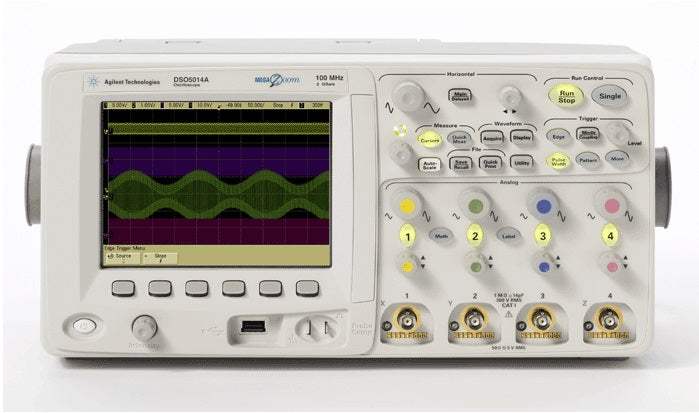
The Agilent 5000 Series Portable Oscilloscopes are bench digital storage oscilloscopes built on Agilent's third-generation MegaZoom III memory and display architecture. The series spans six models covering 100 MHz, 300 MHz, and 500 MHz bandwidths in 2- or 4-channel configurations, delivering deep acquisition memory and high waveform update rates in a compact portable package. Each instrument combines a 6.3-inch XGA color display, comprehensive standard connectivity, and the same acquisition technology blocks used in Agilent's higher-performance bench and lab oscilloscopes.
The 5000 Series is positioned as an everyday bench oscilloscope for engineers and technicians who need to characterize known signal behavior and hunt down intermittent anomalies. Typical applications include circuit design verification, embedded systems debug, production test, and educational laboratory work. The series supports analog HDTV/EDTV triggering for standards including 1080i, 1080p, 720p, and 480p, as well as standard video triggering for NTSC, SECAM, PAL, and PAL-M signals, making it suitable for video and broadcast development work.
The Agilent 5000 Series was developed by Agilent Technologies, the test and measurement business that was spun out of Hewlett-Packard in 1999. In 2014, Agilent's electronic measurement business was further separated and renamed Keysight Technologies, which continues to support and service Agilent-era instruments including the 5000 Series. Buyers of Agilent-branded oscilloscopes are working with instruments whose technology and support lineage runs directly from HP through Agilent to Keysight.
The Agilent 5000 Series spans six oscilloscope models across three bandwidth tiers — 100 MHz, 300 MHz, and 500 MHz — with each bandwidth available in either a 2-channel or 4-channel configuration. All six models share the same MegaZoom III memory and display architecture, the same XGA display, the same standard connectivity package, and the same triggering and measurement feature set. The differentiating dimensions across the family are bandwidth, maximum sample rate, channel count, and peak detect resolution.
The series is structured so that an engineer can select the bandwidth and channel count appropriate to the application without losing access to the platform's core acquisition technology, software analysis features, or connectivity options. A buyer choosing a DSO5012A receives the same MegaZoom III deep memory architecture, the same 100,000 waveforms-per-second update capability, and the same LXI Class C connectivity as a buyer of the DSO5054A.
Each pre-owned 5000 Series model below is presented as its own dedicated product page with condition-matched pricing. Use the comparison table to identify the bandwidth, sample rate, channel count, and peak detect specification appropriate to your measurement requirement, then navigate to the corresponding model page for full specifications, condition details, and current availability.
The DSO5034A occupies the mid-range position in the 5000 Series with 300 MHz bandwidth, 2 GSa/s sample rate per channel, and 4 analog channels. It provides 500 ps peak detect for narrow glitch capture and a calculated rise time of 1.17 ns. The 4-channel configuration enables simultaneous observation of multiple signals — a common requirement in embedded systems debug where power rails, clock signals, and data lines must be viewed in time correlation.
The primary differentiators across the 5000 Series family are bandwidth (100, 300, or 500 MHz), channel count (2 or 4), and the resulting sample rate and peak detect characteristics. The 100 MHz models (DSO5012A, DSO5014A) deliver 2 GSa/s per channel with 1 ns peak detect. The 300 MHz models (DSO5032A, DSO5034A) deliver 2 GSa/s per channel with 500 ps peak detect. The 500 MHz models (DSO5052A, DSO5054A) deliver 4 GSa/s in half-channel mode and 2 GSa/s per channel, with 250 ps peak detect.
Memory depth scales the same way across all models: 1 Mpts in half-channel mode and 500 kpts per channel when both channels of a pair are active. Timebase range varies with bandwidth, extending down to 5 ns/div on the 100 MHz models, 2 ns/div on the 300 MHz models, and 1 ns/div on the 500 MHz models. All other specifications — display, connectivity, triggering, measurements, math functions, and FFT — are identical across the family. Refer to the comparison table for the per-model specification summary.
| Model | Bandwidth | Channels | Max Sample Rate |
|---|---|---|---|
| DSO5032A | 300 MHz | 2 | 2 GSa/s |
| DSO5012A | 100 MHz | 2 | 2 GSa/s |
| DSO5014A | 100 MHz | 4 | 2 GSa/s |
| DSO5034A | 300 MHz | 4 | 2 GSa/s |
Additional differences in specifications beyond the few shown above are not listed here — see each model's full specifications below.
| Acquisition | |
|---|---|
| Sample Rate | DSO501xA/503xA: 2 GSa/s each channel; DSO505xA: 4 GSa/s half channel, 2 GSa/s each channel |
| Equivalent-Time Sample Rate | 400 GSa/s (when real-time mode is turned off) |
| Memory Depth | 1 Mpts half channel, 500 kpts each channel |
| Vertical Resolution | 8 bits, up to 12 in high-resolution or averaging modes |
| Peak Detection | DSO501xA: 1 ns; DSO503xA: 500 ps; DSO505xA: 250 ps |
| Averaging | Selectable from 2, 4, 8, 16, 32, 64 ... to 65536 |
| High Resolution Mode | Average mode with #avg = 1; 12 bits of resolution when ≥10 µs/div at 4 GSa/s or ≥20 µs/div at 2 GSa/s |
| Filter | Sinx/x interpolation (single shot BW = sample rate/4 or bandwidth of oscilloscope, whichever is less) |
| Vertical System | |
| Scope Channels | DSO50x2A: 2 Ch simultaneous acquisition; DSO50x4A: 4 Ch simultaneous acquisition |
| Bandwidth (-3 dB) | DSO501xA: DC to 100 MHz; DSO503xA: DC to 300 MHz; DSO505xA: DC to 500 MHz |
| AC Coupled | DSO501xA: 3.5 Hz to 100 MHz; DSO503xA: 3.5 Hz to 300 MHz; DSO505xA: 3.5 Hz to 500 MHz |
| Calculated Rise Time | DSO501xA: 3.5 nsec; DSO503xA: 1.17 nsec; DSO505xA: 700 psec |
| Single-Shot Bandwidth | DSO501xA: 100 MHz; DSO503xA: 300 MHz; DSO505xA: 500 MHz |
| Range | 2 mV/div to 5 V/div (1 MΩ or 50 Ω) |
| Maximum Input | CAT I 300 Vrms, 400 Vpk; transient overvoltage 1.6 kVpk. CAT II 100 Vrms, 400 Vpk. With 50 Ω input: 5 Vrms |
| Offset Range | ±5 V on ranges < 10 mV/div; ±20 V on ranges 10 mV/div to 200 mV/div; ±75 V on ranges >200 mV/div |
| Dynamic Range | ±8 div |
| Input Impedance | 1 MΩ ± 1% || 12 pF or 50 Ω ± 1.0%, selectable |
| Coupling | AC, DC |
| BW Limit | 25 MHz selectable |
| Channel-to-Channel Isolation | DC to max bandwidth > 40 dB |
| ESD Tolerance | ±2 kV |
| Noise Peak-to-Peak | DSO501xA: 3% full scale or 2.5 mV; DSO503xA: 3% full scale or 3 mV; DSO505xA: 3% full scale or 3.6 mV |
| DC Vertical Gain Accuracy | ±2.0% full scale |
| DC Vertical Offset Accuracy | ≤ 200 mV/div: ±0.1 div ±2.0 mV ±0.5% offset value; > 200 mV/div: ±0.1 div ±2.0 mV ±1.5% offset value |
| Horizontal | |
| Range | DSO501xA: 5 nsec/div to 50 sec/div; DSO503xA: 2 nsec/div to 50 sec/div; DSO505xA: 1 nsec/div to 50 sec/div |
| Resolution | 2.5 psec |
| Timebase Accuracy | 25 ppm (0.0025%) to 40° C, plus 1 ppm per ° C from 40° C to 55° C |
| Vernier | 1-2-5 increments when off, ~25 minor increments between major settings when on |
| Delay Range | Pre-trigger: Greater of 1 screen width or 125 µs; Post-trigger: 1 s to 500 seconds |
| Modes | Main, delayed, roll, XY |
| Reference Positions | Left, center, right |
| Trigger System | |
| Sources | DSO50x2A: Ch 1, 2, line, ext; DSO50x4A: Ch 1, 2, 3, 4, line, ext |
| Modes | Auto, Normal (triggered), Single |
| Holdoff Time | ~60 ns to 10 seconds |
| Trigger Jitter | 15 ps rms |
| Selections | Edge, pulse width, pattern, TV, duration |
| Display System | |
| Display | 6.3-inch (161 mm) diagonal color TFT LCD |
| Display Update Rate | Up to 100,000 waveforms/sec in real-time mode |
| Resolution | XGA: 768 vertical by 1024 horizontal points (screen area); 640 vertical by 1000 horizontal points (waveform area); 256 levels of intensity scale |
| Real-Time Clock | Time and date (user adjustable) |
| Measurement Features | |
| Voltage Measurements | Peak-to-peak, maximum, minimum, average, amplitude, top, base, overshoot, preshoot, RMS, standard deviation |
| Time Measurements | Frequency, period, +width, -width, duty cycle, rise time, fall time, X at max Y, X at min Y, delay, phase |
| Counter | Built-in 5-digit frequency counter; counts up to oscilloscope's bandwidth |
| Waveform Math | Subtract, multiply, FFT, differentiate, integrate |
| FFT Window | Rectangular, flattop, hanning |
| I/O | |
| Standard Ports | USB 2.0 high speed device, two USB 1.1 host ports, 10/100-BaseT LAN, IEEE488.2 GPIB, XGA video output |
| Max Transfer Rate | GPIB: 500 kbytes/sec; USB (USBTMC-USB488): 3.5 Mbytes/sec; 100 Mbps LAN (TCP/IP): 1 Mbytes/sec |
| Save/Recall | 10 setups and traces in internal non-volatile memory |
| Image Formats | BMP (8-bit), BMP (24-bit), PNG (24-bit) |
| Data Formats | CSV, ASCII XY, BIN |
| General Characteristics | |
| Physical Size | 35.4 cm W x 18.8 cm H x 17.4 cm D (without handle); 38.5 cm W x 18.8 cm H x 17.4 cm D (with handle) |
| Weight | Net: 4.1 kg (9 lbs); Shipping: approximately 9 kg (20 lbs) |
| Probe Comp Output | ~1.2 kHz, Amplitude ~2.5 V |
Please review the Manufacturer's Data Sheet to verify published specifications. Feedback on this webpage is always welcome — please reach out to your Test Architect at any time for questions or concerns. Thank you, we truly appreciate you being our customer.
Model No
Agilent
Condition
Used
Manufacturer
Agilent
Channels
2
Frequency
300 MHz
Record length
8 MPts
Sampling rate
2 GS/s


30+ Years in Business

Secure Payments

Sell Test Equipments

Knowledgeable Staff

On-site Lab
30+ Years in Business
Secure Payments
Sell Test Equipments
Knowledgeable Staff
On-site Lab
Request A Quote