Chat Live
 Contact Us
 sales@valuetronics.com


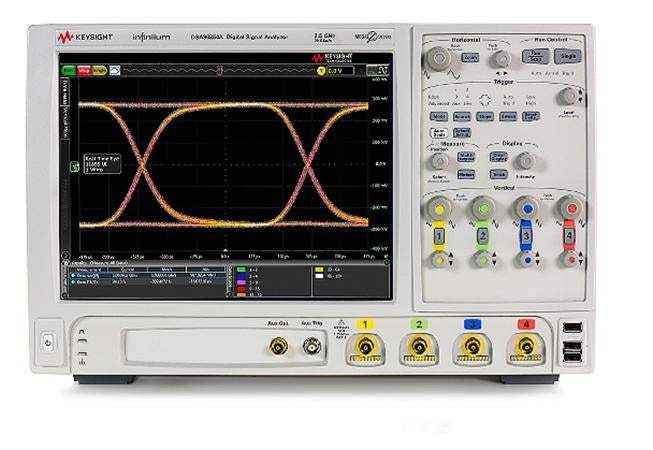
The Agilent Infiniium DSO/DSA90000A Series is a family of four-channel real-time digital oscilloscopes spanning 2.5 GHz to 13 GHz of analog bandwidth. The series is offered in two product lines: the DSO variants (digital storage oscilloscopes) and the DSA variants (digital signal analyzers), which add the high-speed serial data analyzer, EZJIT Plus jitter analysis software, and noise reduction and bandwidth control software as standard. Six bandwidth points are available in the family — 2.5, 4, 6, 8, 12, and 13 GHz — sharing the same chassis, user interface, and probing ecosystem.
The datasheet positions the 90000A Series for high-speed digital and RF design work, including evaluating signal integrity, validating compliance, and analyzing and debugging designs. Specific applications called out by Agilent include PCI Express Gen 2 eye-pattern characterization, 5 Gbps PRBS jitter separation, Certified Wireless USB compliance work using the 89600A vector signal analyzer software, and characterization of high-speed serial buses such as SATA, SAS, Fibre Channel, HDMI, DisplayPort, XAUI, and FBD. The datasheet's bus-standard table maps recommended bandwidth to data rate, ranging from 2 GHz for Ethernet at 250 Mbps up to 13 GHz for 6 to 8.5 Gbps Fibre Channel and SAS 600.
ValueTronics stocks, inspects, and ships the Infiniium DSO/DSA90000A Series from our 20,000-square-foot secure warehouse at 1675 Cambridge Drive in Elgin, Illinois. Each {{CONDITION}} oscilloscope and its accompanying accessories are inventoried and prepared in-house rather than passed through from third-party drop-shippers — this gives our team direct visibility into condition, option content, and accessory completeness before the unit ships to the customer. For an instrument family with software-licensed options, multiple bandwidth tiers, and a complex InfiniiMax probing ecosystem, that direct-handling step is what allows us to confirm exactly what is in the box and what is on the firmware.
The Agilent Technologies brand on this oscilloscope reflects a corporate name history that test engineers continue to encounter on installed instruments. Hewlett-Packard's test and measurement business was spun out as Agilent Technologies in 1999. In 2014, Agilent transferred its electronic measurement business to Keysight Technologies, which is the current corporate home for the Infiniium oscilloscope line. Agilent-branded instruments in this family remain functionally and commercially supported through that lineage.
The Infiniium DSO/DSA90000A Series is offered as six bandwidth tiers — 2.5, 4, 6, 8, 12, and 13 GHz — built on a common chassis with shared user interface, shared probing ecosystem, and shared software option set. Within each bandwidth tier, Agilent further offers a DSO variant and a DSA variant: the DSA models add the high-speed serial data analyzer (Option 003), EZJIT Plus jitter analysis (Option 004), noise reduction and bandwidth control (Option 005), and 20 Mpts standard memory as their bundled configuration.
The selection-guide table in Agilent's datasheet organizes the family around three changing specifications between models: real-time bandwidth, maximum sample rate, and noise floor at 5 mV/div. Memory depth is consistent across models (10 Mpts standard, optionally upgradeable to 1 Gpts). This shared architecture means that probes, software options, and rack hardware ordered for one bandwidth tier remain compatible with the others — and the After-Burner III Upgrade Program allows a customer to step from any lower tier to the 13 GHz top model in field-installable increments.
Each pre-owned 90000A Series model linked below is offered as its own ValueTronics product page with condition-matched pricing and stock status. Selecting between the bandwidth tiers is the most consequential commercial choice — a 6 GHz model and a 13 GHz model share the same form factor and accessory set but differ substantially in capability and price. Use the comparison table that follows to align bandwidth, sample rate, and noise-floor requirements to your application before placing the order.
The defining specification differences across the family are bandwidth, sample rate, and noise floor. Bandwidth steps are 2.5 → 4 → 6 → 8 → 12 → 13 GHz. Sample rate is 20 GSa/s on all four channels for the 2.5/4/6 GHz models and steps up to 40 GSa/s on all four channels for the 8/12/13 GHz models. RMS noise floor at 5 mV/div ranges from 147 µVrms on the 90254A to 389 µVrms on the 91304A — noise increases with bandwidth, which is expected for a real-time oscilloscope front end and is reflected in the datasheet's per-model noise table.
The DSO91304A is a special case: it reaches its 13 GHz headline bandwidth via DSP enhancement on a 12 GHz analog front end, and that DSP-enhanced bandwidth is not applicable at 5 mV/div. The DSA variants of all six models ship with the high-speed serial data analyzer, EZJIT Plus jitter analysis, and noise-reduction software included as standard rather than as paid options. The After-Burner III upgrade kits (N5471A–N5471E) allow stepwise bandwidth upgrades; the 12-to-13 GHz step is in-place, while lower-tier upgrades require a service-center return.
| Model | Bandwidth | Channels | Sample Rate |
|---|---|---|---|
| DSA91304A | 13 GHz | 4 | 40 GSa/s on 4 ch |
| DSO91304A | 13 GHz | 4 | 40 GSa/s on 4 ch |
| DSO91204A | 12 GHz | 4 | 40 GSa/s on 4 ch |
| DSA91204A | 12 GHz | 4 | 40 GSa/s on 4 ch |
Additional differences in specifications beyond the few shown above are not listed here — see each model's full specifications below.
| Specification | Value |
|---|---|
| Vertical | |
| Input channels | Four |
| Input impedance | 50 Ω, ± 3% |
| Sensitivity | 1 mV/div to 1 V/div |
| Input coupling | DC |
| Vertical resolution | 8 bits, ≥ 12 bits with averaging |
| DC gain accuracy | ± 2% of full scale at full resolution channel scale |
| Maximum input voltage | ± 5 V |
| Dynamic range | ± 4 div from center screen |
| Horizontal | |
| Main timebase range | 5 ps/div to 20 s/div real-time, 5 ps/div to 500 ns/div equivalent-time |
| Main timebase delay range | –200 s to 200 s real-time, –25 µs to 200 s equivalent-time |
| Zoom timebase range | 1 ps/div to current main time scale setting |
| Channel deskew | ± 25 µs range, 100 fs resolution |
| Time scale accuracy | ± (0.4 + 0.5 * YrsSinceCal) ppm pk |
| Acquisition | |
| Standard memory depth | 10 Mpts on 4 channels (DSO); 20 Mpts on 4 channels (DSA) |
| Maximum memory depth (Option 01G) | 1 Gpts on 4 channels |
| Sampling modes | Real-time, real-time with averaging, real-time with peak detect, real-time with hi resolution, equivalent-time, segmented memory |
| Equivalent-time resolution | 100 fs |
| Hardware Trigger | |
| Trigger sources | Channel 1, channel 2, channel 3, channel 4, aux, and line |
| Sweep modes | Auto, triggered, single |
| Trigger holdoff range | 100 ns to 10 s |
| Auxiliary trigger sensitivity | DC to 100 MHz: 200 mV p-p into 50 Ω; 100 MHz to 1 GHz: 500 mV p-p into 50 Ω |
| Measurements and Math | |
| Maximum measurement update rate | > 42,000 measurement/sec (one measurement); > 122,000 measurement/sec/measurement (five measurements) |
| Number of math functions | Four |
| Display | |
| Display | 12.1-inch color XGA TFT-LCD with touch screen |
| Resolution | 1024 x 768 (XGA) |
| Intensity grayscale | 256-level intensity-graded display |
| Maximum waveform update rate | > 400,000 waveforms per second (segment memory mode) |
| Computer System | |
| Operating system | Windows XP Pro |
| CPU | Intel Pentium 4 3.4-GHz microprocessor |
| PC system memory | 2 GB DDR2 standard (4 GB optional - Option 803) |
| Drives | ≥ 80-GB internal hard drive |
| I/O Ports | |
| LAN | RJ-45, 10Base-T, 100Base-T, 1000Base-T (VXI-11) |
| USB 2.0 hi-speed (host) | Three on front panel, four on rear panel |
| USB 2.0 hi-speed (device) | One on rear panel |
| GPIB | IEEE 488.2, fully programmable (optional - Option 805) |
| Time base reference input | 10 MHz, 50 Ω, 500 mV p-p (–2 dBm) min to 2.0 V p-p (+10 dBm) max |
| LXI compliance | Functional Class C |
| General Characteristics | |
| Operating temperature | 5 °C to +40 °C |
| Non-operating temperature | –40 °C to +70 °C |
| Operating humidity | Up to 95% relative humidity (non-condensing) at +40 °C |
| Operating altitude | Up to 4,600 meters (15,000 feet) |
| Power | 100 - 240 VAC at 50/60 Hz; maximum input power 800 Watts |
| Weight (Net) | 20 kg (44 lbs.) |
| Weight (Shipping) | 27.4 kg (60 lbs.) |
| Dimensions (excluding handle) | Height: 283 mm (11.13 in); Width: 432 mm (17.02 in); Depth: 506 mm (19.91 in) |
| Safety | Meets IEC 61010-1 +A2, CSA certified to C22.2 No.1010.1, self-certified to UL 3111 |
Please review the Manufacturer's Data Sheet to verify published specifications. Feedback on this webpage is always welcome — please reach out to your Test Architect at any time for questions or concerns. Thank you, we truly appreciate you being our customer.
Model No
Agilent
Condition
Used
Manufacturer
Agilent
Channels
4
Frequency
13 GHz
Record length
50 MPts
Sampling rate
40 GS/s
01G
Memory - 1G memory / channel upgrade - installed
64
Compliance application eMMC - installed
100
100M memory/Channel upgrade
1CM
Rack Mount Kit
200
Memory - 200M memory / channel upgrade - installed
500
Memory - 500M memory / channel upgrade - installed
50M
Memory - 50M memory / channel upgrade - installed
800
Standard hard drive - installed
801
Removable hard drive - installed
805
GPIB card-interface - installed
823
PCI express cards - installed
DSA
standard 50 Mpts memory , high speed serial data analysis (Option 003/E2688A) , EZJIT Complete jitter analysis software (Option 070/N8823A) , EZJIT Plus jitter analysis software (Option 004/N5400A) , and EZJIT jitter analysis software (Option 002/E2681A).”


30+ Years in Business

Secure Payments

Sell Test Equipments

Knowledgeable Staff

On-site Lab
30+ Years in Business
Secure Payments
Sell Test Equipments
Knowledgeable Staff
On-site Lab
Request A Quote