Chat Live
 Contact Us
 sales@valuetronics.com


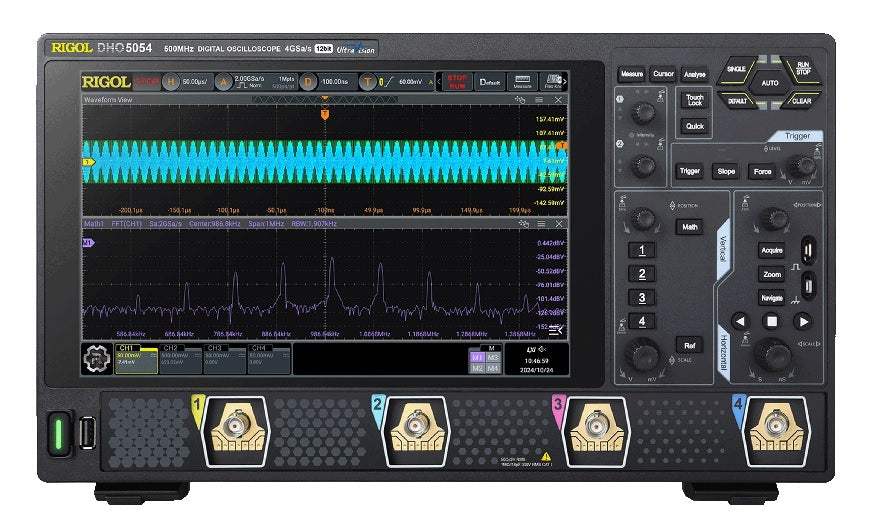
In summary, the Rigol MHO5054 is a 500 MHz, 4-channel plus 16 digital channel digital oscilloscope built on Rigol's Centaurus platform with 12-bit vertical resolution standard, 4 GSa/s real-time sample rate, and 500 Mpts maximum memory depth. At 500 MHz analog bandwidth (50 Ω, -3 dB), the MHO5054 covers the dominant mid-range zone of professional bench oscilloscope work — embedded systems, motor drives, switching power supplies, and general digital design. Applying the conventional 3–5× bandwidth rule, this model accurately measures fundamental frequencies up to roughly 100 MHz including the harmonic content that defines fast edges and switching transients.
The MHO5054 is used by design engineers, embedded systems developers, and production test teams to visualize, measure, and characterize electrical signals as waveforms in the time domain. With 4 analog channels and 16 integrated digital channels on a unified time base, the MHO5054 is particularly well suited to mixed-signal debug where analog power rails and digital buses (SPI, I2C, UART, CAN, LIN, FlexRay) must be viewed together.
12-bit vertical resolution gives 4,096 quantization levels — sixteen times finer than the 256 levels of a conventional 8-bit oscilloscope. On a 400 V full-scale measurement, that means 97.6 mV per count instead of 1.56 V per count. For engineers measuring switching ripple on a high-voltage rail, characterizing GaN HEMTs and SiC MOSFETs, or doing precision analog work, the 12-bit floor is the difference between resolving the signal and not seeing it. With 4 analog channels plus 16 integrated digital channels viewable on the same display and the same time base, an engineer can correlate an analog power-rail anomaly with the exact SPI, I2C, or CAN transaction that caused it. The MHO designation means the digital channel circuitry is built in — the PLA3204 4-channel logic analyzer probe (sold separately) connects to the dedicated LA1/LA2 inputs to use the digital channels. This eliminates the need for a separate logic analyzer in most mixed-signal debug workflows.
The Rigol MHO5054 delivers 500 MHz (50 Ω, -3 dB) analog bandwidth with a calculated rising time of ≤750 ps, 4 GSa/s real-time sample rate (4 GSa/s (single-channel & half-channel), 2 GSa/s (full-channel)), 500 Mpts maximum memory depth, a vertical sensitivity range of 100 µV/div to 10 V/div on 1 MΩ input, and ENOB of 7.7 (typical) at full bandwidth. The platform sustains a maximum waveform capture rate of 1,000,000 wfms/s in Record mode and 200,000 wfms/s in Vector mode, with peak detection that captures 500 ps glitches. Noise floor figures published in the datasheet reach as low as 31.2 µVrms at 100 µV/div on the 50 Ω input with the 20 MHz bandwidth limit engaged. Digital channels offer ±15.0 V threshold range in 10 mV steps, ±(100.00 mV + 3% of threshold setting) threshold accuracy, and 500 mVpp minimum voltage swing across the 16 channels (D0–D15).
Rigol Technologies, founded in 1998, is a recognized value-tier manufacturer of oscilloscopes, signal generators, spectrum analyzers, and power supplies, with growing share in mid-range professional bench instrumentation. The MHO/DHO5000 Series is Rigol's first Centaurus-platform release for the mainstream digital oscilloscope market, designed to deliver 12-bit resolution and 1 GHz bandwidth at price points historically associated with 8-bit instruments. The platform conforms to IEC 61326-1:2013 / EN 61326-1:2013 Group 1 Class A electromagnetic compatibility requirements, EN 61010-1:2019 and UL 61010-1:2012 R7 safety standards, MIL-PRF-28800F class 3 random vibration testing, and IEC 60068-2-27 class 3 mechanical shock testing.
| Item | Quantity | Notes |
|---|---|---|
| Power Cord | 1 | Conforming to the standard of the destination country |
| USB Cable | 1 | Standard USB Device cable |
| RP3500A Passive High-Impedance Probe (500 MHz, 10:1) | 4 | One per analog channel |
| Order No. | Description |
|---|---|
| PLA3204 | 4 sets of 4-Channel Active Logic Analyzer Probe — required to use the 16 digital channels on the MHO models |
| MHO5004-BWU05T10 / MHO5008-BWU05T10 | 500 MHz → 1 GHz bandwidth upgrade option (4-channel model) |
| MHO5000-AUTOA | CAN, CAN-FD, LIN bus trigger and analysis option |
| MHO5000-AEROA | MIL-STD-1553 bus trigger and analysis option |
| MHO5000-FLEXA | FlexRay serial bus trigger and analysis option |
| MHO5000-AUDIOA | I2S bus trigger and analysis option |
| MHO5000-AWG | Built-in dual-channel 50 MHz function/waveform generator option (available only on MHO5054 and MHO5104) |
| MHO5000-PWRA | Power analysis option |
| MHO5000-BND | Function and application bundle option, including AUTOA/AEROA/FLEXA/AUDIOA/PWRA |
| Compatible Probes | PVP2150, PVP2350, PVP3150 passive; RP1010H/RP1018H/RP1300H high-voltage; PHA0150/PHA1150/PHA2150 and RP1025D/RP1050D/RP1100D differential; RP7080/RP7150/PVA7250 low-voltage differential; RP7080S/RP7150S/PVA8150S single-ended active; PCA1030/PCA1150/PCA2030/PCA1500, RP1001C/RP1002C/RP1003C/RP1004C/RP1005C/RP1006C current; PIA1000 optical-fiber isolated |
The MHO5054 sits on Rigol's self-developed Centaurus technical platform. The first specification to understand is the 12-bit ADC: with 4,096 vertical quantization levels instead of the 256 levels of a conventional 8-bit oscilloscope, the platform resolves signals 16× finer at any given vertical scale. For a 400 V full-scale measurement, that is the difference between 1.56 V per count (8-bit) and 97.6 mV per count (12-bit) — and in high-resolution mode, the MHO5054 extends to 16-bit, bringing per-count resolution to 24.4 mV at the same full scale. This is the resolution required to resolve switching ripple on a high-voltage rail, to characterize the gate behavior of GaN and SiC power transistors, and to do precision analog measurement work that 8-bit instruments cannot support.
The MHO5054 is one of only two models in the MHO/DHO5000 Series (the other is the MHO5104) that supports the optional MHO5000-AWG built-in dual-channel 50 MHz Arbitrary Function Generator and ships with the Bode plot function as standard configuration. The AFG provides 1 GSa/s sample rate, 16-bit vertical resolution, and outputs sine, square, pulse, ramp, noise, and built-in waveforms (DC, Sinc, Exp.Rise, Exp.Fall, ECG, Gauss, Lorentz, Haversine) with AM, FM, and PM modulation. For frequency response characterization, Bode plot output spans 10 Hz to 25 MHz with 10–100 points per decade.
| Analog Bandwidth (50 Ω, -3 dB) | 500 MHz |
|---|---|
| Analog Bandwidth (1 MΩ, -3 dB) | 500 MHz |
| Calculated Rising Time under 50 Ω (10%–90%, typical) | ≤750 ps |
| Number of Input Channels | 4 analog channels + 1 EXT channel + 16 digital channels |
| Max. Sample Rate | 4 GSa/s (single-channel & half-channel), 2 GSa/s (full-channel) |
| Max. Memory Depth | 500 Mpts (single-channel & half-channel), 250 Mpts (full-channel) |
| Input Coupling | DC, AC, or GND |
| Input Impedance | 1 MΩ ± 1%, 50 Ω ± 1% |
| Input Capacitance | 19 pF ± 3 pF |
| Probe Attenuation Coefficient | 0.001X to 50000X plus user-defined |
| Probe Recognition | Auto-recognized RIGOL probe |
| Maximum Input Voltage | 1 MΩ: CAT I 300 Vrms, 400 Vpk (DC + Vpeak); 50 Ω: 5 Vrms |
| Vertical Resolution | 12-bit (up to 16-bit in high resolution mode) |
| ENOB (Typical) | 7.7 at 1 GHz BW; 7.7 at 500 MHz BW; 8.0 at 250 MHz BW |
| Vertical Sensitivity Range | 1 MΩ: 100 µV/div to 10 V/div; 50 Ω: 100 µV/div to 1 V/div |
| Offset Range (1 MΩ) | ±1 V (≥1 mV/div, ≤65 mV/div); ±10 V (>65 mV/div, ≤270 mV/div); ±20 V (>270 mV/div, ≤2.75 V/div); ±100 V (>2.75 V/div, ≤10 V/div) |
| Offset Range (50 Ω) | ±1 V (≥1 mV/div, ≤135 mV/div); ±4 V (>135 mV/div) |
| Dynamic Range | ±4 div (12 bits) |
| Bandwidth Limit (Typical) | 20 MHz, 250 MHz, FULL — selectable per channel; auto 250 MHz at ≤500 µV, auto 20 MHz at ≤200 µV |
| DC Gain Accuracy | ±2% (<5 mV); ±1% (≥5 mV) |
| DC Offset Accuracy | ≤200 mV/div: (±0.1 div ± 2 mV ± 1.5% of offset value); >200 mV/div: (±0.1 div ± 2 mV ± 1.0% of offset value) |
| Channel-to-Channel Isolation | ≥100:1 (DC to 500 MHz), ≥30:1 (>500 MHz to rated bandwidth) |
| ESD Tolerance | ±8 kV (on input BNCs) |
| Number of Channels | 16 input channels (D0 to D15), grouped D0–D3, D4–D7, D8–D11, D12–D15 |
|---|---|
| Threshold Range | ±15.0 V, in 10 mV step |
| Threshold Accuracy | ±(100.00 mV + 3% of threshold setting) |
| Threshold Selection | TTL (1.4 V), CMOS5.0 (2.5 V), CMOS3.3 (1.65 V), CMOS2.5 (1.25 V), CMOS1.8 (0.9 V), ECL (-1.3 V), PECL (3.7 V), LVDS (1.2 V), 0.0 V; user-adjustable for 4 channels in a group |
| Max. Input Voltage | ±40 V peak CAT I; transient overvoltage 800 Vpk |
| Max. Input Dynamic Range | ±10 V + threshold |
| Minimum Voltage Swing | 500 mVpp |
| Input Impedance | 100 kΩ ± 1% |
| Probe Load | About 11 pF |
| Vertical Resolution | 1-bit |
Note: The PLA3204 logic analyzer probe is required to use the digital channels.
| Range of Time Base | 200 ps/div to 500 s/div; fine adjustment supported |
|---|---|
| Time Base Resolution | 20 ps |
| Time Base Accuracy | ±1.5 ppm ± 1 ppm/year |
| Time Base Delay Range (Pre-trigger) | -5 div |
| Time Base Delay Range (Post-trigger) | 1 s or 100 div, whichever is greater |
| Delta Time Accuracy | ±(Time Base Accuracy × Readout) ± (0.001 × Screen Width) ± 20 ps |
| Channel-to-Channel Skew Correction | Range ±100 ns, Accuracy ±1 ps |
| Analog Channel-to-Channel Delay (Typical) | ≤200 ps |
| Horizontal Modes | YT (default); XY (CH 1/2/3/4); SCAN (≥200 ms/div); ROLL (≥50 ms/div or ≥100 ms/div selectable) |
| Sampling Mode | Real-time Sampling |
|---|---|
| Acquisition Modes | Normal (default); Peak Detection (500 ps glitches); Average (2 to 65536); High Resolution (14-bit, 16-bit); Waveform Recording; Vector Mode |
| Max. Waveform Capture Rate | 1,000,000 wfms/s (Record mode); 200,000 wfms/s (Vector mode) |
| Max. Frames of Waveform Recording | 500,000 frames |
| Trigger Source | Analog channel (1~4), EXT TRIG, AC Line, D0 to D15 |
|---|---|
| Trigger Mode | Auto, Normal, Single |
| Trigger Coupling | DC; AC (cut-off ~16 kHz); High Frequency Rejection (~200 kHz); Low Frequency Rejection (~180 kHz); Noise Rejection on/off |
| Holdoff Range | 8 ns to 10 s |
| Trigger Bandwidth — Internal | Analog Bandwidth |
| Trigger Bandwidth — External | 200 MHz |
| Trigger Sensitivity — Internal | 0.50 div, ≥50 mV/div; 0.7 div with noise rejection enabled |
| Trigger Sensitivity — External | 200 mVpp (DC to 100 MHz); 500 mVpp (100 MHz to 200 MHz) |
| EXT TRIG Input Impedance | 1 MΩ ± 1%, BNC connector |
| Trigger Jitter (Typical) | <1 nsrms |
| Trigger Level Range — Internal | ±5 div from center of screen |
| Trigger Level Range — External | ±5 V |
| Standard Trigger Types | Edge, Pulse, Slope, Video, Pattern, Duration, Timeout, Runt, Window, Delay, Setup/Hold, Nth Edge, I2C, SPI, RS232/UART |
| Optional Trigger Types | CAN, CAN-FD, LIN (AUTOA); FlexRay (FLEXA); I2S (AUDIOA); MIL-STD-1553 (AEROA) |
| Cursor | 2 pairs of XY cursors; Manual, Track, Auto Measurement, XY Mode |
|---|---|
| Auto Measurements | 41 automatic measurements; up to 14 displayed at a time |
| Vertical Measurements | Vmax, Vmin, Vpp, Vtop, Vbase, Vamp, Vupper, Vmid, Vlower, Vavg, VRMS, Per. VRMS, Overshoot, Preshoot, Area, Period Area |
| Horizontal Measurements | Period, Frequency, Rise Time, Fall Time, +Width, -Width, +Duty, -Duty, Positive Pulse Count, Negative Pulse Count, Rising Edge Count, Falling Edge Count, Tvmax, Tvmin, +Slew Rate, -Slew Rate |
| Statistics | Current, Average, Max, Min, Standard Deviation, Count; statistical times settable |
| Math Functions | 4 simultaneously: A+B, A-B, A×B, A/B, FFT, A&&B, A||B, A^B, !A, Intg, Diff, Lg, Ln, Exp, Sqrt, Abs, AX+B, LowPass, HighPass, BandPass, BandStop |
| FFT | Up to 1 Mpts record; Rectangular, Blackman-Harris, Hanning (default), Hamming, Flattop, Triangle; max 15 peaks |
| Waveform Recording | Up to 500,000 segments; supports frame-by-frame and continuous playback with calculation, measurement, and decoding |
| Pass/Fail Test | User-defined mask comparison; success/fail/total count; immediate stop, beeper, screenshot triggers |
| Color Grade | Dimensional view, >16 color grade, 256-level color scale; temperature and intensity themes |
Four protocol types can be decoded and enabled at the same time. Standard decoding includes Parallel, RS232/UART, I2C, and SPI. Optional decoding adds LIN, CAN, CAN-FD (MHO/DHO5000-AUTOA), FlexRay (MHO/DHO5000-FLEXA), I2S (MHO/DHO5000-AUDIOA), and MIL-STD-1553 (MHO/DHO5000-AEROA).
| Start Frequency | 10 Hz to 24.99 MHz |
|---|---|
| Stop Frequency | 20 Hz to 25 MHz (stop frequency must be greater than start frequency) |
| Points/Decade | 10 to 100 |
| Output Amplitude | HighZ: 20 mV to 5 V; 50 Ω: 10 mV to 2.5 V |
| Number of Channels | 2 (Normal 2-channel output) |
|---|---|
| Sample Rate | 1 GSa/s |
| Vertical Resolution | 16-bit |
| Max. Frequency | 50 MHz |
| Output Waveform | Basic: Sine, Square, Pulse, Ramp, Noise. Built-in: DC, Sinc, Exp.Rise, Exp. Fall, ECG, Gauss, Lorentz, Haversine |
| 2-CH Synchronization Accuracy | 200 ps |
| Sine Frequency Range | 1 µHz to 50 MHz |
| Square/Pulse Frequency Range | 1 µHz to 30 MHz; rise/fall ≥3 ns adjustable; duty 1%–99% |
| Ramp Frequency Range | 1 µHz to 2 MHz; linearity 1%; symmetry 0% to 100% |
| Arbitrary Waveform | 1 µHz to 10 MHz; 2 pts to 16 kpts |
| Amplitude Output Range | 2 mVpp to 10 Vpp (1 MΩ); 1 mVpp to 5 Vpp (50 Ω) |
| DC Offset Range | -10 V to 10 V |
| Modulation | AM, FM, PM (internal source); modulating waveforms: Sine, Square, Triangle, UpRamp, DnRamp, Noise; modulation frequency 2 mHz to 1 MHz |
| Digital Voltmeter | Any analog channel; DC, AC+DCrms, ACrms; 4-bit resolution; user upper/lower limits with beeper |
|---|---|
| High-Precision Frequency Counter | Any analog channel and EXT; frequency, period, totalizer; 3–6 digit resolution; max frequency at analog bandwidth; 48-bit totalizer counts rising edges |
| AutoScale | Minimum voltage >10 mVpp, duty cycle >1%, frequency >35 Hz |
| LCD | 10.1" capacitive multi-touch gesture-enabled display |
|---|---|
| Resolution | 1280×800 (16:9) |
| Graticule | 10 horizontal × 8 vertical divisions |
| Persistence | Off, Infinite, variable (100 ms to 10 s) |
| Brightness | 256 intensity levels (LCD, HDMI) |
| Processor | Cortex-A72 1.8 GHz + Cortex-A53 1.4 GHz, 6-core |
| System Memory | 4 GB RAM |
| Operating System | Android |
| Internal Non-volatile Memory | 128 GB |
| USB 3.0 Host | 1 on front panel |
| USB 3.0 Device | 1 on rear panel |
| LAN | 1 on rear panel; 10/100/1000 Base-T; supports LXI-C and Web Remote Control |
| HDMI | 1 on rear panel; HDMI 1.4, A plug |
| 10 MHz Reference Clock Input/Output | BNC on rear panel; Input: 50 Ω, 130 mVpp to 4.1 Vpp, 10 MHz ± 10 ppm; Output: 50 Ω, 1.5 Vpp sine |
| AUX Out | BNC on rear; Trig Out or Pass/Fail; rise time ≤1.5 ns |
| Probe Compensation Output | 1 kHz frequency, 0.3 V amplitude, Square |
| Power Voltage | AC 100 V to 240 V, 50 Hz to 60 Hz |
|---|---|
| Power | Max. 350 VA (with various interfaces, USB, active probes) |
| Fuse | 3.15 A, T degree, 250 V |
| Operating Temperature | -10 ℃ to +50 ℃ |
| Non-operating Temperature | -30 ℃ to +60 ℃ |
| Operating Humidity | ≤90% RH below +30 ℃; ≤75% RH +30 ℃ to +40 ℃; ≤45% RH +40 ℃ to +50 ℃ (without condensation) |
| Operating Altitude | below 3,000 m |
| Dimensions (W × H × D) | 335 mm × 235 mm × 154 mm |
| Rack Mount Kit | 5U |
| Weight (package excluded) | 5.3 kg |
| Weight (package included) | 6.3 kg |
| Warranty | Three years for the mainframe, excluding the probes and accessories. |
|---|---|
| Recommended Calibration Interval | 18 months |
This webpage was written by a human with an A.I. "Intern", which may contain errors. Please review the Manufacturers Data Sheet to verify published specifications. Feedback on this webpage is always welcome, please reach out to your Test Architect at any time for questions or concerns. Thank you, we truly appreciate you being our customer.
Model No
DHO5054
Condition
New
Manufacturer
Rigol
Channels
4
Frequency
500 Hz
Record length
500 MPts
Sampling rate
4 GS/s


30+ Years in Business

Secure Payments

Sell Test Equipments

Knowledgeable Staff

On-site Lab
30+ Years in Business
Secure Payments
Sell Test Equipments
Knowledgeable Staff
On-site Lab
Request A Quote