Chat Live
 Contact Us
 sales@valuetronics.com


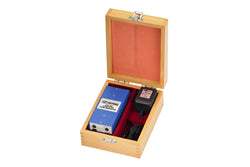
The Com-Power CGC-255E is a battery-operated comb generator designed as a conducted reference signal source for verifying Line Impedance Stabilization Network (LISN) test setups. The unit generates a series of harmonics from a fundamental frequency, producing a comb of spectral lines that simulate an Equipment Under Test (EUT) generating conducted EMI noise. The CGC-255E offers two user-selectable frequency step sizes — 50 kHz and 250 kHz — with usable output extending to 400 MHz.
The primary application of the CGC-255E is quick verification of conducted emissions test setups. It plugs directly into the EUT power socket of a LISN via its NEMA 15-P interface, with conducted noise output levels close to or above the CISPR 22 limits. Beyond LISN verification, the CGC-255E is also suited to production evaluation of components such as cable shields and filters. Because most EMI labs calibrate LISNs, spectrum analyzers, cables, and connectors only at regular intervals, equipment malfunctions occurring between calibrations can go undetected and produce erroneous test results — the comb generator allows test engineers to perform frequent interim verification of the conducted test setup to assure accurate results.
| Specification | Value |
|---|---|
| Intended Application | Reference Signal Source for LISN verification |
| Frequency Range | 50 kHz to 400 MHz |
| Frequency Step Size | 50 kHz or 250 kHz |
| Frequency Stability | 50 ppm |
| Amplitude Stability | ± 0.1 dB |
| Time Stability | <1 dB over 12 months |
| Charger Output / Input | 6 VDC, 500 mA / 110 VAC 60 Hz or 230 VAC 50 Hz |
| Battery Type | 6V NiMH, 1 Ah |
| Operating Time | >18 Hours Typical With Fully Charged Battery |
| External Indicators | Battery Low and Power On |
| LISN Interface Plug | NEMA 15-P type |
| Dimensions | 5 x 2.2 x 2.2 inches / 13.2 x 5.9 x 5.9 cm |
| Weight | 1 lbs / 0.5 kg |
| Warranty | Three-Year Warranty |
Please review the Manufacturer's Data Sheet to verify published specifications. Feedback on this webpage is always welcome — please reach out to your Test Architect at any time for questions or concerns. Thank you, we truly appreciate you being our customer.
Model No
Com-Power
Condition
New
Manufacturer
Com-Power
Frequency
250 MHz


30+ Years in Business

Secure Payments

Sell Test Equipments

Knowledgeable Staff

On-site Lab
30+ Years in Business
Secure Payments
Sell Test Equipments
Knowledgeable Staff
On-site Lab
Request A Quote