Chat Live
 Contact Us
 sales@valuetronics.com


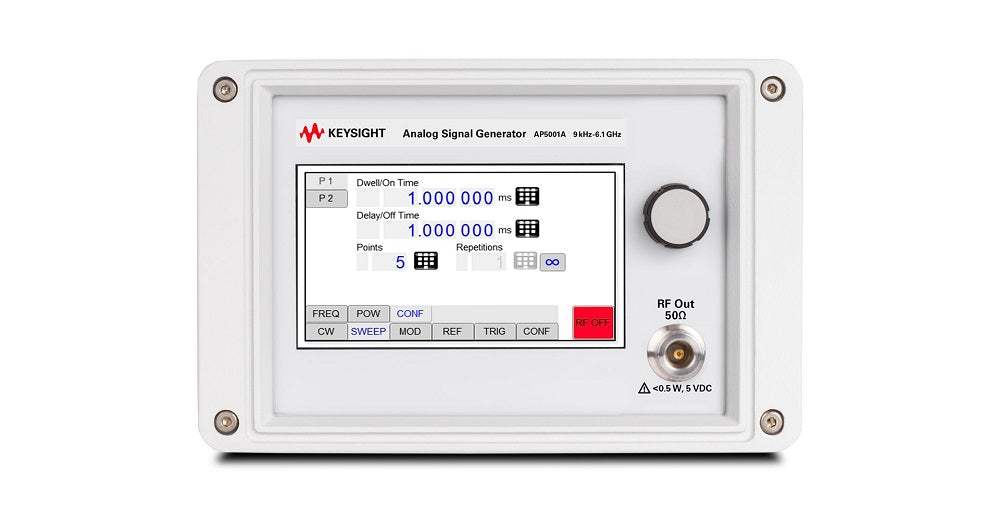
The Keysight AP5001A is an RF analog signal generator that produces continuous-wave and modulated signals across a frequency range beginning at 9 kHz and extending to 2, 4, or 6.1 GHz depending on the configured frequency option. An RF signal generator supplies a known, controllable stimulus — a defined frequency, amplitude, and modulation — that an engineer uses to exercise a device under test and observe its response. The AP5001A delivers this stimulus from a compact, DC-powered chassis weighing 2.5 kg or less, with an N-type RF output on the front panel and a full complement of modulation, sweep, and trigger interfaces on the rear.
As a stimulus source, the AP5001A is built around flexible modulation and sweep capability. It supports amplitude, frequency, phase, and pulse modulation, and these can be enabled simultaneously — for example, AM and FM can run concurrently and modulate the output RF — with the single restriction that frequency and phase modulation cannot be combined. For frequency-agile testing, the instrument performs linear, logarithmic, and random frequency sweeps, as well as a generalized list sweep that allows individual setting of frequency, power, dwell-time, and off-time for each of up to 20,000 points. A trigger-out synchronization mode allows multiple sources to be coordinated together.
ValueTronics stocks and holds its own inventory in a 20,000 sq ft secure warehouse at 1675 Cambridge Drive in Elgin, Illinois, so the instruments we list are equipment we actually keep on hand. That combination of held inventory and hands-on verification of used equipment is what lets us stand behind both the condition and the availability of what we sell.
Keysight Technologies traces its origins to the test-and-measurement business of Hewlett-Packard. That business was spun off as Agilent Technologies in 1999, and in 2014 Agilent's electronic measurement division was established as the independent Keysight Technologies.
The AP5001A is offered as a single instrument platform configured by frequency option. All variants share the same 9 kHz lower frequency limit, the same modulation and sweep architecture, the same LAN and USB control interfaces, and the same compact chassis; they differ in the upper end of their frequency coverage. The frequency option is selected at order time as the -502, -504, or -506, corresponding to upper limits of 2.0, 4.0, and 6.1 GHz respectively.
Beyond the base frequency option, the platform supports the 1E1 step attenuator option and a set of license-key upgrades. The frequency ceiling can be raised in the field — from 2 GHz to 4 GHz, 2 GHz to 6.1 GHz, or 4 GHz to 6.1 GHz — and the step attenuator can likewise be added by license key, so a unit's configuration can evolve without returning hardware.
Each model below links to its own dedicated product page with condition-matched pricing. Whether you select a new unit at one frequency tier or another, the configuration and pricing shown apply to that specific model and condition, so choose the page that matches the frequency option and condition you need.
The primary difference across the family is frequency coverage: the -502 reaches 2.0 GHz, the -504 reaches 4.0 GHz, and the -506 reaches 6.1 GHz, all sharing the 9 kHz lower limit. The comparison table below lists each option's upper frequency limit alongside the shared specifications so the right tier can be matched to the highest frequency the application requires.
A second axis of difference is output level range. In the standard configuration, output power spans -30 dBm to +17 dBm; adding the 1E1 step attenuator (Option 1E1) lowers the minimum settable level to -120 dBm for applications that require low-level signals. Because the frequency tiers and the step attenuator are both available as license-key upgrades, a model's capabilities can be extended after purchase, as reflected in the comparison table.
| Model | Frequency Range | Max Output Power | SSB Phase Noise (1 GHz, 20 kHz offset) |
|---|---|---|---|
| AP5001A | 9 kHz to 2.0 GHz | +17 dBm | -130 dBc/Hz |
Additional differences in specifications beyond the few shown above are not listed here — see each model's full specifications below.
| Specification | Value |
|---|---|
| Frequency Parameters / Range | |
| Frequency range (AP5001A-502) | 9 kHz to 2.0 GHz |
| Frequency range (AP5001A-504) | 9 kHz to 4.0 GHz |
| Frequency range (AP5001A-506) | 9 kHz to 6.1 GHz |
| Resolution | 0.001 Hz (typ.) |
| Phase resolution | 0.1 deg (typ.) |
| Settling time | 20 μs (typ.), 200 μs (max.) |
| Frequency update rate, List/Sweep mode | 400 μs (max.); time from receipt of SCPI command firmware |
| Total jitter | 68 fs RMS (typ.); 10 Hz to 1 MHz BW |
| Reference frequency input | 8 MHz to 200 MHz; user programmable |
| Reference input level | -5 dBm (min.), 0 dBm (typ.), +13 dBm (max.) |
| Lock Range | +/- 1.0 ppm (max.) |
| Reference input impedance | 50 Ω (typ.) |
| Internal reference frequency output | 10 MHz (typ.) |
| Initial accuracy of internal reference | ± 40 ppb (max.); calibrated at 23 ± 3 °C at the time of calibration |
| Temperature stability (0 to 50 °C) | ±100 ppb (max.) |
| Aging 1st year | 0.5 ppm (typ.) |
| Aging per day (after 30 days of operations) | 5 ppb (max.) |
| Warm-Up time | 5 min (typ.) |
| Output of internal reference | +0 dBm, 50 Ω (typ.) |
| Level Performance | |
| Power level, Standard | -30 dBm (min.) to +17 dBm (max.) > 50 MHz and < 6 GHz; +10 dBm (max.) ≤ 50 MHz |
| Power level, Option 1E1 | -120 dBm (min.) to +17 dBm (max.) > 50 MHz and < 6 GHz; +10 dBm (max.) ≤ 50 MHz |
| Resolution | 0.01 dB (typ.) |
| Level uncertainty (-20 to +10 dBm) | ± 0.3 dB (typ.), ± 0.5 dB (max.) |
| Level uncertainty (-80 to -20 dBm) | ± 0.8 dB (typ.), ± 0.8 dB (max.) |
| Level uncertainty (< -80 dBm) | ± 1.3 dB (typ.) |
| Reverse Power Protection and VSWR | |
| Reverse Power Protection, DC Voltage | 5 V (typ.) |
| Reverse Power Protection, RF power | +27 dBm (max.) |
| Output impedance | 50 Ω (typ.) |
| VSWR (< 3 GHz) | 1.5 (typ.), 1.8 (max.) |
| VSWR (> 3 GHz) | 1.7 (typ.), 2.0 (max.) |
| Phase Noise | |
| SSB Phase noise at 1 GHz, at 20 kHz from carrier | -130 dBc/Hz (typ.), -128 dBc/Hz (max.) |
| Spectral Purity | |
| Output harmonics | -40 dBc (typ.), -30 dBc (max.); Pout = +10 dBm |
| Sub-harmonics | -80 dBc (typ.), -70 dBc (max.) |
| Non-harmonic spurious (< 1 MHz) | -70 dBc (typ.), -60 dBc (max.); Pout = +10 dBm |
| Non-harmonic spurious (1 MHz to 5.8 GHz) | -65 dBc (typ.), -55 dBc (max.); Pout = +10 dBm |
| Non-harmonic spurious (5.8 GHz to 6.1 GHz) | -60 dBc (typ.), -50 dBc (max.); Pout = +10 dBm |
| Residual FM at 1 GHz | 3 Hz (0.3 kHz to 3 kHz, weighted ITU-T); 12 Hz (0.03 kHz to 23 kHz) |
| Sweeping Capability | |
| Frequency sweep, Step time (tstep) | 400 μs (min.) to 19998 s (max.) |
| Frequency sweep, Dwell time (tdwell) | 50 μs (min.) to 9999 s (max.) |
| Frequency sweep, Off-time incl. transient time (toff) | 0 / 50 μs (min.) to 9999 s (max.) |
| Frequency sweep, Timing accuracy per point | 1 μs (typ.) |
| Generalized list sweep, List size | 2 (min.) to 20.000 (max.) |
| Generalized list sweep, Step time (tstep) | 200 μs (min.) to 19998 s (max.) |
| Generalized list sweep, Dwell time (tdwell) | 50 μs (min.) to 9999 s (max.) |
| Generalized list sweep, Off-time incl. transient time (toff) | 0 / 50 μs (min.) to 9999 s (max.) |
| Generalized list sweep, Time resolution | 0.1 μs (typ.) |
| Generalized list sweep, Timing accuracy per point | 1 μs (typ.) |
| Pulse Modulation | |
| On/off ratio | 70 dB (typ.) |
| Repetition frequency | DC (min.) to 33 MHz (max.) |
| Pulse width | 30 ns to 20 s (ALC hold); 50 μs to 20 s (ALC on) |
| Pulse rise/fall time | 25 ns (typ.) |
| Pulse train length (pulses) | 2 (min.) to 4,192 (max.) |
| Video crosstalk | -40 dB (typ.) |
| External input threshold | 0.85 V (min.), 0.9 V (typ.), 0.95 V (max.); TTL compatible |
| External input voltage range | -0.5 V (min.) to +5.5 V (max.); TTL compatible |
| External input hysteresis | 60 mV (typ.) |
| Delay (to RF) | 20 ns (typ.), 40 ns (max.) |
| Frequency Modulation | |
| Maximum Frequency deviation (peak) | 0 to 0.05 x f (< 0.25 GHz); 0 to N x 200 MHz where N=0.125 (0.25 to 0.75 GHz), N=0.25 (0.75 to 1.5 GHz), N=0.5 (1.5 to 3 GHz), N=1 (> 3 to 6.1 GHz) |
| Modulation waveforms | Sine, triangle, FSK |
| Modulation rate | 1 Hz/DC (min.) to 800 kHz (max.); -3 dB frequency response; max. phase deviation degrades above 20 kHz modulation rate |
| External input sensitivity | < N x 100 MHz for 1 Vpp; settable in AC mode, discrete values in DC mode |
| Total harmonic distortion | < 1% at 1 kHz rate and N x 100 kHz deviation |
| Frequency Chirps (linear ramp, up/down) | |
| Span | 10% (max.) |
| Dwell time (tchirp) | 10 ns (min.) to 60 s (max.) |
| Slope | 100 MHz/μs (max.) |
| Total duration of finite repeated chirps (tchirp x repetitions) | 64.1 s (max.) |
| Number of frequencies | 20,000 (max.) |
| Phase Modulation | |
| Phase deviation (peak) | 0 to N x 80 rad |
| Modulation rate | 1 Hz (min.) to 800 kHz (max.); > -3 dB frequency response |
| Modulation waveforms | Sine, triangle, FSK |
| External Input sensitivity | N x 40 rad for 1 Vpp |
Important: Reverse power protection is rated to a maximum of 5 V DC and +27 dBm of RF.
Important: Sweeps can be performed with combined internal or external AM/FM/PM/pulse modulation running. With modulation enabled, the minimum step time increases to 2 ms.
Important: All modulation types (FM, PM, AM, and pulse modulation) may be enabled simultaneously except that FM and phase modulation cannot be combined.
Important: Specifications describe the warranted performance for 23 ± 5 °C after a 30-minute warm-up period (unless otherwise stated).
This is a brand-new, factory-sealed unit, supplied exactly as it arrives from the manufacturer and backed by the full manufacturer warranty. For the exact configuration, available options, included accessories, or current lead time for your application, our Test Architects can confirm the details before you order.
ValueTronics supplies both new and used test and measurement equipment. New units ship factory-sealed, exactly as received from the manufacturer; every used unit is inspected and functionally verified in-house at our 20,000 sq ft secure facility in Elgin, Illinois before it ships. Our Test Architects can help you select the condition, calibration, and configuration that fit your application.
Please review the Manufacturer's Data Sheet to verify published specifications. Feedback on this webpage is always welcome — please reach out to your Test Architect at any time for questions or concerns. Thank you, we truly appreciate you being our customer.
Model No
Keysight
Condition
Factory New
Manufacturer
Keysight
Rf_gen_freq
9 kHz to 2 GHz


30+ Years in Business

Secure Payments

Sell Test Equipments

Knowledgeable Staff

On-site Lab
30+ Years in Business
Secure Payments
Sell Test Equipments
Knowledgeable Staff
On-site Lab
Request A Quote