Chat Live
 Contact Us
 sales@valuetronics.com


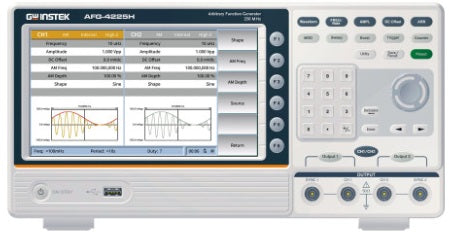
The GW Instek AFG-4000 Series is a family of arbitrary function generators spanning 25 MHz to 250 MHz of bandwidth, offered in both single-channel (AFG-4125E, AFG-4125AE) and dual-channel configurations (AFG-4225E, AFG-4235, AFG-4260, AFG-4280, AFG-4210H, AFG-4225H). Every model in the series provides 1 µHz frequency resolution across its full bandwidth, with built-in standard waveforms including sine, square, triangle, ramp, pulse, noise, harmonic, and arbitrary waves, plus a comprehensive modulation library.
The series is positioned by the datasheet for educational institutions, automotive electronics, and electronic products and parts development. The integrated modulation set — AM, DSB-AM, FM, PM, PWM, ASK, PSK, BPSK, QPSK, FSK, 3FSK, 4FSK, OSK, and SUM — combined with sweep, burst, and counter functions makes the AFG-4000 Series a flexible stimulus source for stimulus-response benches, classroom signal-generation curricula, and component-level automotive electronics test.
GW Instek is the test and measurement brand of Good Will Instrument Co., Ltd., a Taiwan-based instrument manufacturer founded in 1975 and headquartered in New Taipei City. The company has operated continuously under the GW Instek brand and has not undergone the kind of corporate-name evolution seen with brands such as HP/Agilent/Keysight.
The AFG-4000 Series is structured as a tiered arbitrary function generator family covering bandwidths from 25 MHz to 250 MHz. The datasheet defines a clear three-tier architecture: entry-level 25 MHz models (AFG-4125E, AFG-4125AE, AFG-4225E) at 125 MSa/s and 14-bit resolution; mid-range 35 MHz to 100 MHz models (AFG-4235, AFG-4260, AFG-4280, AFG-4210H) at 500 MSa/s and 16-bit resolution; and the flagship AFG-4225H at 250 MHz, 1.25 GSa/s, and 16-bit resolution.
Beyond raw bandwidth, the family is differentiated by channel count, arbitrary waveform memory depth, communication interfaces, and touch screen support. All members of the family share the same 1 µHz frequency resolution, the same 8-inch TFT display platform, and the same built-in modulation, sweep, burst, and counter functions documented in the datasheet.
Each new AFG-4000 Series model linked below is its own dedicated product page with condition-matched pricing, inventory status, and supporting documentation. Review the specific model page for the bandwidth, channel count, sample rate, memory length, and interface set that matches the application requirement.
The AFG-4000 Series progression follows three primary axes documented in the datasheet's specification table. First, sine-wave bandwidth steps from 25 MHz (AFG-4125E, AFG-4125AE, AFG-4225E) through 35 MHz (AFG-4235), 60 MHz (AFG-4260), 80 MHz (AFG-4280), 100 MHz (AFG-4210H), and up to 250 MHz (AFG-4225H). Second, sample rate scales correspondingly: 125 MSa/s on the entry tier, 500 MSa/s on the 35–100 MHz mid-range, and 1.25 GSa/s on the AFG-4225H. Third, amplitude resolution improves from 14 bits on entry models to 16 bits on every model from AFG-4235 upward.
Additional differentiators captured in the comparison table that follows include channel count (AFG-4125E and AFG-4125AE are single-channel; all other models are dual-channel), arbitrary memory length (16 k points per channel on AFG-4125E/4125AE versus 10 M points per channel on AFG-4225E through AFG-4225H), touch screen support (available on AFG-4235 and above), LAN interface availability (AFG-4235 and above), and the built-in power amplifier function unique to the AFG-4125AE. Use the table below to align bandwidth, sample rate, memory, and interface requirements to the specific AFG-4000 Series model.
| Model | Channels | Max Frequency (Sine) | Sample Rate |
|---|---|---|---|
| AFG-4225H | 2 | 250 MHz | 1.25 GSa/s |
| AFG-4125E | 1 | 25 MHz | 125 MSa/s |
| AFG-4125AE | 1 | 25 MHz | 125 MSa/s |
| AFG-4225E | 2 | 25 MHz | 125 MSa/s |
Additional differences in specifications beyond the few shown above are not listed here — see each model's full specifications below.
| Specification | AFG-4125E | AFG-4125AE | AFG-4225E | AFG-4235 | AFG-4260 | AFG-4280 | AFG-4210H | AFG-4225H |
|---|---|---|---|---|---|---|---|---|
| Channels | ||||||||
| Channels | 1 | 1 | 2 | |||||
| Waveforms | ||||||||
| Waveforms | Sine, Square, Triangle, Ramp, Pulse, Noise, Harmonic wave, Arbitrary wave | |||||||
| Arbitrary Functions | ||||||||
| ARB Function | Built-in | |||||||
| Sample Rate (*1) | 125 MSa/s | 500 MSa/s | 1.25 GSa/s | |||||
| Repetition Rate (Arbitrary Wave) | 15 MHz | 30 MHz | 30 MHz | |||||
| Waveform Length | 2 to 16 K points | 2 to 10 M points | ||||||
| Amplitude Resolution | 14 bits | 16 bits | ||||||
| Minimum Rise and Fall Time | < 10 ns | < 8 ns | < 5 ns | |||||
| Jitter | 8 ns | |||||||
| Non-Volatile Memory | ||||||||
| Non-Volatile Memory | 32 MB | |||||||
| User-defined Output Section | From point 2 to 16,384 | From point 2 to 10,240,000 | ||||||
| User-defined Output Marker Section | From point 2 to 16,384 | From point 2 to 10,240,000 | ||||||
| Output Mode | 1 to 1,000,000 cycles or infinite mode | |||||||
| Frequency Characteristics | ||||||||
| Sine | 25 MHz | 35 MHz | 60 MHz | 80 MHz | 100 MHz | 250 MHz | ||
| Square | 5 MHz | 30 MHz | 50 MHz | |||||
| Pulse | 5 MHz | 15 MHz | 25 MHz | |||||
| Triangle, Ramp | 1 MHz | 3 MHz | 5 MHz | |||||
| Noise (-3 dB) | 25 MHz BW | 35 MHz BW | 60 MHz BW | 80 MHz BW | 100 MHz BW | 120 MHz BW | ||
| Harmonic Wave | 12.5 MHz | 17.5 MHz | 30 MHz | 40 MHz / 50 MHz | 125 MHz | |||
| Resolution | 1 μHz or 10 significant figures | |||||||
| Accuracy Stability | ±2 ppm at 25 °C ± 5 °C | ±1 ppm at 0 to 40 °C | ||||||
| Aging | ±1 ppm, per 1 year | |||||||
| Tolerance | ±1 ppm | |||||||
| Output Characteristics (*2) | ||||||||
| Output Amplitude (Into 50 Ω) | 1 mVpp to 10 Vpp, for ≤ 25 MHz; 1 mVpp to 5 Vpp, for ≤ 60 MHz; 1 mVpp to 2.3 Vpp, for ≤ 100 MHz | 1 mVpp to 10 Vpp, for ≤ 40 MHz; 1 mVpp to 5 Vpp, for ≤ 80 MHz; 1 mVpp to 2.5 Vpp, for ≤ 120 MHz; 1 mVpp to 1 Vpp, for ≤ 250 MHz | ||||||
| Output Amplitude (Open-circuit) | 2 mVpp to 20 Vpp, for ≤ 25 MHz; 2 mVpp to 10 Vpp, for ≤ 60 MHz; 2 mVpp to 5 Vpp, for ≤ 100 MHz | 2 mVpp to 20 Vpp, for ≤ 40 MHz; 2 mVpp to 10 Vpp, for ≤ 80 MHz; 2 mVpp to 5 Vpp, for ≤ 120 MHz; 2 mVpp to 2 Vpp, for ≤ 250 MHz | ||||||
| Bandwidth Flatness | ≤10 MHz: ±0.2 dB; ≤60 MHz: ±0.3 dB; ≤100 MHz: ±0.5 dB; (relative to 100 kHz Sine wave, 1 Vpp, 50 Ω) | ≤10 MHz: ±0.2 dB; ≤60 MHz: ±0.3 dB; ≤100 MHz: ±0.5 dB; ≤160 MHz: ±1 dB; ≤250 MHz: ±1.5 dB; (relative to 1 kHz Sine wave, 1 Vpp, 50 Ω) | ||||||
| Accuracy | ±(2% of setting + 1 mVpp) (1 kHz sine, 0 V offset, >10 mVpp) | |||||||
| Resolution | 0.1 mVpp or 4 digits (The amplitude ≥ 1 Vpp is 1 mVpp) | |||||||
| Output Impedance | 50 Ω (Typical) | |||||||
| Output Protection | Short circuit protection, the output will be automatically turned off when overloaded | |||||||
| DC Offset Range | ± (10 Vpk − Amplitude Vpp / 2) (High resistance) | ± (1 % of |setting| + 5 mV + amplitude Vpp * 0.5 %) | ||||||
| DC Offset Accuracy | ± (3 % of |setting| + 5 mV + amplitude Vpp * 0.5 %) | ± (1 % of |setting| + 5 mV + amplitude Vpp * 0.5 %) | ||||||
| DC Offset Resolution | 0.1 mVpp or 4 digits (The amplitude > 1 Vpp is 1 mVpp) | |||||||
| Sine Wave Characteristics | ||||||||
| Harmonic Distortion (*3) | DC to 1 MHz: <-65 dBc; 1 MHz to 10 MHz: <-60 dBc; 10 MHz to 60 MHz: <-55 dBc; 60 MHz to 100 MHz: <-50 dBc Typical (0 dBm) | DC to 1 MHz: <-65 dBc; 1 MHz to 10 MHz: <-60 dBc; 10 MHz to 120 MHz: <-50 dBc; 120 MHz to 250 MHz: <-45 dBc Typical (0 dBm) | ||||||
| Total Harmonic Distortion | < 0.05%, 10 Hz to 20 kHz, 1 Vpp | |||||||
| Non-harmonic Distortion | ≤10 MHz: <-70 dBc; >10 MHz: <-70 dBc + 6 dB/sound interval; Typical (0 dBm) | |||||||
| Phase Noise | 10 MHz: ≤-110 dBc/Hz Typical (0 dBm, 10 kHz offset) | |||||||
| Square Wave Characteristics | ||||||||
| Rise/Fall Time | < 30 ns | < 8 ns | < 5 ns | |||||
| Overshoot | Typical (100 kHz, 1 Vpp) < 5 %, (1 Vpp, 50 Ω) | Typical (100 kHz, 1 Vpp) < 3 %, (1 Vpp, 50 Ω) | ||||||
| Duty Cycle | 50.00 % (fixed) | |||||||
| Ramp Wave Characteristics | ||||||||
| Linearity | < 0.1 % of peak output (typical 1 kHz, 1 Vpp, symmetry 50 %) | |||||||
| Symmetry | 0.0 % to 100.0 % | |||||||
| Pulse Wave Characteristics |
Please review the Manufacturer's Data Sheet to verify published specifications. Feedback on this webpage is always welcome — please reach out to your Test Architect at any time for questions or concerns. Thank you, we truly appreciate you being our customer.
Model No
GW
Condition
New
Manufacturer
Instek
Frequency
250 MHz


30+ Years in Business

Secure Payments

Sell Test Equipments

Knowledgeable Staff

On-site Lab
30+ Years in Business
Secure Payments
Sell Test Equipments
Knowledgeable Staff
On-site Lab
Request A Quote