Chat Live
 Contact Us
 sales@valuetronics.com


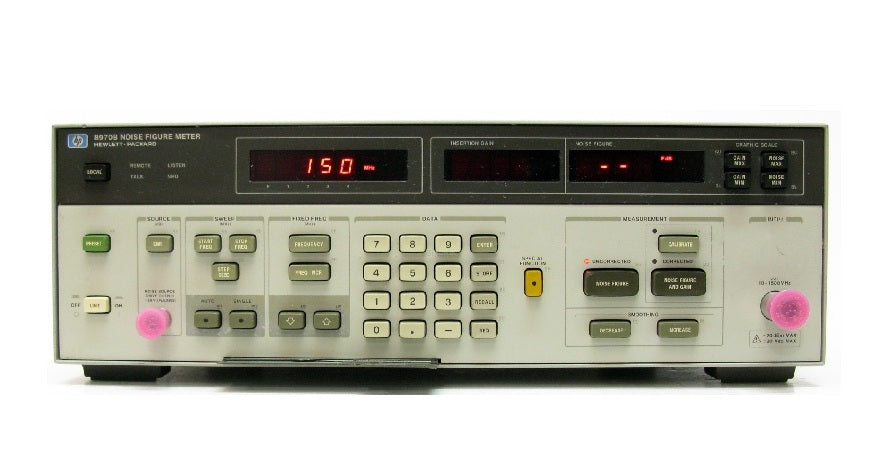
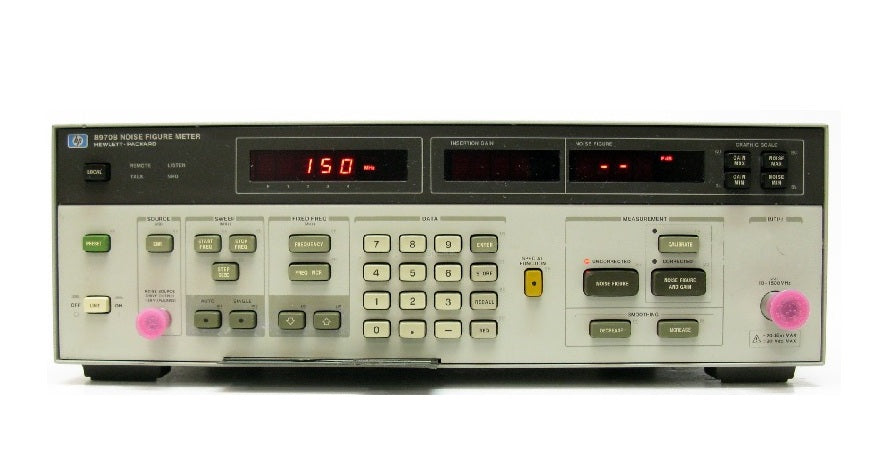
The HP 8970B Noise Figure Meter is a dedicated noise figure measurement instrument that tunes its input from 10 to 1600 MHz (extendable to 2047 MHz with Option 020) and automates the complete noise figure measurement sequence. The instrument tunes the input frequency, controls an external local oscillator for receiver or microwave measurements, drives the noise source on and off, makes the noise power measurements, calculates the noise figure, removes the effects of the measurement system's own noise, compensates for losses before or after the device under test, and displays the result in noise figure, effective noise temperature, or Y factor.
Applications listed in the product literature include amplifier characterization with simultaneous noise figure and gain measurement, transistor measurements using tuners with single-sideband accuracy, receiver testing with tunable IF and external LO control, and mixer characterization showing simultaneous noise figure and conversion loss. The instrument supports real-time, swept, corrected oscilloscope output for tuning work and produces permanent hard-copy plots of noise figure and gain versus frequency through a digital plotter connected over the System Interface Bus.
ValueTronics International, LLC stocks, inspects, and ships legacy and current test equipment from our 20,000 square foot secure warehouse at 1675 Cambridge Drive, Elgin, Illinois. For an instrument like the HP 8970B — where the test and measurement community has decades of installed base, where specific model compatibility (HP 8971C test sets, HP 346A/B/C noise sources, the recommended synthesized LO list) matters more than catalog newness, and where a unit that arrives uncalibrated or with incorrect IF cal data is unusable — sourcing through a stocking dealer that physically holds and verifies inventory removes the variables that pure pass-through brokers cannot resolve. We can confirm what is in the box, what the input SWR looks like at power-on, and whether the noise source drive and IF output behave as the operating manual describes before the unit ships.
Hewlett-Packard's test and measurement business was spun off as Agilent Technologies in 1999. The electronic measurement portion of Agilent was subsequently separated into Keysight Technologies in 2014. HP-branded noise figure instruments such as the 8970B therefore trace through Agilent to today's Keysight test and measurement portfolio.
The HP 8970 series is a noise figure measurement family built around the HP 8970B Noise Figure Meter as the controller and display instrument. By itself the HP 8970B handles 10 to 1600 MHz (or 10 to 2047 MHz with Option 020). The HP 8971C Noise Figure Test Set adds microwave downconversion with a YIG-tuned filter and an optional built-in low-noise preamplifier, allowing the HP 8970B to measure noise figure from 10 MHz to 26.5 GHz when combined with a suitable local oscillator.
Two pre-defined system configurations are offered: the HP 8970S, which is a user-configurable combination of the HP 8970B, an HP 8971C (with the customer's chosen options), and a synthesized LO selected from the recommended source list; and the HP 8970V, which is a pre-configured 10 MHz to 20 GHz system consisting of the HP 8970B, HP 8971C, and HP 83711B Synthesized CW Generator.
Each model on this datasheet is listed on its own product page with pre-owned-matched pricing. Buyers who need only the 10 to 1600 MHz (or 2047 MHz with Option 020) measurement capability typically choose the HP 8970B alone; buyers who need microwave coverage add the HP 8971C and an LO, either by configuring an HP 8970S or by ordering the pre-defined HP 8970V.
Within the family the HP 8970B is the controller — it is the instrument that displays results, runs the GPIB and System Interface Bus, stores the ENR tables, and drives the noise source. Whether the application is RF-only or extends to 26.5 GHz, the HP 8970B is the common element; the HP 8971C and LO selection determine the upper frequency limit and the test port configuration.
The principal differences between configurations are frequency coverage and system completeness. The HP 8970B standalone covers 10 to 1600 MHz (2047 MHz with Option 020). The HP 8970S extends specified operation to 10 MHz to 26.5 GHz with the HP 8971C and a recommended synthesized LO; the upper frequency in any given HP 8970S build is set by the LO selected. The HP 8970V is fixed at 10 MHz to 20 GHz because it ships with the HP 83711B.
The HP 8971C itself is offered in three variants per the datasheet: standard, Option 001 (adds internal LO power amp, reducing required LO input from +7 dBm to +1 dBm — typically required above 20 GHz or where there is LO cabling loss), and Option 002 (deletes the built-in low-noise RF preamp, intended for measuring high-gain devices or when the user supplies their own preamplifier). The comparison table that follows summarizes how these choices map to frequency range, noise figure, input SWR, and LO drive requirements.
| Model | Type | Frequency Range | Noise Figure Measurement Range |
|---|---|---|---|
| 8970B | Noise Figure Meter | 10 to 1600 MHz (10 to 2047 MHz with Option 020) | 0 to 30 dB |
| 8971C | Noise Figure Test Set | 10 MHz to 26.5 GHz | — |
| 8970S | Measurement System (configurable) | 10 MHz to 26.5 GHz (upper frequency limited by LO selected) | 0 to 30 dB |
| 8970V | Pre-configured Measurement System | 10 MHz to 20 GHz | 0 to 30 dB |
Additional differences in specifications beyond the few shown above are not listed here — see each model's full specifications below.
| Specification | Value |
|---|---|
| Noise Figure Measurement | |
| Measurement range | 0 to 30 dB |
| Instrumentation uncertainty | ±0.1 dB (for a 14 to 16 dB ENR noise source in a 0 to 55°C environment) |
| Resolution | 0.01 dB (0.001 dB over GPIB) |
| Gain Measurement | |
| Measurement range | -20 to >+40 dB (for DUT and system noise figures totalling 30 dB or less) |
| Instrumentation uncertainty | ±0.15 dB |
| Resolution (Gain >-9.99 dB) | 0.01 dB |
| Resolution (Gain <-9.99 dB) | 0.1 dB |
| Input Specifications | |
| Frequency range | Tunable from 10 to 1600 MHz (10 to 2047 MHz with Option 020) |
| Tuning accuracy (for 10 to 40°C) | ±(1 MHz + 1% of frequency); 6 MHz maximum |
| Frequency resolution | 1 MHz |
| Noise figure (for input power levels below -60 dBm) | <7 dB + 0.003 dB/MHz (<7 dB + 0.002 dB/MHz with Option 020) |
| Input SWR (50 ohm reference) | <1.7 (10 MHz to 1600 MHz); <1.8 with Option 020; <2.0 (1600 MHz to 2047 MHz, Option 020 only) |
| Maximum operating input power | -10 dBm |
| Maximum net external gain | >65 dB between noise source and HP 8970B RF input |
| Electromagnetic Compatibility | |
| EMI | Conducted and radiated interference in compliance with MIL-STD-461B CE03, RE02, EN55011 Class A (1991) and CISPR Class A (1990) |
| Conducted and radiated susceptibility | Meets MIL-STD-461B-1980, CS01/CS02, RS03 and EN50082-1 (1991) (IEC 801-2, 801-3 and 801-4) |
| General | |
| Noise source drive | 28.0 ±0.1 V for noise source ON (up to 60 mA peak); <1 V for noise source OFF |
| GPIB capability | SH1, AH1, T5, TE0, L4, LE0, SR1, RL1, PP0, DC1, DT1, C0, E1 |
| Operating temperature | 0 to 55°C |
| Storage temperature | -55 to 75°C |
| Connectors | RF input: N(f); noise source drive: BNC(f) |
| Power | 100, 120, 220, or 240 V (±5%, -10%); 48-66 Hz; 150 VA maximum |
| Net weight | 15.5 kg (34 lb) |
| Shipping weight | 18.5 kg (40 lb) |
| Dimensions | 143H x 425W x 467D mm (5.68 x 16.75 x 18.38 in.) |
| Supplemental Characteristics | |
| Bandwidth | Approximately 4 MHz |
| Sensitivity | -100 dBm (no external gain required; able to measure its own noise figure) |
| Measurement speed | 6 to 9 measurements per second with minimum smoothing |
| Sweep speed at minimum smoothing (10 to 1600 MHz) | 140 ms per frequency point |
| Jitter at minimum smoothing | Peak-to-peak Y-factor variation <0.15 dB (typical) |
| Jitter with increased smoothing | Peak-to-peak Y-factor variation <0.02 dB (for smoothing factor of 64) (typical) |
| Maximum safe input level | ±20 Vdc; +20 dBm peak (or average) at RF |
| Audible noise level | <5.5 bels at 1 meter |
| Functional Properties | |
| Noise figure display units | Noise Figure: dB, ratio; Uncorrected Y factor: dB, ratio; Effective Input Noise Temperature: K |
| Displayed measurement frequency range | 10 to 99,999 MHz |
| Noise figure display jitter | <0.01 dB (with appropriate smoothing) |
| Cold noise source data range | 0 to 9999 K |
| Hot noise source data range | ENR from -7 to +50 dB; spot Thot from 0 to >2.9x10^7 K |
| Number of calibration points in one sweep | 181 |
| Storage capacity of hot noise source tables | 4 stored ENR tables with 35 frequencies each (plus 1 working ENR table) |
| Compatible digital plotters | HP 7470A, HP 7475A, HP 7550A, HP 7440A, HP 9872B |
Please review the Manufacturer's Data Sheet to verify published specifications. Feedback on this webpage is always welcome — please reach out to your Test Architect at any time for questions or concerns. Thank you, we truly appreciate you being our customer.
Model No
HP
Condition
Used
Manufacturer
Agilent
Frequency
1.6 GHz
20
Extends upper frequency from 1600 to 2047 MHz
H18
1800 MHz Frequency range
UK6
Commercial calibration with test results data


30+ Years in Business

Secure Payments

Sell Test Equipments

Knowledgeable Staff

On-site Lab
30+ Years in Business
Secure Payments
Sell Test Equipments
Knowledgeable Staff
On-site Lab
Request A Quote