Chat Live
 Contact Us
 sales@valuetronics.com


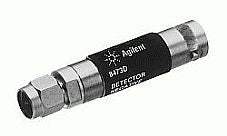
The Agilent 8473D is a Planar-Doped Barrier (PDB) detector covering 10 MHz to 33 GHz, with typical performance extending to 40 GHz. The detector combines characteristics of point-contact and low-barrier Schottky diodes through PDB diode technology, delivering broadband flatness, square-law response, and low SWR in a single rugged package.
Detectors of this class convert RF and microwave signal power into a proportional DC video voltage, enabling power measurement, signal monitoring, leveling loops, and ALC feedback in broadband test setups. The 8473D's square-law response across its operating range supports accurate relative power measurements, while the wide frequency coverage allows a single detector to serve applications spanning HF through Ka-band.
Hewlett-Packard's test and measurement business was spun out as Agilent Technologies in 1999, and Agilent's electronic measurement division was then transferred to Keysight Technologies in 2014. Instruments and components carrying the Agilent label, including the 8473D, originate from this lineage and remain widely deployed in active service.
The 8473D is the 33 GHz member of Agilent's Planar-Doped Barrier detector family. PDB diode technology was developed to provide the broadband flatness and low SWR of a low-barrier Schottky alongside the square-law response and sensitivity associated with point-contact detectors, in a single rugged coaxial package.
Within this family, models differ primarily by frequency coverage and connector interface, with the underlying PDB diode architecture and square-law detection characteristic shared across the line. The 8473D's APC-3.5 male input positions it for microwave applications extending into Ka-band, where its ±0.4 dB flatness through 26.5 GHz and ±1.25 dB flatness across the full 33 GHz span are the defining performance attributes.
Each model below is its own dedicated product page. Configurations and condition grades are evaluated per unit, and the pre-owned units we list reflect what our technicians measured during inspection — not generic catalog descriptions.
The 8473D specifically targets applications requiring coverage from below 1 GHz through 33 GHz in a single detector, with the option of positive output polarity via Option 003 for systems where that convention is required. Standard configuration delivers negative output.
When comparing PDB detectors across the family, the primary axes of differentiation are upper frequency limit, RF connector type, and the resulting SWR and flatness performance across each segment of the band. The 8473D's specification table breaks performance into three frequency ranges — through 14 GHz, through 26.5 GHz, and through 33 GHz — allowing direct comparison against detectors covering narrower or wider spans.
See the comparison table below for the configurations we currently stock from this family. Output polarity, connector type, and frequency coverage are the key columns to evaluate against your application.
| Model | Frequency Range | Frequency Response | Max Operating Input |
|---|---|---|---|
| 8473D | 0.01 to 33.0 GHz | ±1.25 dB (0.01 to 33.0 GHz) | 200 mW |
Additional differences in specifications beyond the few shown above are not listed here — see each model's full specifications below.
| Specification | Value |
|---|---|
| Frequency range | 0.01 to 33.0 GHz (Below 1 GHz RF may leak through the video connector; if objectionable, this may be eliminated with a low pass filter.) |
| Frequency response | ±0.25 dB (0.01 to 14.0 GHz); ±0.4 dB (0.01 to 26.5 GHz); ±1.25 dB (0.01 to 33.0 GHz); ±2.0 dB typical to 40 GHz |
| SWR | 1.2 (0.01 to 14 GHz); 1.4 (14 to 26.5 GHz); 3.0 (26.5 to 33.0 GHz); 3.0 typical to 40 GHz |
| Low level sensitivity | > 0.4 mV/mW |
| Maximum operating input | 200 mW |
| Typical short-term maximum input (less than 1 minute) | 1 watt |
| Noise (peak to peak with CW power applied to produce 100 mV output, 400 kHz BW) | < 50 mV |
| Output polarity (Standard) | Negative |
| Output polarity (Option 003) | Positive |
| RF connector | APC-3.5 Male (SMA compatible) |
| Output connector | BNC (Female) |
| Operating temperature | -65° C to +100° C (Tested only to 50,000 ft / 15,240 m, capable of much higher performance.) |
| Temperature cycling | MIL-STD-883, Method 1010.1 (-65° C to +100° C) |
| Measurement conditions | Measured at 25° C and -20 dBm unless otherwise specified. |
Please review the Manufacturer's Data Sheet to verify published specifications. Feedback on this webpage is always welcome — please reach out to your Test Architect at any time for questions or concerns. Thank you, we truly appreciate you being our customer.
Model No
Agilent
Condition
Used
Manufacturer
Agilent
Frequency
33 GHz


30+ Years in Business

Secure Payments

Sell Test Equipments

Knowledgeable Staff

On-site Lab
30+ Years in Business
Secure Payments
Sell Test Equipments
Knowledgeable Staff
On-site Lab
Request A Quote