 Chat Live
 Contact Us
 sales@valuetronics.com



🎓 Request a Quote To Get An EDU Discount
Couldn't load pickup availability
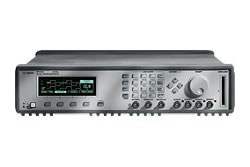
The Agilent 81110A is a pulse pattern generator from the 81100 family, designed to generate the standard pulses and digital patterns needed for testing digital designs and components across current logic technologies including CMOS, TTL, LVDS, and ECL. As a mainframe instrument, the 81110A accepts one or two output modules — the 81111A (165 MHz, 10 V) or the 81112A (330 MHz, 3.8 V differential) — allowing the configuration to match the specific frequency, voltage, and connector requirements of the test application.
The 81110A is used for testing digital designs and components, generating stimuli for current logic technologies (CMOS, TTL, LVDS, ECL), simulation of reflections and distortions, and generation of three-level and four-level codes. Pattern mode supports user-defined data sequences up to 16 kbit per channel as well as pseudo-random binary sequences, making the instrument suitable for both deterministic stimulus generation and statistical bit-pattern testing. With dual output modules, multi-level and multi-timing signals can be created using the internal channel addition feature.
ValueTronics International has supported the test and measurement community since 1992 from our 20,000 sq ft secure warehouse at 1675 Cambridge Drive, Elgin, Illinois. Unlike drop-shippers and pass-through brokers, we physically stock, inspect, and test instruments in-house before they ship. The 81110A and other 81100-family mainframes and output modules are evaluated by our technicians, and condition reports document what we found against the manufacturer's published specifications. Calibration upgrade paths are available with each unit for customers whose quality systems require NIST-traceable or accredited calibration documentation.
Hewlett-Packard's test and measurement business was spun off as Agilent Technologies in 1999, then transferred to Keysight Technologies in 2014. Instruments such as the 81110A bearing the Agilent brand are part of this continuous lineage. The 81100 family pulse pattern generators continue to be supported through the Keysight service organization for calibration and repair where applicable.
The Agilent 81100 family of pulse pattern generators spans six mainframe-and-module configurations covering frequency ranges from 1 mHz to 660 MHz. The family is organized around four mainframes — the 81101A (single channel, 50 MHz), the 81104A (one or two channels, 80 MHz), the 81110A (one or two channels, 165 or 330 MHz depending on output module), and the 81130A (one or two channels, 400 or 660 MHz depending on output module).
All members of the 81100 family share form/fit compatibility and offer pattern mode operation from 80 MHz upward, including pseudo-random binary sequence generation. The output modules within each mainframe are user-retrofittable, which allows configuration changes without returning the mainframe to the factory. Dual-channel instruments can be configured with channel addition — analog summing on the 81101A/81104A/81110A modules, and EXOR digital combination on the 81130A modules — to create multi-level signals or higher effective data rates from a single instrument.
Each pre-owned 81100-family model below links to its own product page with condition-matched pricing and configuration. Mainframes and output modules are listed separately where applicable, and the compatibility constraint of matching module types within a dual-channel mainframe applies to all configurations.
The 81110A specifically occupies the 165–330 MHz tier in the 81100 family. It is the configuration of choice when the application requires pattern mode operation above 80 MHz with sub-nanosecond timing resolution, but where the 400/660 MHz data-generator architecture of the 81130A is not required. The 81110A retains variable pulse parameters in both pulse and pattern mode, which the 81130A does not.
The primary differences across the 81100 family are frequency range, channel count, timing resolution, and output module voltage. The 81101A is the entry tier at 50 MHz with a single fixed channel and 10 V amplitude. The 81104A extends to 80 MHz with one or two channels at 10 V. The 81110A reaches 165 MHz with the 81111A module (10 V, variable transitions) or 330 MHz with the 81112A module (3.8 V differential, selectable 800 ps or 1.6 ns transitions).
The 81101A, 81104A, and 81110A all support dropout-free and glitch-free timing changes; the 81130A does not. The 81130A trades this for higher-frequency operation, deeper pattern memory with sequencing and looping, and four selectable output formats (RZ, NRZ, DNRZ, R1). For applications requiring smooth parameter sweeps during measurement, the 81101A/81104A/81110A are the appropriate choice. For applications requiring the highest data rates and most complex pattern structures, the 81130A is appropriate.
| Model | Frequency Range | Channels | Amplitude Range |
|---|---|---|---|
| 81110A | 1 mHz to 165/330 MHz | 1 or 2 | 100 mV to 20.0 V (81111A) / 100 mV to 3.8 V (81112A) |
| 81101A | 1 mHz to 50 MHz | 1 | 100 mV to 20.0 V |
| 81104A | 1 mHz to 80 MHz | 1 or 2 | 100 mV to 20.0 V |
| 81130A | 1 kHz to 400/660 MHz | 1 or 2 | 100 mV to 3.8 V (81131A) / 100 mV to 2.5 V (81132A) |
Additional differences in specifications beyond the few shown above are not listed here — see each model's full specifications below.
| Specification | Agilent 81110A with 81111A (165 MHz) | Agilent 81110A with 81112A (330 MHz) |
|---|---|---|
| Frequency range | 1 mHz to 165 MHz (Up to 60 MHz typ. from 1 kΩ) | 1 mHz to 330 MHz |
| Timing resolution | 3.5 digits, 5 ps best case | 3.5 digits, 5 ps best case |
| Period range | 12.5 ns to 999.5 s | 12.5 ns to 999.5 s |
| Period RMS jitter (PLL) | 0.001% + 15 ps | 0.001% + 15 ps |
| Period RMS jitter (VCO) | 0.01% + 15 ps | 0.01% + 15 ps |
| Accuracy (PLL) | ± 0.01% (± 0.5% typ. after self-cal., ± 3% without self-cal.) | ± 0.01% (± 0.5% typ. after self-cal., ± 3% without self-cal.) |
| Width range | 3.03 ns to (period - 3.03 ns) | 1.515 ns to (period - 1.515 ns) |
| Width accuracy | ± 0.5% ± 250 ps typ. after self-cal.; ±3% ± 250 ps | ± 0.5% ± 250 ps typ. after self-cal.; ±3% ± 250 ps |
| Jitter (RMS) | 0.01% +15 ps | 0.01% +15 ps |
| Add. variable delay range | 0 ns to (period -3.03 ns) | 0 ns to (period -3.03 ns) |
| Delay accuracy | ± 0.5% ± 0.5 ns typ.; ± 3% ± 0.5 ns after self-cal. | ± 0.5% ± 0.5 ns typ.; ± 3% ± 0.5 ns after self-cal. |
| Double pulse delay range | 6.06 ns to (period - width - 3.03 ns); min period 12.2 ns (82 MHz) typ. | 3.03 ns to (period - width - 1.5 ns); 6.06 ns (165 MHz) typ. |
| Double pulse delay accuracy | ± 0.5% ± 150 ps typ.; ± 3% ± 150 ps after self-cal. | ± 0.5% ± 150 ps typ.; ± 3% ± 150 ps after self-cal. |
| Transition time range (10/90) | 2 ns to 200 ms variable; ≤ 2 ns/1.4 ns typ. for ECL levels (20/80) | 800 ps or 1.6 ns selectable; ≤ 600 ps for Vpp ≤ 1 V; 450 ps typ. for ECL levels (20/80); ≤ 900 ps for Vpp > 1 V |
| Transition accuracy | ± 10% ± 200 ps typ.; ± 10% ± 400 ps | ± 10% ± 200 ps typ.; ± 10% ± 400 ps |
| Linearity | 3% typ. for transitions > 100 ns | N/A |
| Amplitude (50 Ω into 50 Ω) | 100 mVpp to 10.0 Vpp | 100 mVpp to 3.8 Vpp |
| Level window (50 Ω) | -10.0 V to +10.0 V | -2.0 V to 3.8 V |
| Level window (1 kΩ) | -20.0 V to +20.0 V | N/A |
| Level accuracy (50 Ω) | ± (1% + 50 mV) | ± (2% + 50 mV) |
| Level accuracy (1 kΩ) | ± (1% + 100 mV) | N/A |
| Resolution (50 Ω / 1 kΩ) | 10 mV / 20 mV | 10 mV / N/A |
| Output connectors | BNC single-ended | BNC differential |
| Source impedance | Selectable 50 Ω or 1 kΩ | 50 Ω only |
| Max. external voltage | ± 24 V | -2.2 V to +5.5 V |
| Short circuit current | ±400 mA max. (doubles for channel addition) | -84 mA to +152 mA |
| Dynamic crosstalk | < 0.1% typ. | < 0.1% typ. |
| Base line noise | 10 mV RMS typ. / 4 mV RMS typ. | 10 mV RMS typ. / 4 mV RMS typ. |
| Overshoot/preshoot/ringing | ± 5% of amplitude ± 20 mV | ± 5% of amplitude ± 50 mV |
| Pattern length | 16 kbit/channel and strobe output | 16 kbit/channel and strobe output |
| Output format | RZ, NRZ, DNRZ | RZ, NRZ, DNRZ |
| Random pattern | PRBS 2^(n - 1) n = 7,8,...,14 | PRBS 2^(n - 1) n = 7,8,...,14 |
| Self-calibration | Yes | Yes |
Please review the Manufacturer's Data Sheet to verify published specifications. Feedback on this webpage is always welcome — please reach out to your Test Architect at any time for questions or concerns. Thank you, we truly appreciate you being our customer.
Model No
Agilent
Condition
Used
Manufacturer
Agilent
(1) 81112A
330 MHz , 3.8 V Output Module
2 X 81105A
2 X 80 MHz , 10 V Output Module
2 X 81112A
2 X 81112A 330 MHz , 3.8 V Output Modules
2 X 81132A
2 X 81132A 660 MHz , 2.4 V Output Modules
81111A
165 MHz , 10 V Output Module


30+ Years in Business

Secure Payments

Sell Test Equipments

Knowledgeable Staff

On-site Lab
30+ Years in Business
Secure Payments
Sell Test Equipments
Knowledgeable Staff
On-site Lab
Request A Quote


