 Chat Live
 Contact Us
 sales@valuetronics.com



🎓 Request a Quote To Get An EDU Discount
Couldn't load pickup availability
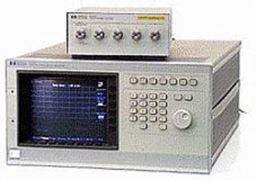
The HP 54121T is a 20 GHz digitizing oscilloscope built around the HP 54120B mainframe paired with the HP 54121A Four Channel Test Set. As part of the broader HP 54120-series, it combines high bandwidth, time domain reflectometry, four input channels, and superb stability in a fully programmable oscilloscope that needs no manual loop gain adjustment. Digital feedback sampling delivers repeatable, accurate, and operator-independent measurement results across the full input dynamic range.
The 54120-series is designed for high-speed device and circuit characterization, high-speed telecom analysis, and microwave design. Picosecond-level time interval resolution and accuracy support digital pulse parameter measurements in semiconductors and computers, while built-in time and voltage histograms characterize the noise and jitter encountered in telecommunications applications such as eye pattern analysis. On the 54121T and 54123T, time domain reflectometry locates and removes discontinuities in transmission line systems by identifying ringing and waveform distortion.
Hewlett-Packard's test and measurement business was spun out as Agilent Technologies in 1999, then transferred to Keysight Technologies in 2014. Instruments originally branded HP, including the 54120-series digitizing oscilloscopes, trace their corporate lineage through this chain.
The HP 54120-series digitizing oscilloscopes share the HP 54120B color mainframe and differ primarily in the bandwidth and risetime delivered by the paired four-channel test set. All three configurations — 54121T, 54122T, and 54123T — provide four input channels, digital feedback sampling, 0.25 ps time interval resolution, 10 ps time interval accuracy, and full HP-IB programmability.
The series spans dc to 12.4 GHz (54122T), dc to 20 GHz (54121T), and dc to 34 GHz (54123T) in high bandwidth mode. The 54121T and 54123T also include a switchable step generator and trigger input on their respective four-channel test sets, supporting time domain reflectometry. The 54122T four-channel test set substitutes internal attenuators (×1, ×3, ×10, ×30) for the step generator and extends the maximum scale factor to 2.4 V/div.
Each model below links to its own product page with pre-owned-matched pricing. Configuration, calibration scope, and accessory inclusions vary by model and condition, so the per-model page is the authoritative reference for what is actually in stock and what is included.
Within the family, the 54121T occupies the middle bandwidth tier at dc to 20 GHz, with 17.5 ps transition time on channels 2, 3, and 4 (19.4 ps on channel 1). It retains the step generator and trigger input found on the 54123T configuration but at the 20 GHz tier rather than the 34 GHz tier of the 54123T.
The three configurations differ on three primary axes. Bandwidth: 12.4 GHz, 20 GHz, or 34 GHz at the high bandwidth setting. Vertical scale factor maximum: 80 mV/div on the 54121T and 54123T versus 2.4 V/div on the 54122T (which includes internal ×1/×3/×10/×30 attenuators in place of the step generator). TDR capability: present on the 54121T and 54123T via the integrated step generator; not present on the 54122T.
Maximum safe input voltage also tracks the test-set configuration: ±2 V dc + ac peak (+16 dBm) on the 54121T and 54123T versus ±5 V dc + peak (+24 dBm) on the 54122T. All three share the same 50 Ω nominal input impedance, ±320 mV dynamic range (relative to channel offset on 54121T/54123T, multiplied by the attenuation factor on the 54122T), and 3.5 mm (m) input connectors. The comparison table that follows summarizes these differences across the family.
| Model | Bandwidth | Risetime | Channels |
|---|---|---|---|
| 54121A | dc to 20 GHz | 17.5 ps (Chs 2,3,4) | 4 |
| 54121T | dc to 20 GHz | 17.5 ps (Chs 2,3,4); 19.4 ps (Ch 1) | 4 |
| 54122T | dc to 12.4 GHz | 28.2 ps | 4 |
| 54123T | dc to 34 GHz | 10.3 ps (Chs 2,3,4); 17.5 ps (Ch 1) | 4 |
Additional differences in specifications beyond the few shown above are not listed here — see each model's full specifications below.
| Specification | Value |
|---|---|
| Time Base Scale Factor, Minimum (full-scale is 10 divisions) | 10 ps/division |
| Time Base Scale Factor, Maximum | 1 s/division |
| Delay (time offset relative to trigger), Minimum | 16 ns |
| Delay, Maximum | 1000 screen diameters or 10 seconds, whichever is smaller |
| Time Interval Accuracy (Dual marker measurement) | <10 ps ± 0.1% of reading |
| Time Interval Resolution | 0.25 ps or .02 division, whichever is larger |
| Trigger Sensitivity, dc - 100 MHz | 40 mV peak-to-peak |
| Trigger Sensitivity, 100 MHz to 2.5 GHz | Increasing linearly from 40 mV at 100 MHz to 200 mV at 2.5 GHz |
| Trigger Pulse Width | <200 ps, > 200 mV |
| Trigger High Frequency Reject | Trigger bandwidth reduced to approximately 100 MHz |
| Trigger Level Range | ± 1 V |
| Trigger Jitter (Trigger and time base combined, one standard deviation) | < 2.5 ps + 5E-5 x delay setting (Tested using 2 GHz synthesized source at 200 mV peak-to-peak with High Frequency Sensitivity ON and High Frequency Reject OFF.) |
| Trigger Input Maximum Safe Input Voltage | ± 2 V dc ± ac peak (+16 dBm) |
| Trigger Nominal Impedance | 50 Ω |
| Trigger Percent Reflection | <10% for 100 ps risetime |
| Trigger Connector | 3.5 mm (m) |
Please review the Manufacturer's Data Sheet to verify published specifications. Feedback on this webpage is always welcome — please reach out to your Test Architect at any time for questions or concerns. Thank you, we truly appreciate you being our customer.
Model No
HP
Condition
Used
Manufacturer
Agilent
Channels
4
Frequency
2 GHz


30+ Years in Business

Secure Payments

Sell Test Equipments

Knowledgeable Staff

On-site Lab
30+ Years in Business
Secure Payments
Sell Test Equipments
Knowledgeable Staff
On-site Lab
Request A Quote


