Chat Live
 Contact Us
 sales@valuetronics.com


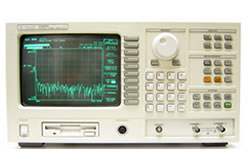
The Agilent 35665A is a 2-channel dynamic signal analyzer covering DC to 102.4 kHz in single-channel mode and DC to 51.2 kHz when both channels are active. It performs FFT-based frequency-domain analysis with 100, 200, 400, or 800 lines of resolution per measurement, and frequency accuracy of ±30 ppm. The instrument combines dual-channel input acquisition, an integrated source output for stimulus-response measurements, and trigger and tachometer inputs for rotating-machinery analysis in a single benchtop chassis.
Dynamic signal analyzers like the 35665A are used wherever an engineer needs to characterize signals in the frequency domain rather than the time domain — measuring amplitude versus frequency, phase relationships between two signals, and transfer functions of physical or electronic systems. The 35665A's IEPE signal conditioning, tachometer input with pulses-per-revolution settings from 0.5 to 2048, and ±5 V peak source output position it for vibration measurement on accelerometers, structural and modal analysis using stimulus-response methods, and order-tracking measurements on rotating equipment when ordered with the appropriate option.
Hewlett-Packard's test and measurement business was spun out as Agilent Technologies in 1999. In 2014 the electronic measurement portion of Agilent was transferred to Keysight Technologies, while Agilent retained its life-sciences and chemical-analysis businesses. Instruments originally sold under the HP and Agilent labels — including the 35665A — trace their support and calibration lineage through this corporate sequence.
| Specification | Value |
|---|---|
| Frequency | |
| Range, One Channel Mode (Ch. 1) | 102.4 kHz |
| Range, Two Channel Mode (Ch 1 & 2) | 51.2 kHz |
| Resolution | 100, 200, 400 or 800 lines resolution |
| Minimum Frequency Resolution, One Channel Mode | 244 µHz |
| Minimum Frequency Resolution, Two Channel Mode | 122 µHz |
| Spans, One Channel Mode | 102.4 kHz to 0.19531 Hz |
| Spans, Two Channel Mode | 51.2 kHz to 0.097656 Hz |
| Accuracy | ±30 ppm |
| Real Time Bandwidth (Fast Average On) | ≥12.8 kHz |
| Measurement Rate, One Channel Mode (401 pt FFT, fast avg on) | ≥33 averages/second (typical) |
| Measurement Rate, Two Channel Mode | ≥15 averages/second (typical) |
| Display Update Rate | ≥8 updates/second (typical) |
| Amplitude / Phase | |
| Input Ranges (full scale) | +27 dBVrms (31.7 Vpk) to -51 dBVrms (3.99 mVpk) in 2 dB steps |
| Amplitude Resolution | 0.016% of full scale (typical) |
| Absolute Amplitude Accuracy | ±2.92% (0.25 dB) of reading, ±0.025% of full scale |
| Cross-Channel Gain Accuracy (Source = Full scale) | ±0.04 dB |
| Cross-Channel Gain Accuracy (Source = -20 dB full scale) | ±0.08 dB |
| Cross-Channel Phase Accuracy (Source = Full scale) | ±0.5 deg |
| Cross-Channel Phase Accuracy (Source = -20 dB full scale) | ±0.5 deg |
| Dynamic Range | |
| Full Span FFT Noise Floor (Input Range 27 to -35 dBVrms) | <-76 dBfs (-85 dBfs typical) |
| Full Span FFT Noise Floor (Input Range -37 to -51 dBVrms) | <(-112 - Range) dBfs |
| Spurious Free Dynamic Range | <-72 dBfs (includes spurs, harmonic distortion, intermodulation distortion, alias products) |
| Zoom Mode Alias Responses (1.5% to 98.5% of frequency span) | <-72 dBfs |
| Zoom Mode Alias Responses (Lower and Upper 1.5% of span) | <-65 dBfs |
| Input Noise Level (Above 1280 Hz) | <-140 dBVrms/√Hz |
| Input Noise Level (160 Hz to 1.28 kHz, 6.4 kHz span) | <-130 dBVrms/√Hz |
| Input | |
| Input Ranges | -51 dBVrms to +27 dBVrms |
| Input Impedance | 1 MΩ ±30%, ≤100 pF |
| Low Side to Chassis Impedance (Floating Mode) | 1 MΩ ±30% (typical), <0.01 µF (typical) |
| AC Coupling | <3 dB rolloff at 1 Hz |
| Common Mode Rejection (-51 to -11 dBVrms ranges) | >80 dB (typical) |
| Common Mode Rejection (-9 to +9 dBVrms ranges) | >60 dB (typical) |
| Common Mode Rejection (+11 to +27 dBVrms ranges) | >40 dB (typical) |
| Common Mode Range (floating mode) | ±4 V pk |
| IEPE Signal Conditioning Current Source | 4.25 ±1.5 mA |
| IEPE Open Circuit Voltage | +26 to +32 Vdc |
| Trigger / Tachometer | |
| Trigger Modes | Internal, External TTL, Source, HP-IB |
| Maximum Trigger Delay (Post Trigger) | 8191 seconds |
| Maximum Trigger Delay (Pre Trigger) | 8191 samples |
| Pulses Per Revolution | 0.5, 1 to 2048 (integer steps) |
| RPM Accuracy | ±100 ppm |
| Trigger Level Range (Low) | -4 V to +4 V |
| Trigger Level Range (High) | -20 V to +20 V |
| Trigger Level Resolution (Low Range) | 100 mV |
| Trigger Level Resolution (High Range) | 500 mV |
| RPM Range | 5 < RPM < 220,759 |
| Maximum Trigger Pulse Rate | 800 kHz |
| Source Output | |
| Amplitude Range | ±5 V peak |
| Amplitude Resolution (Voltage ≥ 0.2 Vrms) | 2.5 mVpeak |
| Amplitude Resolution (Voltage < 0.2 Vrms) | 0.25 mVpeak |
| Residual DC Offset | ±10.0 mV |
| Output Impedance | <5 Ω |
| Source Type | Sine, random, pink noise, chirp |
Please review the Manufacturer's Data Sheet to verify published specifications. Feedback on this webpage is always welcome — please reach out to your Test Architect at any time for questions or concerns. Thank you, we truly appreciate you being our customer.
Model No
Agilent
Condition
Used
Manufacturer
Agilent
Frequency
102 kHz
1C1
Adds 2 MByte Memory , requires memory board upgrade OEM P/N 35665-66586
1C2
HP Instrument BASIC
1D0
Computed Order Tracking (also requires hardware option 1C1 or ANA)
1D1
Real-time Octave Measurements
1D2
Swept-Sine Measurements
1D3
Curve Fit and Synthesis
1D4
Arbitrary Waveform Source
ANA
Adds 6 MByte Memory , requires memory board upgrade OEM P/N 35665-66587


30+ Years in Business

Secure Payments

Sell Test Equipments

Knowledgeable Staff

On-site Lab
30+ Years in Business
Secure Payments
Sell Test Equipments
Knowledgeable Staff
On-site Lab
Request A Quote