 Chat Live
 Contact Us
 sales@valuetronics.com



🎓 Request a Quote To Get An EDU Discount
Couldn't load pickup availability
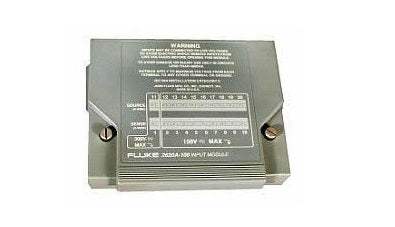
The Fluke 2635A Hydra Data Bucket is a portable 21-channel data acquisition unit designed for gathering and transporting large volumes of measurement data, including extended operation from remote locations. The Hydra Data Bucket is part of the broader Hydra Series, which also includes the 2625A Data Logger and the 2620A Data Acquisition Unit. The 2635A is distinguished within the family by its removable PCMCIA memory card storage, which the 2625A (internal storage) and 2620A (no nonvolatile storage) do not provide.
A data acquisition instrument captures readings from multiple sensor inputs over time, recording values for later analysis or transmitting them in real time to a host computer. The Hydra Data Bucket is used for standalone monitoring operations where data is collected on the memory card and later retrieved at a PC, and for PC-based data acquisition where the RS-232 link feeds readings directly into application software. The datasheet describes its role in test and monitoring systems, remote-location data gathering, and applications that mix standalone recording with periodic upload via the Hydra RS-232 port, an optional external PC memory card drive, or a standard PCMCIA slot on the user's computer.
Fluke Corporation is the original manufacturer of the Hydra Series. The Hydra family was developed during the era when Fluke operated as a standalone public company before its 1998 acquisition by Danaher Corporation. Fluke has continued to operate under its own brand name through the Danaher era and into the current Fortive Corporation, which was spun off from Danaher in 2016 and now serves as Fluke's parent company.
The Hydra Series comprises four data acquisition instruments built on a common 21-channel Universal Input Module front end with shared measurement specifications. All four models share the same analog measurement performance, the same isolation and safety ratings, and the same Universal Input Module that accepts thermocouples, RTDs, DC and AC voltage, resistance, and frequency without external signal conditioning.
The models differ along two axes: nonvolatile data storage and host interface. The 2635A Hydra Data Bucket adds PCMCIA memory card storage to the RS-232 interface, supporting standalone logging with later upload. The 2625A Hydra Data Logger provides internal nonvolatile memory storing more than 2,000 scans with RS-232 transfer. The 2620A Hydra Data Acquisition Unit has no internal nonvolatile storage and is designed for direct PC connection via RS-232, while the 2620A/05 substitutes an IEEE-488 interface for the RS-232 (the two interfaces are mutually exclusive when IEEE-488 is in use).
Each pre-owned Hydra Series model below is its own dedicated product page with condition-matched pricing, inventory status, and quote workflow. Use the comparison table to confirm which storage and interface combination matches the deployment, then navigate to the specific model page for current availability.
Within the Hydra Series, the 2635A Data Bucket is the configuration optimized for standalone field logging with bulk data offload. Its PCMCIA memory card storage, multiple card capacity options (256 KB through 4 MB), and ability to transfer real-time data to a PC while simultaneously recording to the card distinguish it from the internally-stored 2625A and the PC-tethered 2620A. The datasheet explicitly identifies the 2635A as the right choice for gathering and transporting large volumes of data and for working extended periods from remote locations.
The compare-models table below summarizes the four Hydra Series variants by storage type and host interface. All four share identical analog measurement performance — the Universal Input Module, the 17-bit ADC, the channel count, the isolation ratings, and the temperature, humidity, and EMI specifications are common across the family.
Selection across the family is driven by deployment mode rather than measurement performance. Standalone field logging with later card retrieval favors the 2635A. Standalone logging with serial upload at a fixed location favors the 2625A. Direct PC-tethered acquisition in a test rack favors the 2620A.
| Model | Universal Signal Conditioning | Nonvolatile Data Storage | Interface |
|---|---|---|---|
| 2620A | Yes | None | RS-232 |
| 2625A | Yes | Internal (2,047 scans) | RS-232 |
| 2635A | Yes | PCMCIA Card (256 KB) | RS-232 |
| 2635A-1MB | Yes | PCMCIA Card (1 MB) | RS-232 |
Additional differences in specifications beyond the few shown above are not listed here — see each model's full specifications below.
| Specification | Value |
|---|---|
| Channel Capacity | |
| Analog inputs | 21 |
| Digital I/O and alarm outputs | 12 total |
| Totalizer | 1 |
| Measurement Rate | |
| Slow | 4 Rdgs/s nominal |
| Fast | 17 Rdgs/s nominal (1.5 Rdgs/s for V ac, Hz and Ω inputs nominal) |
| Analog to Digital Converter | |
| Type | Dual slope, linear to 17 bits |
| Common mode rejection (AC) | ≥120 dB (50/60 Hz, ±0.1 % max 1 kΩ source imbalance) |
| Common mode rejection (DC) | ≥120 dB |
| Normal mode rejection | 53 dB (60 Hz, ±0.1 %); 47 dB (50 Hz, ±0.1 %) |
| Common mode and normal mode voltage maximum | 300V dc or V ac rms (channels 0, 1, 11); 150V dc or V ac rms (all other inputs) |
| Isolation | Analog input to analog input, and analog input to any digital input: meets IEC 1010 for 300/150 volts reinforced and ANSI/ISA-S82.01-1994 and CSA-C22.2 for 250 volts single insulation |
| Input Ranges, Resolution & Accuracy (3-Sigma) | |
| DC Volts | 90 mV to 150/300 V; Resolution: 1 µV to 10 mV; Accuracy: 0.018 % |
| AC Volts (crest factor to 2.0) | 300 mV to 150/300 V; Resolution: 10 µV to 10 mV; Accuracy: 0.13 % |
| Resistance | 300 Ω to 10 MΩ; Resolution: 10 mΩ to 1 kΩ; Accuracy: 0.013 % |
| Frequency | 15 Hz to 1 MHz; Resolution: 0.01 Hz to 1 kHz; Accuracy: 0.05 % |
| RTD (Pt100) | -200 to 600 °C; Resolution: 0.02 °C; Accuracy: 0.05 °C |
| Thermocouple J | -100 to 760 °C; Resolution: 0.1 °C; Accuracy: 0.39 °C |
| Thermocouple K | -100 to 1372 °C; Resolution: 0.1 °C; Accuracy: 0.45 °C |
| Thermocouple T | -150 to 400 °C; Resolution: 0.1 °C; Accuracy: 0.39 °C |
| Other Thermocouple Types | R, S, B, C, E, N |
| Current Measurements | |
| AC or DC current | Up to 100 mA using the 2620A-101 10 Ω Current Shunt Strip |
| Totalizing Input | |
| Type | DC coupled, non-isolated |
| Maximum input | +30 V, min -4 V |
| Max count | 65,535 |
| Minimum signal | 2 V peak |
| Threshold | 1.4 V |
| Rate | 0–5 kHz (debounce off) |
| Hysteresis | 500 mV |
| Input debouncing | None or 1.66 ms |
| Digital Inputs | |
| Threshold | 1.4 V |
| Hysteresis | 500 mV |
| Maximum Input | +30 V, min -4 V; non-isolated |
| Digital/Alarm Outputs | |
| Output type | Open collector, non-isolated, TTL compatible |
| Alarm associations | Alarm outputs 0–3 are fixed assignments associated to channels 0–3. Alarms for channels 4–19 are mapped to digital I/O lines. Digital I/O may be used as a digital input or alarm status output (associated with any input channel or channels). |
| Trigger Input | |
| Minimum pulse | 5 µs |
| Maximum latency | 100 ms |
| Repeatability | 1 ms |
| Input "High" | 2.0 V min, 7.0 V max |
| Input "Low" | -0.6 V min, 0.8 V max |
| Type | Non-isolated, contact closure and TTL compatible |
| Clock | |
| Accuracy | Within 1 minute/month for 0 to 50 °C range |
| Power | |
| AC input | 90 to 264 V ac, 50 or 60 Hz (<10 watts) |
| DC input | 9 to 16 V dc (<4 watts) |
| Dual-source operation | If both sources are applied simultaneously, the greater of AC or DC is used. At 120 V ac the equivalent DC voltage is ~14.5 V. |
| Environmental | |
| Operating temperature/humidity | 0 to 28 °C, ≤90 % RH; 28 to 40 °C, ≤75 % RH; 40 to 60 °C, ≤50 % RH |
| Storage | -40 to 75 °C, 5 to 95 % RH |
| Compliance | |
| EMI | Passes FCC EMI Class B Equipment, VDE 0871B, and CE-EN61010, CE approved |
| Safety | Complies with applicable sections of IEC1010, ANSI/ISA-S82.01-1994, CSA-C22.2, and CE |
| Physical | |
| Weight | 3.0 kg (6.5 lbs) |
| Dimensions (H x W x D) | 9.3 cm x 21.6 cm x 31.2 cm (3.67" x 8.50" x 12.28") |
| Interfaces | |
| Standard | RS-232 |
| Optional (2620A only) | IEEE-488 – Disables RS-232 interface while in use |
| Hydra 2625A Data Memory | |
| Storage capacity | 2,047 scans |
| Memory life | 5 years minimum at 25 °C |
| Scan contents | Date and time stamp; all defined analog input channel values; status of four alarm outputs and eight digital I/O; totalizer count |
Please review the Manufacturer's Data Sheet to verify published specifications. Feedback on this webpage is always welcome — please reach out to your Test Architect at any time for questions or concerns. Thank you, we truly appreciate you being our customer.
Model No
Fluke
Condition
Used
Manufacturer
Fluke


30+ Years in Business

Secure Payments

Sell Test Equipments

Knowledgeable Staff

On-site Lab
30+ Years in Business
Secure Payments
Sell Test Equipments
Knowledgeable Staff
On-site Lab
Request A Quote


