 Chat Live
 Contact Us
 sales@valuetronics.com


🎓 Request a Quote To Get An EDU Discount
Couldn't load pickup availability
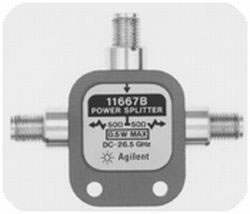
The Agilent 11667A is a two-resistor power splitter covering DC to 18 GHz, designed for external source leveling and ratio measurement applications. As part of the 11667 series, it shares the same architectural approach used across the family — a resistive splitter topology that provides excellent output SWR at the auxiliary arm when used for source leveling or ratio measurement work.
Power splitters in this family are recommended for two primary applications listed in the datasheet: external source leveling and ratio measurements. The two-resistor topology delivers excellent match and tracking between outputs, which is the characteristic that makes these devices the right tool for wideband source-leveling loops and ratio measurement setups where output SWR at the auxiliary arm directly affects measurement uncertainty.
ValueTronics International stocks, inspects, and ships RF and microwave passive components from our 20,000 sq ft secure warehouse at 1675 Cambridge Drive, Elgin, Illinois. Every unit in our inventory is professionally evaluated against the manufacturer's published specifications before it ships — connectors are inspected for wear, mechanical condition is verified, and the unit is graded against our condition standards rather than described from external appearance alone. That verified-condition model is what distinguishes a professionally sourced passive component from an unverified marketplace listing of the same part number.
The 11667 series carries Agilent branding from the Agilent Technologies era of test and measurement. Hewlett-Packard spun off its test and measurement business as Agilent Technologies in 1999, and Agilent later spun off its electronic measurement business as Keysight Technologies in 2014. Instruments and accessories carrying the HP, Agilent, or Keysight name trace to the same engineering lineage.
The 11667 series is a three-model family of two-resistor power splitters covering progressively wider frequency ranges. Each model uses the same resistive splitter topology, with differences in upper frequency limit, connector type, output SWR, insertion loss, and tracking performance that follow directly from the bandwidth each model is designed to cover.
The series is recommended for external source leveling and ratio measurement applications. The two-resistor topology is selected for these applications because it provides excellent output SWR at the auxiliary arm — the property that determines measurement uncertainty in source-leveling and ratio measurement setups.
Each pre-owned 11667 series unit below is its own dedicated product page with condition-matched pricing and availability. Connector type and frequency coverage differ across the three models — confirm both before ordering to make sure the splitter matches your existing cable infrastructure and the highest frequency your application requires.
The 11667A covers DC to 18 GHz with Type-N connectors, making it the right choice for general RF source-leveling and ratio measurement work where N-type is the existing cable standard. Option 001 (N (m) input) and Option 002 (APC-7 outputs) provide connector flexibility for specific test fixture requirements.
The three models differ in upper frequency limit and connector interface: the 11667A covers DC to 18 GHz with Type-N connectors, the 11667B covers DC to 26.5 GHz with 3.5 mm connectors, and the 11667C covers DC to 50 GHz with 2.4 mm connectors. Output SWR tightens at the lower-frequency models (1.10 nominal at low frequency on the 11667A versus 1.65 across band on the 11667C), and tracking is correspondingly tighter on the lower-frequency models.
Insertion loss is 7 dB nominal on the 11667A and 11667B and 8.5 dB on the 11667C, reflecting the wider frequency coverage of the 50 GHz model. Maximum input power is 0.5 W across all three models. The comparison table below summarizes the headline differences — select the model whose upper frequency limit and connector type match your application.
| Model | Frequency Range | Output SWR (nominal 50 Ω) | Insertion Loss (input to either output) |
|---|---|---|---|
| 11667B | dc to 26.5 GHz | 1.22 | 7 dB |
| 11667A | dc to 18.0 GHz | 1.10: dc to 4 GHz; 1.20: dc to 8 GHz; 1.33: dc to 18 GHz | 7 dB |
| 11667A | dc to 18.0 GHz | 1.10: dc to 4 GHz; 1.20: dc to 8 GHz; 1.33: dc to 18 GHz | 7 dB |
| 11667A | dc to 18.0 GHz | 1.10: dc to 4 GHz; 1.20: dc to 8 GHz; 1.33: dc to 18 GHz | 7 dB |
Additional differences in specifications beyond the few shown above are not listed here — see each model's full specifications below.
| Parameter | Specification |
|---|---|
| Frequency range | dc to 26.5 GHz |
| Equivalent output SWR (nominal 50 Ω) | 1.22 |
| Maximum input power | 0.5 W |
| Nominal insertion loss (input to either output) | 7 dB |
| Tracking between any two ports | <0.25 dB |
| Connectors | 3.5 mm (f) all ports |
| Shipping weight | 0.14 lb (0.3 kg) |
Please review the Manufacturer's Data Sheet to verify published specifications. Feedback on this webpage is always welcome — please reach out to your Test Architect at any time for questions or concerns. Thank you, we truly appreciate you being our customer.
Model No
Agilent
Condition
Used
Manufacturer
Agilent
Frequency
26.5 GHz


30+ Years in Business

Secure Payments

Sell Test Equipments

Knowledgeable Staff

On-site Lab
30+ Years in Business
Secure Payments
Sell Test Equipments
Knowledgeable Staff
On-site Lab
Request A Quote


