Chat Live
 Contact Us
 sales@valuetronics.com


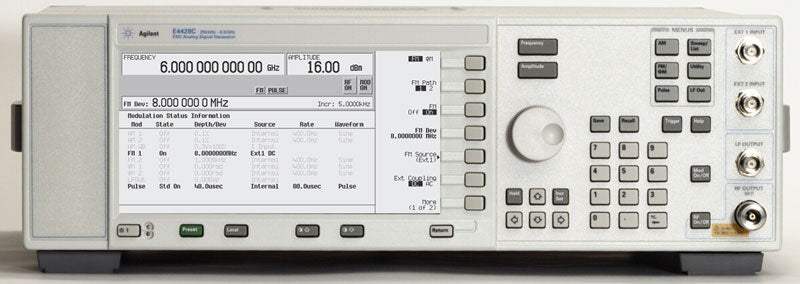
The Agilent E4428C ESG is an analog signal generator that produces RF carrier signals with analog modulation across a frequency range that extends to 6 GHz in its widest configuration. It delivers calibrated output power, a high-stability frequency reference, and a built-in modulation source, presenting frequency, power, and modulation control through both a front panel and full remote programming. The instrument is offered in frequency-range and output-power configurations selected by option, with a 50 Ω type-N RF output.
An analog signal generator provides a known, controllable RF stimulus — a carrier at a defined frequency and amplitude that can be modulated in a defined way — so that a device or system can be excited and its response measured. The E4428C generates amplitude, frequency, phase, and pulse modulation, and its spectral-purity and jitter performance is characterized at SONET/SDH carrier frequencies and data rates of 155, 622, and 2488 MB/s. Step and list sweeps of both frequency and power allow a sequence of carrier settings to be stepped through automatically.
ValueTronics stocks and holds its own test-and-measurement inventory in a 20,000-square-foot secure warehouse at 1675 Cambridge Drive in Elgin, Illinois. Every used unit is inspected and functionally verified in-house before it ships, while new units leave factory-sealed exactly as received. Holding inventory directly lets us match the right instrument and configuration to an engineer's application and get it out the door quickly.
This instrument carries Agilent Technologies branding. Agilent originated as the test-and-measurement business of Hewlett-Packard, which was spun out as Agilent Technologies in 1999; that electronic measurement business was subsequently established as Keysight Technologies in 2014.
Newer model: per the manufacturer, this unit has been replaced by MXG X-Series.
| Specification | Value |
|---|---|
| Frequency | |
| Frequency range (Option 503) | 250 kHz to 3 GHz [electronic attenuator standard] |
| Frequency range (Option 506) | 250 kHz to 6 GHz [mechanical attenuator only] |
| Frequency minimum | 100 kHz (performance below 250 kHz not guaranteed) |
| Frequency resolution | 0.01 Hz |
| Frequency switching speed, Option 503 [hops < 5 MHz within a band] | Freq. (< 9 ms); Freq./Amp. (< 9 ms) |
| Frequency switching speed, Option 506 [hops < 5 MHz within a band] | Freq. (< 16 ms); Freq./Amp. (< 17 ms); within a band (< 12 ms) / (< 14 ms) |
| Phase offset | Adjustable remotely [LAN, GPIB, RS-232] or via front panel in nominal 0.1 ° increments |
| Sweep modes | |
| Operating modes | Frequency step, amplitude step and arbitrary list |
| Dwell time | 1 ms to 60 s |
| Number of points | 2 to 65,535 (Step); 2 to 1601 (List) |
| Internal Reference Oscillator | |
| Aging rate | < ±0.1 ppm/yr or < ±0.0005 ppm/day after 45 days |
| Temp [0 to 55 °C] | (< ±0.05 ppm) |
| Line voltage | (< ±0.002 ppm) |
| Line voltage range | (+5% to –10%) |
| RF reference input frequency | 1, 2, 5, 10 MHz ±0.2 ppm |
| RF reference output frequency | 10 MHz |
| RF reference output amplitude | 4 dBm ±2 dB |
| Output Power — Maximum Available Power (measured) | |
| 250 kHz to 250 MHz | Opt 503: +11 to –136 dBm; Opt 503 with UNB: +15 to –136 dBm; Opt 506: +12 to –136 dBm |
| > 250 MHz to 1 GHz | Opt 503: +13 to –136 dBm; Opt 503 with UNB: +17 to –136 dBm; Opt 506: +14 to –136 dBm |
| > 1 to 3 GHz | Opt 503: +10 to –136 dBm; Opt 503 with UNB: +16 to –136 dBm; Opt 506: +13 to –136 dBm |
| > 3 to 6 GHz | Opt 503: N/A; Opt 503 with UNB: N/A; Opt 506: +10 to –136 dBm |
| Level resolution | 0.02 dB |
| Level range with Attenuator Hold active, 250 kHz to 1 GHz | Opt 503: 23 dB; Opt 503 with UNB: 27 dB; Opt 506: 24 dB |
| Level range with Attenuator Hold active, > 1 to 3 GHz | Opt 503: 20 dB; Opt 503 with UNB: 26 dB; Opt 506: 23 dB |
| Level range with Attenuator Hold active, > 3 to 6 GHz | Opt 503: N/A; Opt 503 with UNB: N/A; Opt 506: 20 dB |
| Level Accuracy [dB], Option 503 (23 °C ±5 °C) | |
| 250 kHz to 2.0 GHz | +7 to –50 dBm: ±0.5; –50 to –110 dBm: ±0.5; –110 to –127 dBm: ±0.7; < –127 dBm: (±1.5) |
| 2.0 to 3 GHz | +7 to –50 dBm: ±0.6; –50 to –110 dBm: ±0.6; –110 to –127 dBm: ±0.8; < –127 dBm: (±2.5) |
| Level Accuracy [dB], Option UNB (23 °C ±5 °C) | |
| 250 kHz to 2.0 GHz | +10 to –50 dBm: ±0.5; –50 to –110 dBm: ±0.7; –110 to –127 dBm: ±0.8; < –127 dBm: (±1.5) |
| 2.0 to 3 GHz | +10 to –50 dBm: ±0.6; –50 to –110 dBm: ±0.8; –110 to –127 dBm: ±1.0; < –127 dBm: (±2.5) |
| Level Accuracy [dB], Option 506 (23 °C ±5 °C) | |
| 250 kHz to 2.0 GHz | +7 to –50 dBm: ±0.6; –50 to –110 dBm: ±0.8; –110 to –127 dBm: ±0.8; < –127 dBm: (±1.5) |
| 2.0 to 3 GHz | +7 to –50 dBm: ±0.6; –50 to –110 dBm: ±0.8; –110 to –127 dBm: ±1.0; < –127 dBm: (±2.5) |
| 3 to 4 GHz | +7 to –50 dBm: ±0.8; –50 to –110 dBm: ±0.9; –110 to –127 dBm: ±1.5; < –127 dBm: (±2.5) |
| 4 to 6 GHz | +7 to –50 dBm: ±0.8; –50 to –110 dBm: ±0.9; –110 to –127 dBm: (±1.5) |
| Level accuracy with ALC off | (±0.15 dB) [relative to ALC on, after power search is executed] |
| Level switching speed, Normal operation [ALC on] | Opt 503: (< 15 ms); Opt 503 with UNB: (< 21 ms); Opt 506: (< 21 ms) |
| Level switching speed, power search manual | Opt 503: (< 83 ms); Opt 503 with UNB: (< 95 ms); Opt 506: (< 95 ms) |
| Level switching speed, power search auto | Opt 503: (< 103 ms); Opt 503 with UNB: (< 119 ms); Opt 506: (< 119 ms) |
| Spectral Purity | |
| SSB phase noise [at 20 kHz offset], 500 MHz | < –135 dBc/Hz, (< –138 dBc/Hz) |
| SSB phase noise [at 20 kHz offset], 1 GHz | < –130 dBc/Hz, (< –134 dBc/Hz) |
| SSB phase noise [at 20 kHz offset], 2 GHz | < –124 dBc/Hz, (< –128 dBc/Hz) |
| SSB phase noise [at 20 kHz offset], 3 GHz | < –121 dBc/Hz, (< –125 dBc/Hz) |
| SSB phase noise [at 20 kHz offset], 4 GHz | < –118 dBc/Hz, (< –122 dBc/Hz) |
| SSB phase noise [at 20 kHz offset], 6 GHz | < –113 dBc/Hz, (< –117 dBc/Hz) |
| Residual FM [CW mode, 0.3 to 3 kHz BW, CCITT, rms] | < N x 1 Hz (< N x 0.5 Hz) |
| Harmonics | < –30 dBc above 1 GHz, (< –30 dBc 1 GHz and below) |
| Nonharmonics, 250 kHz to 250 MHz | > 3 kHz offset: < –65 dBc; > 10 kHz offset: (< –58 dBc) |
| Nonharmonics, 250 MHz to 500 MHz | < –80 dBc; < –80 dBc |
| Nonharmonics, 500 MHz to 1 GHz | < –80 dBc; < –80 dBc |
| Nonharmonics, 1 to 2 GHz | < –74 dBc; < –74 dBc |
| Nonharmonics, 2 to 4 GHz | < –68 dBc; < –68 dBc |
| Nonharmonics, 4 to 6 GHz | < –62 dBc; < –62 dBc |
| Subharmonics ≤ 1 GHz | None |
| Subharmonics > 1 GHz | None |
| Frequency Modulation (FM) | |
| Maximum deviation | N x 1 MHz |
| Resolution | 0.1% of deviation or 1 Hz, whichever is greater |
| Modulation frequency rate [deviation = 100 kHz], FM path 1 [DC] | 1 dB BW: DC to 100 kHz; 3 dB BW: (DC to 10 MHz) |
| Modulation frequency rate, FM path 2 [DC] | 1 dB BW: DC to 100 kHz; 3 dB BW: (DC to 0.9 MHz) |
| Modulation frequency rate, FM path 1 [AC] | 1 dB BW: 20 Hz to 100 kHz; 3 dB BW: (5 Hz to 10 MHz) |
| Modulation frequency rate, FM path 2 [AC] | 1 dB BW: 20 Hz to 100 kHz; 3 dB BW: (5 Hz to 0.9 MHz) |
| Deviation accuracy [1 kHz rate, deviation < N x 100 kHz] | < ± 3.5% of FM deviation + 20 Hz |
| Carrier frequency accuracy relative to CW in DCFM | ±0.1% of set deviation + (N x 1 Hz) |
| Distortion [1 kHz rate, dev. = N x 100 kHz] | < 1% |
| FM external inputs sensitivity | 1 Vpeak for indicated deviation |
| FM external inputs impedance | 50 Ω, nominal |
| Phase Modulation (ØM) | |
| Resolution | 0.1% of set deviation |
| Modulation frequency response, Normal BW | Max deviation N x 10 radians; ØM path 1: DC to 100 kHz; ØM path 2: DC to 100 kHz |
| Modulation frequency response, High BW | Max deviation N x 1 radians; ØM path 1: (DC to 1 MHz); ØM path 2: (DC to 0.9 MHz) |
| Deviation accuracy [1 kHz rate, Normal BW mode] | < ±5% of deviation + 0.01 radians |
| Distortion [1 kHz rate, deviation < 10N radians, Normal BW mode] | < 1% |
| ØM external inputs sensitivity | 1 Vpeak for indicated deviation |
| ØM external inputs impedance | 50 Ω, nominal |
| Amplitude Modulation (AM) [fc > 500 kHz] | |
| Range | 0 to 100% |
| Resolution | 0.1% |
| Rates [3 dB bandwidth], DC coupled | 0 to 10 kHz |
Important: Option 506 and Option UNB cannot be ordered together: Option 506 is standard with the high-power mechanical attenuator used in Option UNB.
Important: Frequency performance below 250 kHz is not guaranteed (frequency minimum 100 kHz).
Important: Power requirements: 90 to 254 V; 50 or 60 Hz; 300 W maximum, power factor corrected. Not for 400 Hz use. For 400 Hz systems, order transformer 70001-60066.
Important: Save and recall of user files and instrument states from non-volatile storage is guaranteed only over the range 0 to 40 °C.
Important: External 1 and External 2 modulation input damage levels are 5 Vrms and 10 Vpeak (50 ohm input impedance).
Important: Reverse power protection maximum DC voltage is 40 V.
This pre-owned unit is inspected and functionally verified in-house before it ships and is backed by our pre-owned warranty. To confirm its exact condition, firmware revision, installed options, or included accessories for your application before ordering, contact our Test Architects.
ValueTronics supplies both new and used test and measurement equipment. New units ship factory-sealed, exactly as received from the manufacturer; every used unit is inspected and functionally verified in-house at our 20,000 sq ft secure facility in Elgin, Illinois before it ships. Our Test Architects can help you select the condition, calibration, and configuration that fit your application.
Please review the Manufacturer's Data Sheet to verify published specifications. Feedback on this webpage is always welcome — please reach out to your Test Architect at any time for questions or concerns. Thank you, we truly appreciate you being our customer.
Model No
Agilent
Condition
Pre-Owned
Manufacturer
Agilent
Rf_gen_freq
250 kHz to 6 GHz
["503
250 kHz to 3 GHz frequency range [electronic attenuator standard]
506
250 kHz to 6 GHz frequency range [mechanical attenuator only]
UNB
High output power with mechanical attenuator
]


30+ Years in Business

Secure Payments

Sell Test Equipments

Knowledgeable Staff

On-site Lab
30+ Years in Business
Secure Payments
Sell Test Equipments
Knowledgeable Staff
On-site Lab
Request A Quote