Chat Live
 Contact Us
 sales@valuetronics.com


In summary, the Keysight 3458A is the fastest, most flexible, and most accurate multimeter Keysight has ever offered — an 8.5-digit precision system multimeter that delivers up to 100,000 readings per second for production throughput and 0.1 ppm transfer accuracy for calibration-lab metrology. The instrument integrates seven measurement functions (DCV, ACV, DCI, ACI, ohms, frequency, period), high-resolution digitizing (16 to 24 bits, 100,000 to 0.2 samples/sec, 12 MHz bandwidth), and self-verifying auto-calibration into a single GPIB-controlled chassis. The 148 k bytes reading memory and 8 ppm/year reference stability are standard.
The Keysight 3458A is used as a system multimeter on the production test floor, as a precision reference in calibration and standards laboratories, and as a high-resolution digitizer in R&D characterization work. With up to 8.5 digits of measurement resolution, 0.1 ppm DC volts transfer accuracy, and 0.01 ppm rms internal noise, the 3458A is the calibration-standard DMM specified by metrology laboratories, semiconductor characterization groups, and aerospace and defense test systems that require traceable measurement uncertainty at the parts-per-million level. The same instrument supports 100,000 readings/second for high-throughput automated testing, making it equally valuable on a production ATE rack and at a primary standards bench.
The 3458A combines speed and accuracy that are typically mutually exclusive in DMM design: 100,000 readings per second at 4.5 digits and 0.5 ppm + 0.05 ppm 24-hour accuracy at 8.5 digits on the 10 V range — selectable in 100 ns aperture steps. Two-source (10 V, 10 kΩ) electronic calibration covers every function including AC. Self-adjusting auto-calibration (ACAL) eliminates measurement errors from time drift and temperature changes between formal calibrations. Programming compatibility through the Keysight multimeter language (ML) means readable, documented commands that reduce system development time compared to lower-level DMM control vocabularies.
The Keysight 3458A delivers 8.5 digits of usable resolution, 0.01 ppm rms internal noise, 0.1 ppm transfer accuracy for 10 volts DC over 1 hour ± 0.5 °C, and linearity characterized within ± 0.05 ppm of 10 volts against Josephson junction array intrinsic standards. The 24-hour DC volts accuracy is 0.5 ppm + 0.05 ppm on the 10 V range; 90-day DC volts accuracy is 4.1 ppm + 0.05 ppm of range. Long-term DC volts stability is 8 ppm per year. Ohms measurement covers 10 µΩ to 1 GΩ with 2.2 ppm midrange accuracy. AC volts accuracy reaches 100 ppm absolute from 45 Hz to 1 kHz and 170 ppm absolute to 20 kHz in synchronous sub-sampled mode. The instrument's reading memory holds up to 10,240 readings standard plus 65,536 additional readings, and data transfers at 100,000 readings/second over GPIB.
Keysight Technologies is the direct commercial heir to Hewlett-Packard's test and measurement legacy. HP spun off its test & measurement and medical divisions as Agilent Technologies in 1999; in 2014, Agilent further divided, with the electronic measurement business becoming Keysight Technologies. Keysight is the world's largest dedicated test and measurement company by revenue. The 3458A occupies the 8.5-digit ultra-precision tier of the digital multimeter market, where it serves as a calibration standard in NIST-traceable measurement chains, ISO/IEC 17025 accredited calibration laboratories, and primary standards labs. The instrument is classified under MIL-T-28800D as Type III, Class 5, Style E, Color R, and complies with IEEE-488.1, IEEE-728, and the HPML (multimeter language) standard.
The 3458A performs a complete self-calibration of all functions, including AC, using high-stability internal standards. This self- or auto-calibration eliminates measurement errors due to time drift and temperature changes in the rack or on the bench. When periodic calibration to external standards is required, the operator simply connects a precision 10 VDC source and a precision 10 kΩ resistor — all ranges and functions, including AC, are automatically calibrated using precision internal ratio transfer measurements relative to those external standards. The instrument also implements a password security code that locks calibration values, an automatically-incrementing calibration counter, a stored secured message for noting calibration date and due date, and an internal hardwired switch that can force removal of the instrument covers for ultimate calibration security.
The Keysight 3458A can be configured with the following manufacturer options and accessories at time of order or added later. Configuration options change measurement performance characteristics; accessories address mechanical integration and calibration documentation.
| Option | Description |
|---|---|
| 3458A-002 | High stability (4 ppm/year) reference — upgrades the voltage reference for the ultimate long-term DCV stability performance. Available as a separate orderable configuration on this product family. |
| 3458A-H01 | Special 1000 vrms ac maximum input voltage — extends the AC input voltage envelope. Available as a separate orderable configuration on this product family. |
| Option | Description |
|---|---|
| 3458A-A6J | ANSI Z540 compliant calibration — for customers whose quality systems require ANSI/NCSL Z540-1-1994 compliant calibration certification. |
| 3458A-OGC | Precision calibration, intended for metrology use only — the highest-grade calibration available for the 3458A, providing the tightest documented uncertainty for primary standards and reference laboratory applications. |
| Accessory | Part Number | Description |
|---|---|---|
| 3458A-907 | P/N 5063-9226 | Front handles kit |
| 3458A-908 | P/N 5063-9212 | Rack mount kit |
| 3458A-909 | P/N 5063-9219 | Rack mount kit with handles |
Included with every 3458A: 34137A test lead set for 3458A, and Certificate of calibration. Note: The 148 k bytes reading memory (option 001) is now standard with the new 3458A.
The digital multimeter is the most widely deployed test instrument in the world, and within that category the precision bench DMM occupies a distinct and uncompromising tier — the instrument that is itself a measurement reference, not just a measurement device. At the top of the bench precision DMM tier sits the 8.5-digit ultra-precision class, where Keysight's 3458A has been the calibration-standard reference for decades. Per Keysight's datasheet, the 3458A is positioned as a single thesis: "A System Multimeter with BOTH High Speed and High Accuracy."
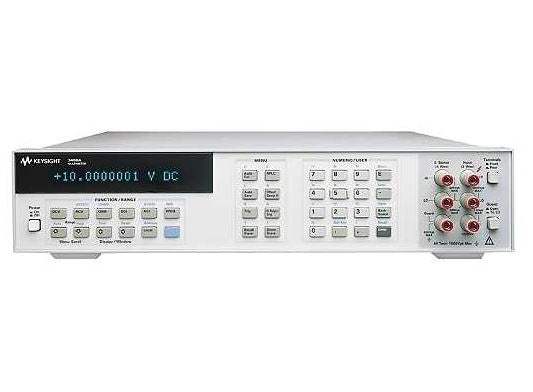
The Keysight Technologies, Inc. 3458A multimeter shatters longstanding performance barriers of speed and accuracy on the production test floor, in R&D, and in the calibration lab. The 3458A is simply the fastest, most flexible, and most accurate multimeter ever offered by Keysight. In your system or on the bench, the 3458A saves you time and money with unprecedented test system throughput and accuracy, seven function measurement flexibility, and low cost of ownership.
Select a reading rate of 100,000 readings/second for maximal test throughput. Or achieve highest levels of precision with up to 8.5 digits of measurement resolution and 0.1 part per million transfer accuracy. Add to this, programming compatibility through the Keysight multimeter language (ML) and the 3458A's simplicity of operation and you have the ideal multimeter for your most demanding applications.
The Keysight 3458A system multimeter heightens test performance in three phases of production test: faster test system startup, faster test throughput, and lower cost of ownership through longer system uptime, designed-in reliability, and fast and easy calibration. The value of a fast system multimeter in production test is clear — but it is also important that the DMM programs easily to reduce the learning time for new system applications. The Keysight multimeter language (ML) offers a standard set of commands for the multimeter user that consists of easily understood, readable commands; easier programming and clearer documentation reduce system development time.
Now you can have a system DMM with both fast and accurate measurements. The 3458A optimizes your measurements for the right combination of accuracy, resolution, and speed. The 3458A multimeter fits your needs from 4.5 digits DC volts measurements at 100,000/second, to 8.5 digits DC volts measurements at 6/second, or anywhere in between in 100 ns steps. Even the traditionally slower measurement functions, such as AC volts, are quicker with the 3458A — for example, you can measure true rms ACV at up to 50 readings/second with full accuracy for input frequencies greater than 10 kHz.
Besides high reading rates, the 3458A's design was tuned for the many function and level changes required in testing your device. The 3458A can change function and range, take a measurement, and output the result at 340/second — at least five times faster than other DMMs. In addition, the 3458A transfers high speed measurement data over GPIB or into and out of its 75,000 readings memory at 100,000 readings/second. You can reduce your data transfer overhead by using the unique nonvolatile program memory of the 3458A to store complete measurement sequences. These test sequences can be programmed and initiated from the front panel for stand-alone operation without a controller.
In the calibration lab, you'll find the 3458A's 8.5 digits to have extraordinary linearity, low internal noise, and excellent short-term stability. The linearity of the 3458A's multi-slope A to D converter has been characterized with state-of-the-art precision. Using Josephsen junction array intrinsic standards, linearity has been measured within ± 0.05 ppm of 10 volts. The 3458A's transfer accuracy for 10 volts DC is 0.1 ppm over 1 hour ± 0.5 °C. Internal noise has been reduced to less than 0.01 ppm rms yielding 8.5 digits of usable resolution. So, the right choice for your calibration standard DMM is the 3458A.
DCV stability: The long-term accuracy of the 3458A is a remarkable 8 ppm per year — more accurate than many system DMMs are after only a day. Option 002 gives you a higher stability voltage reference specified to 4 ppm/year for the ultimate performance.
Reduced-error resistance: The 3458A doesn't stop with accurate DCV. Similar measurement accuracy is achieved for resistance, ACV, and current. You can measure resistance from 10 µΩ to 1 GΩ with midrange accuracy of 2.2 ppm. Finally, the 3458A, like its DMM predecessors, offers offset-compensated ohms on the 10 Ω to 100 kΩ ranges to eliminate the errors introduced by small series voltage offsets. Usable for both two- and four-wire ohms, the 3458A supplies a current through the unknown resistance, measures the voltage drop, sets the current to zero, and measures the voltage drop again. The result is reduced error for resistance measurements.
Precision ACV: The 3458A introduces new heights of true rms AC volts performance with a choice of traditional analog or a new sampling technique for higher accuracy. For calibration sources and periodic waveforms from 1 Hz to 10 MHz, the 3458A's precision sampling technique offers extraordinary accuracy. With 100 ppm absolute accuracy for 45 Hz to 1 kHz or 170 ppm absolute accuracy to 20 kHz, the 3458A will enhance your measurement capabilities. Accuracy is maintained for up to 2 years with only a single 10 volts DC precision standard. No AC standards are necessary. For higher speed and less accuracy, the analog true rms AC technique has a midband absolute measurement accuracy of 300 ppm using the same simple calibration procedure. With a bandwidth of 10 Hz to 2 MHz and reading rates to 50/second, is an excellent choice for high throughput computer-aided testing.
Simple, application-oriented commands in the Keysight multimeter language (ML) make the task of waveform digitizing as easy as measuring DCV. Simply specify the sweep rate and number of samples. The 3458A gives you the choice of two configurations for high speed measurements: a 150 kHz bandwidth integrating path with a variable aperture from 500 ns to 1 second or a 12 MHz bandwidth path with a fixed 2 ns aperture and 16-bit track-and-hold. Use the integration path for lower noise, use the track-and-hold path to precisely capture the voltage at a single point on a waveform.
Direct sampling function: The 3458A has two sampling functions for digitizing wave-forms: direct sampling and sequential or sub-sampling. With direct sampling, the 3458A samples through the 12 MHz path followed by the 2 ns track-and-hold providing 16 bits of resolution. The maximum sample rate is 50,000 samples/second or 20 μs between samples. Samples can be internally paced by a 0.01% accurate timebase with time increments in 100 ns steps.
Sequential sampling function: Sequential or sub-sampling uses the same measurement path as direct sampling; however sequential sampling requires a periodic input signal. The 3458A will synchronize to a trigger point on the waveform set by a level threshold or external trigger. Once synchronized, the dmm automatically acquires the waveform through digitizing successive periods with time increment steps as small as 10 ns, effectively digitizing at rates up to 100 Msamples/second.
| Range | Full scale | Maximum resolution | Input impedance | Temp coeff Without ACAL (ppm rdg + ppm range)/°C | Temp coeff With ACAL (ppm rdg + ppm range)/°C |
|---|---|---|---|---|---|
| 100 mV | 120.00000 | 10 nV | > 10 GΩ | 1.2 + 1 | 0.15 + 1 |
| 1 V | 1.20000000 | 10 nV | > 10 GΩ | 1.2 + 0.1 | 0.15 + 0.1 |
| 10 V | 12.0000000 | 100 nV | > 10 GΩ | 0.5 + 0.01 | 0.15 + 0.01 |
| 100 V | 120.000000 | 1 µV | 10 MΩ ± 1% | 2 + 0.4 | 0.15 + 0.1 |
| 1000 V | 1050.00000 | 10 µV | 10 MΩ ± 1% | 2 + 0.04 | 0.15 + 0.01 |
| Range | 24 hour | 90 day | 1 year | 2 year |
|---|---|---|---|---|
| 100 mV | 2.5 + 3 | 5.0 (3.5) + 3 | 9 (5) + 3 | 14 (10) + 3 |
| 1 V | 1.5 + 0.3 | 4.6 (3.1) + 0.3 | 8 (4) + 0.3 | 14 (10) + 0.3 |
| 10 V | 0.5 + 0.05 | 4.1 (2.6) + 0.05 | 8 (4) + 0.05 | 14 (10) + 0.05 |
| 100 V | 2.5 + 0.3 | 6.0 (4.5) + 0.3 | 10 (6) + 0.3 | 14 (10) + 0.3 |
| 1000 V | 2.5 + 0.1 | 6.0 (4.5) + 0.1 | 10 (6) + 0.1 | 14 (10) + 0.1 |
DCV accuracy notes: Specifications are for PRESET; NPLC 100. 24-hour: for fixed range (> 4 min.), MATH NULL and Tcal ± 1 °C. 90-day, 1 year and 2 year: within 24-hours and ± 1 °C of last ACAL; Tcal ± 5 °C; MATH NULL and fixed range. ppm of reading specifications for high stability (Option 002) are in parentheses. Without MATH NULL, add 0.15 ppm of range to 10 V, 0.7 ppm of range to 0.1V. Without MATH NULL and for fixed range less than 4 minutes, add 0.25 ppm of range to 10 V, 1.7 ppm of range to 1 V and 17 ppm of range to 0.1 V. Add 2 ppm of reading additional error for factory traceability to US NIST. For the 1000 V range, add 12 ppm × (Vin / 1000)² additional error for inputs > 100 V.
| Range | ppm of reading + ppm of range |
|---|---|
| 100 mV | 0.5 + 0.5 |
| 1 V | 0.3 + 0.1 |
| 10 V | 0.05 + 0.05 |
| 100 V | 0.5 + 0.1 |
| 1000 V | 1.5 + 0.05 |
Transfer accuracy conditions: Following 4-hour warm-up. Full scale to 10% of full scale. Measurements on the 1000 V range are within 5% of the initial measurement value and following measurement settling. Tref is the starting ambient temperature. Measurements are made on a fixed range (> 4 min.) using accepted metrology practices. Settling characteristics: For first reading or range change error, add 0.0001% of input voltage step additional error. Reading setting times are affected by source impedance and cable dielectric absorption characteristics.
| NPLC | AC NMR | AC ECMR | DC ECMR |
|---|---|---|---|
| NPLC < 1 | 0 | 90 | 140 |
| NPLC ≥ 1 | 60 | 150 | 140 |
| NPLC ≥ 10 | 60 | 150 | 140 |
| NPLC ≥ 100 | 60 | 160 | 140 |
| NPLC = 1000 | 75 | 170 | 140 |
Noise rejection applies for 1 kΩ unbalance in the LO lead and ± 0.1% of the frequency currently set for LFREQ. For line frequency ± 1%, ACNMR is 40 dB for NPLC ≥ 1, or 55 dB for NPLC ≥ 100. For line frequency ± 5%, ACNMR is 30 dB for NPLC ≥ 100.
| NPLC | Aperture | Digits | Bits | Readings/s A-zero off | Readings/s A-zero on |
|---|---|---|---|---|---|
| 0.0001 | 1.4 µs | 4.5 | 16 | 100,000 | 4,130 |
| 0.0006 | 10 µs | 5.5 | 18 | 50,000 | 3,150 |
| 0.01 | 167 µs | 6.5 | 21 | 5,300 | 930 |
| 0.1 | 1.67 ms | 6.5 | 21 | 592 | 245 |
| 1 | 16.6 ms | 7.5 | 25 | 60 | 29.4 |
| 10 | 0.166 s | 8.5 | 28 | 6 | 3 |
| 100 | — | 8.5 | 28 | 36 / min | 18 / min |
| 1000 | — | 8.5 | 28 | 3.6 / min | 1.8 / min |
Reading rates for PRESET; DELAY 0; DISP OFF; OFORMAT DINT; ARANGE OFF. Apertures shown are for 60 Hz NPLC values where 1 NPLC = 1/LFREQ. For 50 Hz and NPLC indicated, aperture will increase by 1.2 and reading rates will decrease by 0.833. 100,000 rdg/s achievable for OFORMAT SINT.
DC voltage maximum input: HI to LO ± 1000 V pk rated, ± 1200 V pk non-destructive. LO to Guard ± 200 V pk rated, ± 350 V pk non-destructive (>10¹⁰ Ω LO to guard with guard open). Guard to Earth ± 500 V pk rated, ± 1000 V pk non-destructive (>10¹² Ω guard to Earth). Input terminals: Gold-plated tellurium copper. Input leakage current < 20 pA at 25 °C.
| Range | Full scale | Max resolution | Current source | Test voltage | Open circuit | Max load (OHMF) | Max series offset (OCOMP ON) | Temp coeff Without ACAL (ppm rdg + ppm range)/°C | Temp coeff With ACAL |
|---|---|---|---|---|---|---|---|---|---|
| 10 Ω | 12.00000 | 10 µΩ | 10 mA | 0.1 V | 12 V | 20 Ω | 0.01 V | 3 + 1 | 1 + 1 |
| 100 Ω | 120.00000 | 10 µΩ | 1 mA | 0.1 V | 12 V | 200 Ω | 0.01 V | 3 + 1 | 1 + 1 |
| 1 kΩ | 1.2000000 | 100 µΩ | 1 mA | 1.0 V | 12 V | 150 Ω | 0.1 V | 3 + 0.1 | 1 + 0.1 |
| 10 kΩ | 12.000000 | 1 mΩ | 100 µA | 1.0 V | 12 V | 1.5 kΩ | 0.1 V | 3 + 0.1 | 1 + 0.1 |
| 100 kΩ | 120.00000 | 10 mΩ | 50 µA | 5.0 V | 12 V | 1.5 kΩ | 0.5 V | 3 + 0.1 | 1 + 0.1 |
| 1 MΩ | 1.2000000 | 100 mΩ | 5 µA | 5.0 V | 12 V | 1.5 kΩ | — | 3 + 1 | 1 + 1 |
| 10 MΩ | 12.000000 | 1 Ω | 500 nA | 5.0 V | 12 V | 1.5 kΩ | — | 20 + 20 | 5 + 2 |
| 100 MΩ | 120.00000 | 10 Ω | 500 nA | 5.0 V | 5 V | 1.5 kΩ | — | 100 + 20 | 25 + 2 |
| 1 GΩ | 1.2000000 | 100 Ω | 500 nA | 5.0 V | 5 V | 1.5 kΩ | — | 1000 + 20 | 250 + 2 |
Current source is ± 3% absolute accuracy. 100 MΩ and 1 GΩ measurement is computed from 10 MΩ in parallel with input.
| Range | 24-hour | 90 day | 1 year | 2 year |
|---|---|---|---|---|
| 10 Ω | 5 + 3 | 15 + 5 | 15 + 5 | 20 + 10 |
| 100 Ω | 3 + 3 | 10 + 5 | 12 + 5 | 20 + 10 |
| 1 kΩ | 2 + 0.2 | 8 + 0.5 | 10 + 0.5 | 15 + 1 |
| 10 kΩ | 2 + 0.2 | 8 + 0.5 | 10 + 0.5 | 15 + 1 |
| 100 kΩ | 2 + 0.2 | 8 + 0.5 | 10 + 0.5 | 15 + 1 |
| 1 MΩ | 10 + 1 | 12 + 2 | 15 + 2 | 20 + 4 |
| 10 MΩ | 50 + 5 | 50 + 10 | 50 + 10 | 75 + 10 |
| 100 MΩ | 500 + 10 | 500 + 10 | 500 + 10 | 0.1% + 10 |
| 1 GΩ | 0.5% + 10 | 0.5% + 10 | 0.5% + 10 | 1% + 10 |
Add 3 ppm of reading additional error for factory traceability of 10 kΩ to US NIST. For two-wire ohms (OHM) accuracy, add the following offset errors to the four-wire ohms (OHMF) accuracy: 24 Hour 50 mΩ; 90 Day 150 mΩ; 1 Year 250 mΩ; 2 Year 500 mΩ.
| Range | Full scale | Max resolution | Shunt resistance | Burden voltage | Temp coeff Without ACAL (ppm rdg + ppm range)/°C | Temp coeff With ACAL |
|---|---|---|---|---|---|---|
| 100 nA | 120.000 | 1 pA | 545.2 kΩ | 0.055 V | 10 + 200 | 2 + 50 |
| 1 µA | 1.200000 | 1 pA | 45.2 kΩ | 0.045 V | 2 + 20 | 2 + 5 |
| 10 µA | 12.000000 | 1 pA | 5.2 kΩ | 0.055 V | 10 + 4 | 2 + 1 |
| 100 µA | 120.00000 | 10 pA | 730 Ω | 0.075 V | 10 + 3 | 2 + 1 |
| 1 mA | 1.2000000 | 100 pA | 100 Ω | 0.100 V | 10 + 2 | 2 + 1 |
| 10 mA | 12.000000 | 1 nA | 10 Ω | 0.100 V | 10 + 2 | 2 + 1 |
| 100 mA | 120.00000 | 10 nA | 1 Ω | 0.250 V | 25 + 2 | 2 + 1 |
| 1 A | 1.0500000 | 100 nA | 0.1 Ω | < 1.5 V | 25 + 3 | 2 + 2 |
| Range | 24-hour | 90 day | 1 year | 2 year |
|---|---|---|---|---|
| 100 nA | 10 + 400 | 30 + 400 | 30 + 400 | 35 + 400 |
| 1 µA | 10 + 40 | 15 + 40 | 20 + 40 | 25 + 40 |
| 10 µA | 10 + 7 | 15 + 10 | 20 + 10 | 25 + 10 |
| 100 µA | 10 + 6 | 15 + 8 | 20 + 8 | 25 + 8 |
| 1 mA | 10 + 4 | 15 + 5 | 20 + 5 | 25 + 5 |
| 10 mA | 10 + 4 | 15 + 5 | 20 + 5 | 25 + 5 |
| 100 mA | 25 + 4 | 30 + 5 | 35 + 5 | 40 + 5 |
| 1 A | 100 + 10 | 100 + 10 | 110 + 10 | 115 + 10 |
Add 5 ppm of reading additional error for factory traceability to US NIST. Traceability error is the sum of the 10 V and 10 kΩ traceability values. 100 nA, 1 µA, and 10 µA accuracies are typical. DCI maximum input: HI to LO ± 1.5 A pk rated, < 1.25 A rms non-destructive. LO to guard ± 200 V pk rated, ± 350 V pk non-destructive. Guard to Earth ± 500 V pk rated, ± 1000 V pk non-destructive.
The Keysight 3458A supports three techniques for measuring true rms AC voltage, each offering unique capabilities. The desired measurement technique is selected through the SETACV command. The ACV functions will then apply the chosen method for subsequent measurements.
| Technique | Frequency range | Best accuracy | Repetitive signal required | Readings/sec minimum | Readings/sec maximum |
|---|---|---|---|---|---|
| Synchronous sub-sampled (SETACV SYNC) | 1 Hz – 10 MHz | 0.010% | Yes | 0.025 | 10 |
| Analog (SETACV ANA) | 10 Hz – 2 MHz | 0.03% | No | 0.8 | 50 |
| Random sampled (SETACV RNDM) | 20 Hz – 10 MHz | 0.1% | No | 0.025 | 45 |
| Range | Full scale (SYNC) | Full scale (ANA) | Max resolution (SYNC) | Max resolution (ANA) | Input impedance |
|---|---|---|---|---|---|
| 10 mV | 12.00000 | 12.00000 | 10 nV | 10 nV | 1 MΩ ± 15% with <140pF |
| 100 mV | 120.00000 | 120.0000 | 10 nV | 100 nV | 1 MΩ ± 15% with <140pF |
| 1 V | 1.2000000 | 1.200000 | 100 nV | 1 µV | 1 MΩ ± 15% with <140pF |
| 10 V | 12.000000 | 12.00000 | 1 µV | 10 µV | 1 MΩ ± 2% with <140pF |
| 100 V | 120.00000 | 120.0000 | 10 µV | 100 µV | 1 MΩ ± 2% with <140pF |
| 1000 V | 700.0000 | 700.000 | 100 µV | 1 mV | 1 MΩ ± 2% with <140pF |
| Range | 1 Hz – 40 Hz | 40 Hz – 1 kHz | 1 kHz – 20 kHz | 20 kHz – 50 kHz | 50 kHz – 100 kHz | 100 kHz – 300 kHz | 300 kHz – 1 MHz | 1 MHz – 2 MHz |
|---|---|---|---|---|---|---|---|---|
| 10 mV | — | 0.03 + 0.03 | 0.02 + 0.011 | 0.03 + 0.011 | 0.1 + 0.011 | 0.5 + 0.011 | 4.0 + 0.02 | — |
| 100 mV – 10V | 0.007 + 0.004 | 0.007 + 0.002 | 0.014 + 0.002 | 0.03 + 0.002 | 0.08 + 0.002 | 0.3 + 0.01 | 1 + 0.01 | 1.5 + 0.01 |
| 100 V | 0.02 + 0.004 | 0.02 + 0.002 | 0.02 + 0.002 | 0.035 + 0.002 | 0.12 + 0.002 | 0.4 + 0.01 | 1.5 + 0.01 | — |
| 1000 V | 0.04 + 0.004 | 0.04 + 0.002 | 0.06 + 0.002 | 0.12 + 0.002 | 0.3 + 0.002 | — | — | — |
| Range | 45 Hz – 100 kHz | 100 kHz – 1 MHz | 1 MHz – 4 MHz | 4 MHz – 8 MHz | 8 MHz – 10 MHz |
|---|---|---|---|---|---|
| 10 mV | — | 0.09 + 0.06 | 1.2 + 0.05 | 7 + 0.07 | 20 + 0.08 |
| 100 mV – 10V | — | 0.09 + 0.06 | 2.0 + 0.05 | 4 + 0.07 | 4 + 0.08 (15 + 0.1 at 8-10 MHz) |
| 100 V | 0.12 + 0.002 | — | — | — | — |
| 1000 V | 0.3 + 0.01 | — | — | — | — |
ACV synchronous sub-sampled conditions: Specifications apply full scale to 10% of full scale, DC < 10% of AC sine wave input, crest factor = 1.4, and PRESET. Within 24-hours and ± 1 °C of last ACAL. LO to guard switch on. Peak (AC + DC) input limited to 5× full scale for all ranges in ACV function. Add 2 ppm of reading additional error for factory traceability of 10 V DC to US NIST.
AC volts maximum input: HI to LO ± 1000 V pk rated, ± 1200 V pk non-destructive. LO to guard ± 200 V pk rated, ± 350 V pk non-destructive. Guard to Earth ± 500 V pk rated, ± 1000 V pk non-destructive. Volt-Hz product 1×10⁸.
| Range | 10 – 20 Hz | 20 – 40 Hz | 40 – 100 Hz | 100 Hz – 20 kHz | 20 – 50 kHz | 50 – 100 kHz | 100 – 250 kHz | 250 – 500 kHz | 500 kHz – 1 MHz | 1 – 2 MHz |
|---|---|---|---|---|---|---|---|---|---|---|
| 10 mV | — | 0.4+0.32 | 0.15+0.25 | 0.06+0.25 | 0.02+0.25 | 0.15+0.25 | 0.7+0.35 | 4+0.7 | — | — |
| 100 mV – 10 V | 0.4+0.02 | 0.15+0.02 | 0.06+0.01 | 0.02+0.01 | 0.15+0.04 | 0.6+0.08 | 2+0.5 | 3+0.6 | 5+2 | 10+5 |
| 100 V | 0.4+0.02 | 0.15+0.02 | 0.06+0.01 | 0.03+0.01 | 0.15+0.04 | 0.6+0.08 | 2+0.5 | 3+0.6 | 5+2 | — |
| 1000 V | 0.42+0.03 | 0.17+0.03 | 0.08+0.02 | 0.06+0.02 | 0.15+0.04 | 0.6+0.2 | — | — | — | — |
Analog ACV conditions: Specifications apply full scale to 1/20 full scale, sinewave input, crest factor = 1.4, and PRESET. Within 24-hours and ± 1 °C of last ACAL. LO to guard switch on. Maximum DC is limited to 400 V in ACV functions. Add 2 ppm of reading additional error for factory traceability of 10 V DC to US NIST.
| Range | 20 Hz – 100 kHz | 100 – 300 kHz | 300 kHz – 1 MHz | 1 – 2 MHz |
|---|---|---|---|---|
| 10 mV | 0.5+0.02 | 4+0.02 | — | — |
| 100 mV – 10 V | 0.08+0.002 | 0.3+0.01 | 1+0.01 | 1.5+0.01 |
| 100 V | 0.12+0.002 | 0.4+0.01 | 1.5+0.01 | — |
| 1000 V | 0.3+0.01 | — | — | — |
Random sampled conditions: Specifications apply from full scale to 5% of full scale, DC < 10% of AC, sine wave input, crest factor = 1.4, and PRESET. Within 24-hours and ± 1 °C of last ACAL. LO to guard switch on. Maximum DC is limited to 400 V in ACV function. Add 2 ppm of reading additional error for factory traceability of 10V DC to US NIST. Common mode rejection: For 1 kΩ imbalance in LO lead, > 90 dB, DC to 60 Hz.
| Range | Full scale | Max resolution | Shunt resistance | Burden voltage | Temp coeff (% rdg + % range)/°C |
|---|---|---|---|---|---|
| 100 µA | 120.0000 | 100 pA | 730 Ω | 0.1 V | 0.002 + 0 |
| 1 mA | 1.200000 | 1 nA | 100 Ω | 0.1 V | 0.002 + 0 |
| 10 mA | 12.00000 | 10 nA | 10 Ω | 0.1 V | 0.002 + 0 |
| 100 mA | 120.0000 | 100 nA | 1 Ω | 0.25 V | 0.002 + 0 |
| 1 A | 1.050000 | 1 µA | 0.1 Ω | < 1.5 V | 0.002 + 0 |
| Range | 10 – 20 Hz | 20 – 45 Hz | 45 – 100 Hz | 100 Hz – 5 kHz | 5 – 20 kHz | 20 – 50 kHz | 50 – 100 kHz |
|---|---|---|---|---|---|---|---|
| 100 µA (1 kHz max) | — | 0.4+0.03 | 0.15+0.03 | 0.06+0.03 | 0.06+0.03 | — | — |
| 1 mA – 100 mA | 0.4+0.02 | 0.15+0.02 | 0.06+0.02 | 0.03+0.02 | 0.06+0.02 | 0.4+0.04 | 0.55+0.15 |
| 1 A | 0.4+0.02 | 0.16+0.02 | 0.08+0.02 | 0.1+0.02 | 0.3+0.02 | 1+0.04 | — |
ACI conditions: Specifications apply full scale to 1/20 full scale, for sine wave inputs, crest factor = 1.4, and following PRESET within 24-hours and ± 1 °C of last ACAL. Add 5 ppm of reading additional error for factory traceability to US NIST. Traceability is the sum of the 10 V and 10 kΩ traceability values. ACI maximum input: I to LO ± 1.5 A pk rated, < 1.25 A rms non-destructive. LO to guard ± 200 V pk rated, ± 350 V pk non-destructive. Guard to Earth ± 500 V pk rated, ± 1000 V pk non-destructive.
| Parameter | Voltage (ACV or ACDCV) | Current (ACI or ACDCI) |
|---|---|---|
| Frequency range | 1 Hz – 10 MHz | 1 Hz – 100 kHz |
| Period range | 1 sec – 100 ns | 1 sec – 10 µs |
| Input signal range | 700 V rms – 1 mV rms | 1 A rms – 10 µA rms |
| Input impedance | 1 MΩ ± 15% with < 140 pF | 0.1 – 730 Ω (gate dependent) |
| Range | Accuracy |
|---|---|
| 1 Hz – 40 Hz (1 s – 25 ms) | 0.05% of reading |
| 40 Hz – 100 MHz (25 ms – 100 ns) | 0.01% of reading |
| Resolution | Gate time | Readings/second |
|---|---|---|
| 0.00001% | 1 s | 0.95 |
| > 0.0001% | 100 ms | 9.6 |
| > 0.001% | 10 ms | 73 |
| > 0.01% | 1 ms | 215 |
| > 0.1% | 100 µs | 270 |
Frequency measurement details: Reciprocal counting measurement technique. Timebase 10 MHz ± 0.01% over 0 °C to 55 °C. Level trigger ± 500% of range in 5% steps. Trigger filter: selectable 75 kHz low pass trigger filter. Slope trigger: positive or negative. For auto range, the maximum speed is 30 readings/second for ACBAND ≥ 1 kHz.
The Keysight 3458A supports three independent methods for signal digitizing:
| Technique | Function | Input bandwidth | Best accuracy | Sample rate |
|---|---|---|---|---|
| Standard | DCV | DC – 150 kHz | 0.00005 – 0.01% | 100 k / sec |
| Direct-sampled | DSDC / DSAC | DC – 12 MHz | 0.02% | 50 k / sec |
| Sub-sampled | SSDC / SSAC | DC – 12 MHz | 0.02% | 100 M / sec (effective) |
| Range | Input impedance | Offset voltage | Typical bandwidth | Settling time to 0.01% of step |
|---|---|---|---|---|
| 100 mV | > 10¹⁰ Ω | < 5 µV | 80 kHz | 50 µs |
| 1 V | > 10¹⁰ Ω | < 5 µV | 150 kHz | 20 µs |
| 10 V | > 10¹⁰ Ω | < 5 µV | 150 kHz | 20 µs |
| 100 V | 10 MΩ | < 500 µV | 30 kHz | 200 µs |
| 1000 V | 10 MΩ | < 500 µV | 30 kHz | 200 µs |
DC performance: 0.005% of reading + offset. Maximum sample rate: 100 k rdg/s at 15 bits (0.8 µs aperture); 100 k at 16 bits (1.4 µs); 50 k at 18 bits (6.0 µs). Sample timebase: Accuracy 0.01%, Jitter < 100 ps rms. External trigger: Latency < 175 ns (< 125 ns variability between multiple 3458As), Jitter < 50 ns rms. Level trigger: Latency < 700 ns, Jitter < 50 ns rms.
Dynamic performance (100 mV, 1 V, 10 V ranges, aperture = 6 µs): DFT-harmonics 1 kHz < -96 dB; DFT-spurious 1 kHz < -100 dB; Differential non-linearity dc < 0.003% of range; Signal-to-noise ratio 1 kHz > 96 dB. Test input is 2 × full scale pk-pk.
| Range | Input impedance | Offset voltage | Typical bandwidth |
|---|---|---|---|
| 10 mV | 1 MΩ with 140 pF | < 50 µV | 2 MHz |
| 100 mV | 1 MΩ with 140 pF | < 90 µV | 12 MHz |
| 1 V | 1 MΩ with 140 pF | < 800 µV | 12 MHz |
| 10 V | 1 MΩ with 140 pF | < 8 mV | 12 MHz |
| 100 V | 1 MΩ with 140 pF | < 80 mV | 12 MHz (1×10⁸ V-Hz limited) |
| 1000 V | 1 MΩ with 140 pF | < 800 mV | 2 MHz (1×10⁸ V-Hz limited) |
DC to 20 kHz performance: 0.02% of reading + offset. Maximum DC voltage limited to 400 V DC in DSAC or SSAC functions. Maximum sample rate: SSDC/SSAC: 100 M/sec effective at 16 bits (smallest time increment 10 ns); DSDC/DSAC: 50 k/sec at 16 bits. Dynamic performance (100 mV, 1 V, 10 V ranges; 50,000 Samples/sec): DFT-harmonics 20 kHz < -90 dB; DFT-harmonics 1.005 MHz < -60 dB; DFT-spurious 20 kHz < -90 dB; Differential non-linearity 20 kHz < 0.005% of range; Signal-to-noise ratio 20 kHz > 66 dB. External trigger: Latency < 1275 ns (< 25 ns variability between 3458As), Jitter < 2 ns rms. Level trigger: Latency < 700 ns, Jitter < 100 ps for 1 MHz full scale input.
| Configuration change | GPIB rate | Subprogram rate |
|---|---|---|
| DCV ≤ 10 V to DCV ≤ 10 V | 180 / sec | 340 / sec |
| Any DCV / OHMS to any DCV / OHMS | 85 / sec | 110 / sec |
| Any DCV / OHMS to any DCV / OHMS with DEFEAT ON | 150 / sec | 270 / sec |
| TO or FROM any DCI | 70 / sec | 90 / sec |
| TO or FROM any ACV or ACI | 75 / sec | 90 / sec |
| Operation | Rate |
|---|---|
| DCV autorange rate (100 mV to 10V) | 110 / second |
| Execute simple command changes (CALL, OCOMP, etc.) | 330 / second |
| Readings to GPIB, ASCII | 630 / second |
| Readings to GPIB, DREAL | 1000 / second |
| Readings to GPIB, DINT | 50,000 / second |
| Readings to internal memory, DINT | 50,000 / second |
| Readings from internal memory to GPIB, DINT | 50,000 / second |
| Readings to GPIB, SINT | 100,000 / second |
| Readings to internal memory, SINT | 100,000 / second |
| Readings from internal memory to GPIB, SINT | 100,000 / second |
| Maximum internal trigger reading rate | 100,000 / second |
| Maximum external trigger reading rate | 100,000 / second |
| Memory type | Standard | Standard (Bytes) | Option 001 | Option 001 (Bytes) |
|---|---|---|---|---|
| Reading storage | 10,240 readings | 20 k | +65,536 readings | +128 k |
| Non-volatile, for subprograms and/or state storage | 14 k | |||
Modern shipping configuration note: The table above reflects the legacy "Standard / Option 001" memory breakdown from the datasheet specification. The current shipping 3458A includes what the legacy table designates as the Option 001 expansion as standard equipment — yielding a total reading memory of 148 k bytes (the 20 k base plus the 128 k Option 001 expansion). Per Keysight's ordering page: "The 148 k bytes reading memory (option 001) is now standard with the new 3458A." Total reading capacity on a new 3458A is therefore 10,240 + 65,536 = 75,776 readings (148 k bytes), with 14 k of non-volatile memory for subprograms and state storage.
Delay time: Accuracy ± 0.01% ± 5 ns. Maximum 6000 s. Resolution 10 ns. Jitter 50 ns pk-pk. Timer: Accuracy ± 0.01% ± 5 ns. Maximum 6000 s. Resolution 10 ns. Jitter < 100 ps rms.
Ratio measurement: Types include DCV/DCV (Ratio = input/reference), ACV/DCV, and ACDCV/DCV. Reference is (HI sense to LO) – (LO sense to LO). Reference signal range: ± 12 V DC (autorange only). Accuracy = ± (input error + reference error), where input error = 1× total error for input signal measurement function (DCV, ACV, ACDCV), and reference error = 1.5× total error for the range of the reference DC input. All SETACV measurement types are selectable. LO sense to LO limited to ± 0.25 V.
Math is executable as either a real-time or post processed operation. Math function specifications do not include the error in X (the instrument reading) or errors in user entered values. The range of values input or output is + 1.0 × 10⁻³⁷ + 1.0 × 10³⁷. Out of range values indicate OVLD in the display and 1 × 10³⁸ to GPIB. The minimum execution time is the time required to complete one math operation after each reading has completed.
| Function | Operation | Minimum execution time |
|---|---|---|
| NULL | X-OFFSET | 180 µs |
| SCALE | (X-OFFSET)/SCALE | 500 µs |
| PERC | 100 × (X-PERC) / PERC | 600 µs |
| PFAIL | Based on MIN, MAX registers | 160 µs |
| dB | 20 × Log (X/REF) | 3.9 ms |
| dBm | 10 × Log [(X² / RES)/1mW] | 3.9 ms |
| RMS | 1-pole digital filter — Computed rms of inputs | 2.7 ms |
| FILTER | 1-pole digital filter — Weighted average of inputs | 750 µs |
| STAT | MEAN, SDEV computed for sample population (N-1); NSAMP, UPPER, LOWER accumulated | 160 µs |
| CTHRM (FTHRM) | °C (°F) temperature conversion for 5 kΩ thermistor (40653B) | 160 µs |
| CTHRM2K (FTHRM2K) | °C (°F) temperature conversion for 2.2 kΩ thermistor (40653A) | 160 µs |
| CTHRM10K (FTHRM10K) | °C (°F) temperature conversion for 10 kΩ thermistor (40653C) | 160 µs |
| CRTD85 (FRTD85) | °C (°F) temperature conversion for RTD of 100 Ω, Alpha = 0.00385 (40654 or 40654B) | 160 µs |
| CRTD92 (FRTD92) | °C (°F) temperature conversion for RTD of 100 Ω, alpha = 003916 | 160 µs |
| Operating environment | Full accuracy at 0 to 55 °C |
| Operating humidity range | Full accuracy to 95% RH at 40 °C (non-condensing); Full accuracy to 40% RH for 41 °C to 55 °C (non-condensing) |
| Physical characteristics | 88.9 mm H × 425.5 mm W × 502.9 mm D. Net weight: 12 kg (26.5 lbs). Shipping weight: 14.8 kg (32.5 lbs) |
| IEEE-4888 interface | Complies with IEEE-488.1 Interface Standard; IEEE-728 Codes/Formats Standard; HPML (multimeter language) |
| Storage temperature | -40 to +75 °C |
| Warm-up time | 4 hours to published specifications |
| Power requirements | 100/120 V, 220/240 V ± 10%; 48-66 Hz, 360-420 Hz automatically sensed; < 30 W, < 80 VA (peak); Fused: 1.5 @ 115 V or 0.5 A @ 230 V |
| Designed in accordance with | Safety and Regulatory: refer to Declaration of Conformity at www.keysight.com/go/conformity. Classified under MIL-T-28800D as Type III, Class 5, Style E, and Color R |
| Input terminal | Gold-plated tellurium copper |
| Included with 3458A | 34137A test lead set for 3458A; Certificate of calibration |
| External output | Programmable TTL output pulse with 5 modes for flexible system interface; defaults to a voltmeter complete pulse |
| Rear panel | Rear input terminals for convenient system use; external trigger input; GPIB interface connector |
Caution: This is a sensitive measurement apparatus by design and may have some performance loss when exposed to ambient continuous electromagnetic phenomenon.
Absolute versus relative accuracy: All 3458A accuracy specifications are relative to the calibration standards. Absolute accuracy of the 3458A is determined by adding these relative accuracies to the traceability of your calibration standard. For DCV, 2 ppm is the traceability error from the factory. That means that the absolute error relative to the U.S. National Institute of Standards and Technology (NIST) is 2 ppm in addition to the DCV accuracy specifications. When you recalibrate the 3458A, your actual traceability error will depend upon the errors from your calibration standards. These errors will likely be different from the error of 2 ppm.
Errors from temperature changes: The optimum technical specifications of the 3458A are based on auto-calibration (ACAL) of the instrument within the previous 24-hours and following ambient temperature changes of less than ± 1 °C. The 3458A's ACAL capability corrects for measurement errors resulting from the drift of critical components from time and temperature.
Cable considerations: Keysight recommends the use of PTFE (Polytetrafluoroethylene) cable or other high impedance, low dielectric absorption cable for ohms and low-current measurements. Current measurements at rates < NPLC 1 are subject to potential noise pickup. Care must be taken to provide adequate shielding and guarding to maintain measurement accuracies.
Calibration security: Unlike other DMMs, the 3458A goes to great lengths to assure calibration security. First, a password security code "locks" calibration values and the self-calibration function. Next, you can easily store and recall a secured message for noting items, such as calibration date and due date. Plus, the 3458A automatically increments a calibration counter each time you "unlock" the DMM — another safeguard against calibration tampering. If you have a unique situation or desire ultimate security, use the internal DMM hardwired switch to force removal of the instrument covers to perform calibration.
Model No
3458A
Condition
Used
Manufacturer
Keysight


30+ Years in Business

Secure Payments

Sell Test Equipments

Knowledgeable Staff

On-site Lab
30+ Years in Business
Secure Payments
Sell Test Equipments
Knowledgeable Staff
On-site Lab
Request A Quote