Chat Live
 Contact Us
 sales@valuetronics.com


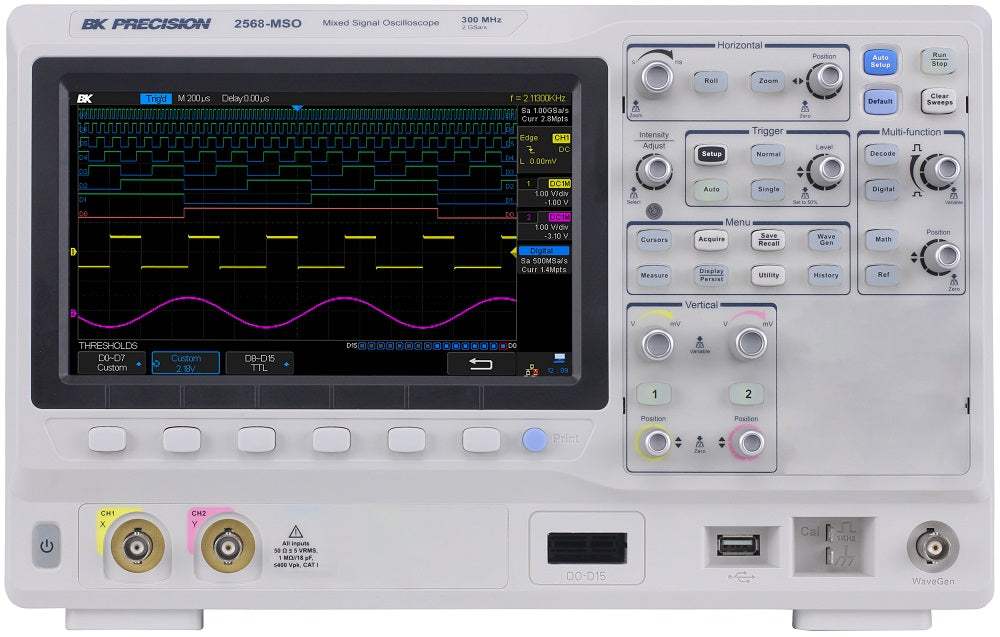
The B&K Precision 2560 Series is a family of digital storage and mixed signal oscilloscopes designed to deliver advanced features and debug capabilities across a wide range of applications. The series spans six base DSO models and six MSO variants, with bandwidth options of 70 MHz, 100 MHz, 200 MHz, and 300 MHz available in either 2-channel or 4-channel configurations. Each model offers a maximum sample rate of 2 GSa/s and a maximum memory depth of 140 Mpts, paired with an 8-inch widescreen display featuring 256 levels of color grading.
According to the datasheet, the 2560 Series is suited for applications in design, education, service, and repair. The instruments are positioned to help engineers capture signal anomalies, decode serial bus protocols, and accelerate debug and analysis work. The optional 25 MHz function and arbitrary waveform generator provides stimulus output for testing devices under test, while the optional logic analyzer upgrade and decode software extend the instrument into mixed-signal and embedded systems debug.
B&K Precision Corporation is a long-established American test and measurement manufacturer founded in 1951 and headquartered in Yorba Linda, California. The company has operated under the Sefelec group since 2014 while continuing to design and market test instruments under the B&K Precision brand.
The 2560 Series is a six-model oscilloscope family with each base DSO model also offered as a factory MSO variant, giving twelve total configurations. Bandwidth tiers step from 70 MHz through 100 MHz, 200 MHz, and 300 MHz, with channel counts of either two or four. All models share the same 2 GSa/s maximum sample rate, 140 Mpts maximum record length, 140,000 wfms/s waveform capture rate, 8-inch 800 x 480 display, and trigger set, so the family differentiates primarily on bandwidth, rise time, and channel count.
The DSO and MSO variants of each model are functionally identical on the analog side. The MSO variant adds 16 digital channels (the LA2560 logic analyzer license enabled at the factory) along with the LP2560 16-channel logic probe in the box. Any DSO model can be field-upgraded to an MSO at any time by purchasing the LA2560 license and LP2560 probe separately.
Each model in the 2560 Series is listed on its own product page at ValueTronics, with new-matched pricing displayed for each configuration. The comparison table below summarizes the headline differences across the family — bandwidth, channel count, and typical rise time — so the right model can be selected for the application before reviewing per-model pricing and availability.
Bandwidth and channel count are the primary axes of differentiation across the 2560 Series. The 2563 and 2563-MSO sit at the entry tier with 70 MHz of bandwidth across four analog channels and a typical rise time of less than 5.0 ns. The 2565 and 2565-MSO step bandwidth to 100 MHz at four channels with a typical rise time of less than 3.5 ns. The 200 MHz tier is offered in both a 2-channel form (2566 / 2566-MSO, typical rise time less than 1.8 ns) and a 4-channel form (2567 / 2567-MSO).
Beyond bandwidth and channel count, the family is uniform in its upgrade structure. The bus decode and analysis license (DC2560) and the 25 MHz waveform generator license (FG2560) are optional on every model — DSO and MSO alike. The LP2560 logic probe and LA2560 license are standard on every MSO model and optional on every DSO model. Refer to the comparison table for a side-by-side view of headline specs across all twelve configurations.
| Model | Bandwidth | Analog Channels | Digital Channels |
|---|---|---|---|
| 2568-MSO | 300 MHz | 2 | 16 |
| 2563 | 70 MHz | 4 | — |
| 2565 | 100 MHz | 4 | — |
| 2566 | 200 MHz | 2 | — |
Additional differences in specifications beyond the few shown above are not listed here — see each model's full specifications below.
| 2560 Series Specifications | |
|---|---|
| Performance Characteristics | |
| Bandwidth | 300 MHz (2568/2569); 200 MHz (2566/2567); 100 MHz (2565); 70 MHz (2563) |
| Typical Rise Time | < 1.2 ns (2568/2569), < 1.8 ns (2566/2567), < 3.5 ns (2565), < 5.0 ns (2563) |
| Sample Rate | 2 GSa/s (single channel), 1 MSa/s (dual channel) |
| Input Channels | 4 Analog Channels: 2563, 2565, 2567, 2569; 2 Analog Channels: 2566, 2568; Digital: 16 (-MSO models or with LA2560 upgrade) |
| Memory Depth | 140 Mpts (single channel), 70 Mpts (dual channel) |
| Waveform Update Rate | 140,000 wfms/s |
| Hardware Bandwidth Limits | 20 MHz |
| Input Coupling | DC, AC, GND |
| Input Impedance | 1 MΩ ± 2% || (22 pF ±3 pF); 50 Ω ± 2% |
| Ch to Ch Isolation | DC - Max BW > 35 dB |
| Acquisition System | |
| Peak Detect | 1 ns |
| Average | 4, 16, 32, 64, 128, 256, 512, 1024 |
| Enhanced Resolution (Eres) | 0.5, 1, 1.5, 2, 2.5, 3 bits selectable |
| Interpolation | Sin(x)/x, Linear |
| Vertical System | |
| Vertical Resolution | 8 bits |
| Vertical Sensitivity | 500 µV/div to 10 V/div (1-2-5) |
| Maximum Input Voltage | 1 MΩ: < 400 Vpk; 50 Ω: < 5 Vrms |
| DC Gain Accuracy | ±3%: 5 mV/div to 10 V/div; ±4%: < 2 mV/div |
| Horizontal System | |
| Time Base Range | 2.0 ns/div to 50 s/div |
| Time Base Accuracy | ±25 ppm |
| Ch to Ch Deskew Range | <100 ps |
| Trigger System | |
| Modes | Auto, Normal, Single |
| Coupling | DC, AC, LF Reject, HF Reject, Noise Reject Ch1-Ch4 |
| Trigger Level | Internal: ±4.5 div from center; External: EXT: ±0.6 V, EXT/5: ±3 V |
| Hold-Off Range | 100 ns to 1.5 s |
| Types | Edge, Slope, Pulse, Video, Window, Interval, Dropout, Runt, Pattern |
| Serial Trigger | I2C, SPI, UART/RS232, CAN, LIN |
| I/O Interface | |
| Standard | USB Host, USB Device, LAN, Pass/Fail, Trigger Out |
| Pass/Fail | 3.3 V TTL Output |
| Display System | |
| Display | 8" Color TFT-LCD, 800 x 480 Resolution |
| Wave Display Mode | Vectors, Dots |
| Persistence | Off, Infinite, 1 sec, 5 sec, 10 sec, 30 sec |
| Intensity Grading | 256 Levels |
| Language | English, French, Japanese, Korean, German, Russian, Italian, Portuguese, Simplified Chinese, Traditional Chinese |
| Cursors | |
| Mode | Manual, Track |
| Measurements | ∆T, 1/∆T, X2, X1, ∆V, Y2, Y1 |
| Waveform Math | |
| Math Operation | Add, Subtract, Multiply, Divide, FFT, Derivative, Integral, Square Root |
| FFT | Windows: Rectangle, Blackman, Hanning, Hamming, Flattop |
| Waveform Measurements | |
| Voltage | Vpp, Vmax, Vmin, Vamp, Vtop, Vbase, Mean, Cmean, Stdev, Cstd, Vrms, Crms, FOV, FPRE, ROV, RPRE, Level@Trigger |
| Time | +SR, -SR, Period, Freq, +Width, -Width, Rise, Fall, BWidth, +Duty, -Duty, Time@Mid |
| Delay | Phase, FRR, FRF, FFR, FFF, LRR, LRF, LFF, Skew |
| Statistics | Current, Mean, Min, Max, Stdev, Count |
| Gating | Time domain |
| MSO Digital Channels (LA2560/LP2560) | |
| Digital Channels | 16 |
| Sample Rate | 500 MSa/s |
| Memory Depth | 14 Mpts/Ch |
| Maximum Input Voltage | ± 20 Vpeak |
| Threshold Accuracy | ± (3% of threshold setting + 150 mV) |
| Input Dynamic Range | ± 10 V |
| Minimum Input Voltage Swing | 800 mVpp |
| Input Impedance | 100 kΩ || 18 pF |
| Maximum Input Frequency | 60 MHz |
| Minimum Detectable Pulse Width | 8.3 ns |
| Ch to Ch Skew | ± (1 digital sample interval) |
| User Defined Threshold Range | ± 3 V in 10 mV steps |
| Threshold Selections | TTL, CMOS, LVCMOS3.3, LVCMOS2.5, Custom (-3 to +3 V) |
| Function/Arbitrary Waveform Generator (FG2560) | |
| Waveforms | Sine, Square, Ramp, Pulse, DC, Noise, Cardiac, Gaus Pulse, Exp Rise |
| Arbitrary | 4 Slots for Arbitrary Waveforms |
| Maximum Output Frequency | 25 MHz |
| Sample Rate | 125 MSa/s |
| Frequency Resolution | 1 µHz |
| Frequency Accuracy | ±50 ppm |
| Vertical Resolution | 14 bits |
| Amplitude Range | -1.5 to +1.5 V @ 50 Ω; -3 to +3 V @ 1 MΩ |
| Output Impedance | 50 Ω ±2% |
| Protection | Short-Circuit Protection |
| Environmental and Safety | |
| Temperature | Operating: 10 °C to +40 °C; Storage: -20 °C to +60 °C |
| Humidity | Operating: 85% RH, 40 °C, 24 hours; Storage: 85% RH, 65 °C, 24 hours |
| Altitude | Operating: 3,000 m; Storage: 15,266 m |
Please review the Manufacturer's Data Sheet to verify published specifications. Feedback on this webpage is always welcome — please reach out to your Test Architect at any time for questions or concerns. Thank you, we truly appreciate you being our customer.
Model No
B&K
Condition
New
Manufacturer
B&K Precision
Channels
2+16
Frequency
300 MHz
Record length
140 MPts
Sampling rate
2 GS/s


30+ Years in Business

Secure Payments

Sell Test Equipments

Knowledgeable Staff

On-site Lab
30+ Years in Business
Secure Payments
Sell Test Equipments
Knowledgeable Staff
On-site Lab
Request A Quote