Chat Live
 Contact Us
 sales@valuetronics.com


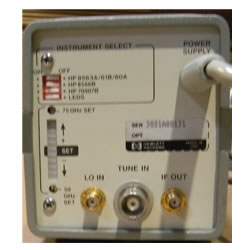
The Agilent 11974 Series Preselected Millimeter Mixers extend preselected signal analysis to 75 GHz across four RF waveguide bands. The series comprises the 11974A (26.5 to 40 GHz), 11974Q (33 to 50 GHz), 11974U (40 to 60 GHz), and 11974V (50 to 75 GHz). Each mixer is individually characterized for conversion loss versus frequency so that calibration data can be entered into the host spectrum analyzer to make amplitude-calibrated measurements at millimeter frequencies.
The datasheet identifies millimeter-frequency component and system testing, signal surveillance, and EMI measurements as the application areas the 11974 Series addresses. With preselection in place, true signals are displayed without the images and multiple responses that appear in unpreselected millimeter measurement setups, eliminating the signal-identification routines that would otherwise be required to distinguish real responses from artifacts. The operator places a marker on a signal, performs a preselector peak, and the analyzer displays the amplitude and frequency of that signal directly.
ValueTronics International is a specialist source for test and measurement instruments operating from a 20,000-square-foot secure warehouse at 1675 Cambridge Drive in Elgin, Illinois. Equipment is held in our own facility, where it can be inspected and performance-verified by our technicians prior to shipment rather than drop-shipped from a third-party location. This in-house handling is the basis on which the condition descriptions and warranty terms in our quotes are made.
Hewlett-Packard's test and measurement business was spun out as Agilent Technologies in 1999, and Agilent's electronic measurement business was then transferred to Keysight Technologies in 2014. Products carrying the Agilent brand, such as the 11974 Series documented here, originate from the same product line that continues under Keysight today.
The 11974 Series consists of four preselected millimeter mixers that together cover 26.5 GHz to 75 GHz, with each model assigned to a specific waveguide band. The 11974A covers 26.5 to 40 GHz on WR-28 waveguide, the 11974Q covers 33 to 50 GHz on WR-22, the 11974U covers 40 to 60 GHz on WR-19, and the 11974V covers 50 to 75 GHz on WR-15. The bands overlap at their edges, so selection between two adjacent models is driven by the specific frequencies of interest, the waveguide flange already in use on the device under test, and the displayed average noise level and image rejection performance at the relevant frequency.
All four models share the same architecture, the same 11974-60028 power supply, the same accessory set, the same operating temperature range of 0 °C to 55 °C, and the same MIL-T-28800C Class 5 environmental qualification. The differences across the family lie in frequency coverage, LO harmonic number used for downconversion, conversion-loss and image-rejection specifications, and preselector bandwidth.
Each pre-owned model below is its own dedicated product page with condition-matched pricing. Use the links to navigate to the specific waveguide band that matches the application, and contact us if the right answer involves more than one band or if a companion item such as the 11975A LO amplifier or a host analyzer upgrade kit needs to be quoted alongside the mixer.
Frequency coverage and LO harmonic number step through the family as follows: the 11974A uses n = 8 for 26.5 to 40 GHz, the 11974Q uses n = 10 for 33 to 50 GHz, the 11974U uses n = 10 for 40 to 60 GHz, and the 11974V uses n = 14 for 50 to 75 GHz. Preselector 3 dB bandwidth (minimum / typical) widens with frequency, from 80 / 130 MHz on the 11974A to 100 / 200 MHz on the 11974V. Conversion-loss chart accuracy at 20 °C to 30 °C is tightest on the 11974A and 11974Q (≤ ±1.0 dB), with the 11974U at ≤ +1.1 dB and the 11974V at ≤ ±2.0 dB.
Image rejection at the host analyzer's IF (8566B, 71000C, PSA Series, 0 °C to 55 °C) is ≤ -54 dBc on the 11974A, ≤ -50 dBc on the 11974Q and 11974U, ≤ -50 dBc on the 11974V from 50 to 67 GHz, and ≤ -40 dBc on the 11974V from 67 to 75 GHz. Maximum conversion loss (RF to IF port, including the 1-m IF cable) is 44 dB on the 11974A, 46 dB on the 11974Q, 43 dB on the 11974U, and 57 dB on the 11974V. Waveguide flange types differ across the family (UG 599/U, UG 383/U, UG 383/U-M, UG 385/U). The comparison table that follows lays these specifications out side by side so the right band can be selected for the measurement at hand.
| Model | Frequency Range | LO Harmonic Number | Waveguide Size |
|---|---|---|---|
| 11974V | 50 GHz to 75 GHz | n = 14 | WR-15 (UG 385/U) |
| 11974A | 26.5 GHz to 40 GHz | n = 8 | WR-28 (UG 599/U) |
| 11974Q | 33 GHz to 50 GHz | n = 10 | WR-22 (UG 383/U) |
| 11974U | 40 GHz to 60 GHz | n = 10 | WR-19 (UG 383/U-M) |
Additional differences in specifications beyond the few shown above are not listed here — see each model's full specifications below.
| Specification | Value |
|---|---|
| Frequency | |
| 11974A frequency range (LO harmonic n = 8) | 26.5 GHz to 40 GHz |
| 11974Q frequency range (LO harmonic n = 10) | 33 GHz to 50 GHz |
| 11974U frequency range (LO harmonic n = 10) | 40 GHz to 60 GHz |
| 11974V frequency range (LO harmonic n = 14) | 50 GHz to 75 GHz |
| Preselector bandwidth, 3 dB points, 11974A | Minimum 80 MHz; Typical 130 MHz |
| Preselector bandwidth, 3 dB points, 11974Q | Minimum 100 MHz; Typical 150 MHz |
| Preselector bandwidth, 3 dB points, 11974U | Minimum 100 MHz; Typical 150 MHz |
| Preselector bandwidth, 3 dB points, 11974V | Minimum 100 MHz; Typical 200 MHz |
| Amplitude | |
| Displayed average noise level (8566B, 71000C, PSA Series; RBW = 10 Hz), 11974A | Maximum −111 dBm; Typical −118 dBm |
| Displayed average noise level (8566B, 71000C, PSA Series; RBW = 10 Hz), 11974Q | Maximum −106 dBm; Typical −116 dBm |
| Displayed average noise level (8566B, 71000C, PSA Series; RBW = 10 Hz), 11974U | Maximum −109 dBm; Typical −117 dBm |
| Displayed average noise level (8566B, 71000C, PSA Series; RBW = 10 Hz), 11974V | Maximum −100 dBm; Typical −109 dBm |
| Displayed average noise level (8563A/62A/61B/60A; RBW = 300 Hz), 11974A | Maximum −96 dBm; Typical −103 dBm |
| Displayed average noise level (8563A/62A/61B/60A; RBW = 300 Hz), 11974Q | Maximum −91 dBm; Typical −101 dBm |
| Displayed average noise level (8563A/62A/61B/60A; RBW = 300 Hz), 11974U | Maximum −94 dBm; Typical −104 dBm |
| Displayed average noise level (8563A/62A/61B/60A; RBW = 300 Hz), 11974V | Maximum −85 dBm; Typical −94 dBm |
| Maximum conversion loss, RF to IF port (incl. 1-m IF cable 5061-5458), 11974A | 44 dB |
| Maximum conversion loss, RF to IF port (incl. 1-m IF cable 5061-5458), 11974Q | 46 dB |
| Maximum conversion loss, RF to IF port (incl. 1-m IF cable 5061-5458), 11974U | 43 dB |
| Maximum conversion loss, RF to IF port (incl. 1-m IF cable 5061-5458), 11974V | 57 dB |
| Conversion loss chart accuracy, 11974A | 0 °C to 55 °C: ≤ ±2.3 dB; 20 °C to 30 °C: ≤ ±1.0 dB |
| Conversion loss chart accuracy, 11974Q | 0 °C to 55 °C: ≤ ±2.3 dB; 20 °C to 30 °C: ≤ +1.0 dB |
| Conversion loss chart accuracy, 11974U | 0 °C to 55 °C: ≤ ±2.6 dB; 20 °C to 30 °C: ≤ +1.1 dB |
| Conversion loss chart accuracy, 11974V | 0 °C to 55 °C: ≤ ±4.5 dB; 20 °C to 30 °C: ≤ ±2.0 dB |
| Image rejection (8566B, 71000C, PSA Series), 11974A | 0 °C to 55 °C: ≤ −54 dBc; 20 °C to 30 °C: ≤ −59 dBc |
| Image rejection (8566B, 71000C, PSA Series), 11974Q | 0 °C to 55 °C: ≤ −50 dBc; 20 °C to 30 °C: ≤ −55 dBc |
| Image rejection (8566B, 71000C, PSA Series), 11974U | 0 °C to 55 °C: ≤ −50 dBc; 20 °C to 30 °C: ≤ −55 dBc |
| Image rejection (8566B, 71000C, PSA Series), 11974V (50 to 67 GHz) | 0 °C to 55 °C: ≤ −50 dBc; 20 °C to 30 °C: ≤ −55 dBc |
| Image rejection (8566B, 71000C, PSA Series), 11974V (67 to 75 GHz) | 0 °C to 55 °C: ≤ −40 dBc; 20 °C to 30 °C: ≤ −45 dBc |
| Image rejection (8563A/62A/61B/60A), 11974A | 0 °C to 55 °C: ≤ −50 dBc; 20 °C to 30 °C: ≤ −55 dBc |
| Image rejection (8563A/62A/61B/60A), 11974Q | 0 °C to 55 °C: ≤ −45 dBc; 20 °C to 30 °C: ≤ −50 dBc |
| Image rejection (8563A/62A/61B/60A), 11974U | 0 °C to 55 °C: ≤ −45 dBc; 20 °C to 30 °C: ≤ −50 dBc |
| Image rejection (8563A/62A/61B/60A), 11974V (50 to 67 GHz) | 0 °C to 55 °C: ≤ −45 dBc; 20 °C to 30 °C: ≤ −50 dBc |
| Image rejection (8563A/62A/61B/60A), 11974V (67 to 75 GHz) | 0 °C to 55 °C: ≤ −35 dBc; 20 °C to 30 °C: ≤ −40 dBc |
| Multiple response, 11974A (n = 8) | ≤ −63 dBc |
| Multiple response, 11974Q (n = 10) | ≤ −60 dBc |
| Multiple response, 11974U (n = 10) | ≤ −60 dBc |
| Multiple response, 11974V (n = 14, applied signal 50 to 67 GHz) | ≤ −60 dBc |
| Multiple response, 11974V (n = 14, applied signal 67 to 75 GHz) | ≤ −55 dBc |
| 1 dB gain compression (nominal), 11974A | ≥ +6 dBm |
| 1 dB gain compression (nominal), 11974Q | ≥ 0 dBm |
| 1 dB gain compression (nominal), 11974U | ≥ 0 dBm |
| 1 dB gain compression (nominal), 11974V | ≥ +3 dBm |
| Third-order intercept (nominal), two signals spaced less than 200 MHz apart, all models | ≥ +13 dBm |
| IF subharmonic response intercept (nominal), 11974A/Q/U | ≥ +45 dBm |
| IF subharmonic response intercept (nominal), 11974V | ≥ +30 dBm |
| Inputs and Outputs (nominal) | |
| RF input waveguide, 11974A | WR-28, flange UG 599/U |
| RF input waveguide, 11974Q | WR-22, flange UG 383/U |
| RF input waveguide, 11974U | WR-19, flange UG 383/U-M |
| RF input waveguide, 11974V | WR-15, flange UG 385/U |
| Maximum RF input level (CW, peak, or average) | +25 dBm |
| RF input VSWR (at peak of preselector filter) | < 3.0:1 |
| LO input connector type | SMA (f) |
Please review the Manufacturer's Data Sheet to verify published specifications. Feedback on this webpage is always welcome — please reach out to your Test Architect at any time for questions or concerns. Thank you, we truly appreciate you being our customer.
Model No
Agilent
Condition
Used
Manufacturer
Agilent
Frequency
75 GHz


30+ Years in Business

Secure Payments

Sell Test Equipments

Knowledgeable Staff

On-site Lab
30+ Years in Business
Secure Payments
Sell Test Equipments
Knowledgeable Staff
On-site Lab
Request A Quote