Chat Live
 Contact Us
 sales@valuetronics.com


The Agilent 11691D and 11692D are broadband 20 dB directional couplers designed for swept reflectometer applications across the 2 to 18 GHz frequency range. The 11691D is a single directional coupler and the 11692D is a dual directional coupler. Both are precision instruments built so that one coupler can replace several narrower-band couplers in a microwave test setup without performance degradation, reducing setup and calibration time for swept reflection and transmission measurements.
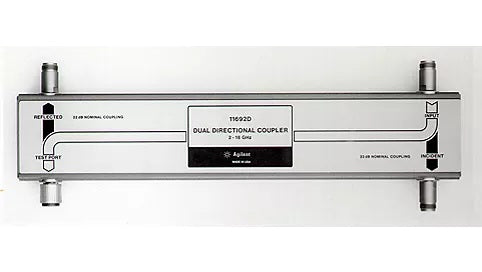
These couplers are used for simultaneous swept measurement of reflection and transmission characteristics from 2 to 18 GHz. In a typical setup, the 11692D dual coupler separates and isolates the incident and reflected signals from the device under test, while the 11691D single coupler is placed in the transmitted-signal path to compensate for the coupling variations seen by the reference detector. The broad frequency coverage of the 11691D also makes it suitable for leveling broadband sources, and its high directivity supports source-match performance that is not achievable with directional detectors alone.
Each pre-owned 11691D or 11692D directional coupler offered by ValueTronics is inspected and prepared at our 20,000 square foot secure warehouse at 1675 Cambridge Drive, Elgin, Illinois. As a dedicated test and measurement specialist, ValueTronics maintains both the physical inventory and the in-house technical staff required to support legacy microwave passive components like these broadband couplers — a level of accountability and product knowledge that drop-shippers and pass-through brokers cannot provide.
These couplers carry the Agilent brand. Agilent Technologies was spun out of Hewlett-Packard in 1999 as HP's test and measurement business, and in 2014 the electronic measurement portion of Agilent was transferred to Keysight Technologies. Many Agilent-branded microwave components from this era are now serviced and supported under the Keysight brand.
The 11691D/11692D family consists of two broadband 20 dB directional couplers covering 2 to 18 GHz. Both share the same nominal coupling value, the same directivity specifications, the same primary line SWR limits, and the same primary line power handling. The functional difference between the two models is the number of coupled arms: the 11691D is a single directional coupler, and the 11692D is a dual directional coupler used to separate incident and reflected signals in the same housing.
Because the two couplers share the same coupling, directivity, and bandwidth specifications, they are designed to be used together in a single swept reflectometer setup. The 11692D handles the incident/reflected separation at the device under test, and the 11691D is placed in the transmitted-signal arm to compensate for coupling variations seen by the reference detector.
Each model below is offered on its own product page with pre-owned-matched pricing. Select the model and connector configuration that matches your test setup.
The 11691D is the single-coupler member of the family. Its maximum primary line residual loss is less than 2 dB, and the standard configuration uses APC-7 primary line connectors with a Type-N(f) auxiliary-arm connector. In a reflectometer setup, the 11691D is used in the transmitted-signal arm to compensate the reference path.
The 11692D adds a second coupled arm in the same housing, giving it both an incident and a reflected sample port (the dual directional coupler configuration). Its maximum primary line residual loss is less than 1.5 dB. The 11692D is also offered in a wider range of connector options (Options 001 through 005), allowing different combinations of Type-N and APC-7 connectors on the primary line and auxiliary ports.
Specifications such as frequency range (2 to 18 GHz), nominal coupling (20 dB), directivity (30 dB from 2 to 8 GHz, 26 dB from 8 to 18 GHz), coupling variation (±1 dB), and primary line power handling (50 W average, 250 W peak) are common to both models. See the comparison table below for the model-by-model specification view.
| Model | Frequency Range | Nominal Coupling | Type |
|---|---|---|---|
| 11692D | 2 to 18 GHz | 20 dB | Dual Directional Coupler |
| 11691D | 2 to 18 GHz | 20 dB | Single Directional Coupler |
Additional differences in specifications beyond the few shown above are not listed here — see each model's full specifications below.
| Specification | 11692D |
|---|---|
| Frequency range | 2 to 18 GHz |
| Minimum directivity (2 to 18 GHz) | 30 dB |
| Minimum directivity (8 to 18 GHz) | 26 dB (24 dB with type-N connector on the TEST PORT) |
| Maximum primary line SWR (2 to 12.4 GHz) | 1.3 |
| Maximum primary line SWR (12.4 to 18 GHz) | 1.40 |
| Maximum auxiliary port(s) SWR | 1.3 |
| Nominal coupling | 20 dB |
| Maximum coupling variation with frequency | ±1 dB (incident to test port) |
| Tracking auxiliary arms | ±0.7 dB (with the test port shorted and not including source match ripple) |
| Maximum primary line residual loss | < 1.5 dB |
| Primary line power handling capability | 50 W average, 250 W peak |
| Net weight | 2.72 kg (6 lb, 0 oz) |
| Dimensions (L × H × W) | 404.8 mm (15-15/16 in) × 133.4 mm (5-1/4 in) × 42.9 mm (1-11/16 in) |
Please review the Manufacturer's Data Sheet to verify published specifications. Feedback on this webpage is always welcome — please reach out to your Test Architect at any time for questions or concerns. Thank you, we truly appreciate you being our customer.
Model No
Agilent
Condition
Used
Manufacturer
Agilent
Frequency
18 GHz


30+ Years in Business

Secure Payments

Sell Test Equipments

Knowledgeable Staff

On-site Lab
30+ Years in Business
Secure Payments
Sell Test Equipments
Knowledgeable Staff
On-site Lab
Request A Quote