 Chat Live
 Contact Us
 sales@valuetronics.com


🎓 Request a Quote To Get An EDU Discount
Couldn't load pickup availability
4 FlexChannel® inputs · 8 GHz bandwidth · 12-bit ADC (16-bit High Res) · 15.6" HD touchscreen · 62.5 Mpoints standard record length.
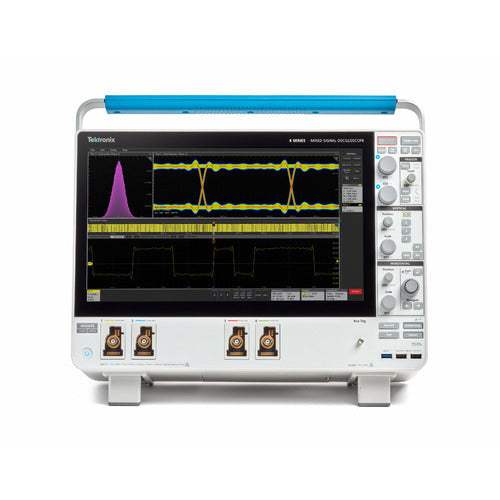
In summary, the Tektronix MSO64B-6-BW-8000 is a 4-channel mixed signal oscilloscope with 8 GHz of analog bandwidth, a 12-bit ADC (extended to 16 bits in High Res mode), a 15.6-inch 1920×1080 capacitive touchscreen, and FlexChannel® inputs that let each channel be used as one analog input or eight digital logic inputs. It is part of the Tektronix 6 Series B MSO family — the current flagship mid-range Tektronix platform — designed for embedded systems debug, power electronics, high-speed serial validation, three-phase power analysis, and RF-adjacent mixed-domain work.
The MSO64B-6-BW-8000 is used to capture, visualize, and analyze time-domain and frequency-domain signals on electronic systems with clock speeds and bus rates up to 8 GHz. Typical applications include embedded firmware and hardware debug across I²C, SPI, UART, CAN/CAN FD, LIN, FlexRay, USB 2.0, Ethernet, and MIPI buses; switching power supply and three-phase inverter characterization; DDR3/LPDDR3 memory debug and compliance; PAM3 and high-speed serial signal-integrity analysis; and Spectrum View frequency-domain analysis on every analog input.
4 analog channels lets you observe more nodes of a system at once without the trigger-alignment and documentation overhead of running two scopes in parallel. Three-phase power conversion, polyphase motor drives, multi-rail power integrity, and complex embedded systems frequently require simultaneous observation of more than four analog signals to verify and characterize device performance. Per Tektronix, six-channel models typically cost only about 25% more than four-channel models, and eight-channel models about 67% more — far less than the doubling that older single-purpose channel-count economics would imply.
Analog bandwidth is 8 GHz on all analog channels, with a 12-bit ADC that delivers 16 times the vertical resolution of traditional 8-bit oscilloscopes. Real-time sample rate is 50 GS/s on 2 channels, 25 GS/s on 4 channels, and 12.5 GS/s on more than 4 channels; this 4-channel configuration tops out at 25 GS/s when all channels are active. Standard record length is 62.5 Mpoints on every channel, expandable to 1 Gpoint per channel as an option. Random noise is specified as low as 51.8 µV RMS at 1 mV/div with 1 GHz bandwidth — among the lowest in this class — enabled by the TEK061 front-end ASIC. Waveform capture rate exceeds 500,000 wfms/s in Peak Detect / Envelope modes.
The 6 Series B MSO platform supports automated TekExpress compliance test solutions for USB 2.0, Ethernet (10/100/1000BASE-T and 2.5/5/10GBASE-T), Automotive Ethernet (100BASE-T1, 1000BASE-T1, 10BASE-T1S, 10BASE-T1L), MIPI D-PHY 1.2, and DDR3/LPDDR3, with calibration data documenting traceability to National Metrology Institutes and ISO 9001 / ISO/IEC 17025 quality system registration. Option 6-SEC adds password-protected I/O lockdown and BIOS protection developed in compliance with NISPOM DoD 5220.22-M Chapter 8 — important for classified and controlled-environment labs. The instrument is LXI Core 2011 compatible and supports IVI-COM drivers, TekVISA, USBTMC, and LAN/USB programmatic control.
Against the prior Tektronix DPO7000C and MSO/DPO70000C platforms, the 6 Series B improves most on noise floor and channel architecture. At 1 GHz / 10 mV/div, typical 50 Ω input-referred noise is 82.9 µV RMS versus 279 µV RMS on the DPO7000C — roughly 3.4× better. At 4 GHz / 100 mV/div, noise is 1.73 mV RMS versus 4.3 mV RMS on the MSO/DPO70000C. FlexChannel® inputs replace fixed analog/digital channel allocation: each input carries one analog, eight digital (TLP058), or a simultaneous spectrum view, in any combination. Vertical resolution is 12-bit native (16-bit in High Res) versus 8-bit on legacy platforms. Typical workloads include embedded debug across I²C, SPI, I3C, UART, CAN/CAN FD, LIN, FlexRay, USB 2.0, eUSB2, and SPMI; power-electronics analysis with 6-PWR; three-phase work with 6-IMDA (MSO66B / MSO68B only); high-speed serial validation with 6-DJA; and mixed-domain RF work using Spectrum View on every channel.
Each new instrument ships with one TPP1000 1 GHz passive voltage probe per FlexChannel® input (high dynamic range, 3.9 pF capacitive loading), a front cover with integrated accessory pouch, a USB mouse, a country-specific power cord (selected at order via the A0–A99 option codes), an installation and safety manual in English, Japanese, and Simplified Chinese, the embedded context-sensitive help system, and a calibration certificate documenting traceability to National Metrology Institute(s) under Tektronix's ISO 9001 and ISO/IEC 17025 registered quality system. The standard one-year warranty covers all parts and labor on both the instrument and the included probes.
Bandwidth is the single most important specification on any oscilloscope: capturing clean square-wave edges requires capturing the harmonics at 3×, 5×, and 7× the fundamental. The MSO64B-6-BW-8000 delivers 8 GHz of analog bandwidth across all 4 channels, and bandwidth is field-upgradeable to higher tiers with only a software license and a new front-panel label.
Sample rate on the 6 Series B is tiered by active channel count: 50 GS/s on two channels, 25 GS/s on four channels, and 12.5 GS/s on more than four. In this 4-channel configuration, the architecture supports 25 GS/s when all channels are active. Standard record length is 62.5 Mpoints on every channel; Capture Duration = Memory ÷ Sample Rate, so even the standard memory captures several milliseconds at full rate. Customers running long compliance sequences, power-supply startup analysis, or rare-event capture should add 6-RL-1 / -2 / -3 / -4 to extend record length up to 1 Gpoint per channel.
Where the 6 Series B genuinely differentiates is noise performance and channel architecture. The TEK061 front-end ASIC delivers as low as 51.8 µV RMS at 1 mV/div / 1 GHz — roughly 3× lower than the prior DPO7000C generation — and FlexChannel® inputs let every channel be used as one analog signal, eight digital logic inputs (with TLP058 probe), or a simultaneous analog + Spectrum View pair with independent time- and frequency-domain controls.
| Parameter | Specification |
|---|---|
| FlexChannel® inputs | 4 |
| Maximum analog channels | 4 |
| Maximum digital channels (with TLP058 probes) | 32 |
| Analog bandwidth | 8 GHz |
| ADC resolution | 12-bit (16-bit in High Res mode) |
| Max sample rate (this config, all ch) | 25 GS/s |
| Sample rate, full architecture | 50 GS/s (2 ch); 25 GS/s (4 ch); 12.5 GS/s (>4 ch); interpolated 2.5 TS/s |
| Standard record length | 62.5 Mpoints / channel |
| Optional record length | 125 M / 250 M / 500 M / 1 Gpoint / ch (6-RL-1 to -4) |
| Waveform capture rate | >500,000 wfms/s (Peak Detect / Envelope); >30,000 wfms/s otherwise; FastFrame™ >5,000,000 wfms/s |
| Time base range | 40 ps/div to 1,000 s/div |
| Timebase accuracy | ±1.0 × 10⁻⁷ over ≥1 ms; ±12 ppb factory tolerance; ±20 ppb temp stability (0–50 °C); ±300 ppb crystal aging/year |
| Aperture uncertainty (typical) | 80 fs (<1 µs); 130 fs (<1 ms) |
| Acquisition modes | Sample, Peak Detect (160 ps glitch), Averaging (2–10,240), Envelope, High Res, FastAcq®, Roll, FastFrame™ |
| Input coupling | DC, AC |
| Input impedance | 1 MΩ ±1% DC; 50 Ω ±3% DC |
| Input capacitance (1 MΩ, typical) | 14.5 pF ±1.5 pF |
| Sensitivity range | 1 MΩ: 500 µV/div–10 V/div; 50 Ω: 1 mV/div–1 V/div (1-2-5) |
| Max input voltage (1 MΩ) | 300 V RMS (derated above 4.5 MHz; 5.5 V RMS above 450 MHz) |
| Max input voltage (50 Ω) | 2.3 V RMS at <100 mV/div; 5.5 V RMS at ≥100 mV/div; peaks ≤ ±20 V (DF ≤ 6.25%) |
| DC gain accuracy | ±2.0% at >2 mV/div; ±1.0% of full scale at >2 mV/div |
| Position range | ±5 divisions |
| Vertical resolution (High Res) | 12-bit @ 12.5 GS/s · 13 @ 6.25 GS/s · 14 @ 3.125 GS/s · 15 @ 1.25 GS/s · 16 @ ≤625 MS/s |
| Vertical resolution (Sample) | 8-bit @ 50 GS/s (2 ch) · 8 @ 25 GS/s (4 ch) · 12 @ 12.5 GS/s |
| Crosstalk (typical) | ≥50 dB to 2 GHz; ≥45 dB to 5 GHz; ≥40 dB to 10 GHz |
| Deskew range | −125 ns to +125 ns; 1 ps resolution |
Each TLP058 logic probe adds 8 digital inputs (D7–D0) at the cost of one analog channel, allowing this 4-channel model to scale up to 32 digital channels with the right probe complement. Maximum input toggle rate is 500 MHz, with a minimum detectable pulse width of 1 ns (typical). Threshold range is ±40 V in 10 mV resolution; accuracy is ±[100 mV + 3% of threshold setting] after calibration. Typical input dynamic range is 30 V p-p for Fin ≤ 200 MHz and 10 V p-p above 200 MHz; absolute maximum input voltage is ±42 V peak. Probe loading is 2 pF / 100 kΩ (typical).
Trigger modes are Auto, Normal, and Single. Coupling supports DC, HF Reject (attenuates >50 kHz), LF Reject (attenuates <50 kHz), and Noise Reject. Standard trigger types include Edge, Pulse Width, Runt, Timeout, Window, Logic, Setup & Hold, Rise/Fall Time, Parallel Bus, Sequence, and Visual Trigger; Video (optional 6-VID) and RF Magnitude / Frequency vs. Time (optional 6-SV-RFVT) are also available. Auxiliary trigger input accepts ≤5 V RMS into 50 Ω at 400 MHz (Edge trigger only). Holdoff range is 0 ns to 10 s. Typical trigger jitter is ≤1.5 ps RMS in Sample-mode edge triggering, ≤2 ps RMS in FastAcq edge mode, and ≤80 ps p-p for non-edge trigger types. An 8-digit trigger frequency counter is included free with product registration.
Tektronix-patented frequency-domain analysis with independent time- and frequency-domain controls per channel. Span 74.5 Hz – 1.25 GHz standard (2 GHz with option 6-SV-BW-1); RBW 93 µHz to 62.5 MHz (100 MHz with 6-SV-BW-1). Center frequency is limited by instrument bandwidth (8 GHz). Window types include Blackman-Harris, Flat-Top 2, Hamming, Hanning, Kaiser-Bessel, and Rectangular. Reference level −42 dBm to +44 dBm; vertical units dBm, dBµW, dBmV, dBµV, dBmA, dBµA. Option 6-SV-RFVT adds RF Magnitude / Frequency / Phase vs. Time traces and hardware trigger on RF vs. time events.
The optional 6-AFG arbitrary / function generator delivers 50 MHz output across Sine, Square, Pulse, Ramp/Triangle, DC level, Gaussian, Lorentz, Exponential Rise/Fall, Sin(x)/x, Random Noise, Haversine, Cardiac, and Arbitrary waveforms, with 128 k arbitrary waveform memory at a 250 MS/s arb sample rate; compatible with Tektronix ArbExpress. A 4-digit Digital Voltmeter (DC, AC RMS, DC+AC RMS on any analog input) and an 8-digit Trigger Frequency Counter are both included free with product registration.
| Parameter | Specification |
|---|---|
| Display | 15.6 in (396 mm) TFT, 1920 × 1080 HD, capacitive multi-touch |
| USB | Front: 2× USB 2.0 + 1× USB 3.0 Host. Rear: 2× USB 2.0 + 2× USB 3.0 Host + 1× USB 3.0 Device (USBTMC) |
| LAN / video | 10/100/1000BASE-T Ethernet (LXI Core 2011); DisplayPort, DVI-I, VGA |
| Remote control | e*Scope® web, TekVISA, IVI-COM, USBTMC; Windows Remote Desktop with 6-WIN |
| Operating system | Closed embedded OS on removable SSD; optional 6-WIN adds Windows 10 SSD |
| Power | 500 W max; 100–240 V ±10% at 50–60 Hz; 115 V ±10% at 400 Hz |
| Dimensions / weight | 12.2 in H × 17.9 in W × 8.0 in D (309 × 454 × 204 mm); <28.4 lb (12.88 kg) |
| Environmental | 0 to +50 °C operating; 5–90% RH (≤+40 °C), 5–55% RH (+40 to +50 °C); up to 3,000 m |
| Regulatory | CE (EU), UL (US/Canada), RoHS, ISO 9001 / ISO 14001 registered |
The 6 Series B supports a deep library of factory-installed and field-upgradeable options. Node-locked licenses permanently enable features on a single instrument; floating licenses move between compatible instruments. Bandwidth itself is software-upgradeable — moving from 8 GHz to a higher tier later requires only a license and a new front-panel label, no hardware swap.
Note: Options 6-IMDA and 6-IMDA-DQ0 (Inverter Motor Drive Analysis) are not compatible with MSO64B 4-channel models — these require an MSO66B or MSO68B.
Instrument functions: 6-RL-1, 6-RL-2, 6-RL-3, 6-RL-4 (extend record length to 125 M, 250 M, 500 M, or 1 Gpoint/ch); 6-AFG (50 MHz arbitrary/function generator, 13 waveform types); 6-WIN (Windows 10 SSD); 6-SEC (NISPOM DoD 5220.22-M Ch. 8 enhanced security — order with instrument, not available as later upgrade).
Power, motor & jitter analysis: 6-PWR (harmonics, switching loss, SOA, dv/dt, di/dt, ripple, magnetics, efficiency, Bode plot, PSRR); 6-PS2 (power solution bundle — 6-PWR + THDP0200 + TCP0030A + 067-1686-XX deskew fixture); 6-DPM (Digital Power Management); 6-DJA (Advanced Jitter and Eye Analysis — TJ@BER, RJ-δδ, DJ-δδ, PJ, NPJ, eye mask); 6-PAM3.
Spectrum & specialty: 6-SV-BW-1 (Spectrum View to 2 GHz); 6-SV-RFVT (RF vs. Time, IQ data for SignalVu-PC); 6-MTM (Mask & Limit Testing); 6-VID (NTSC/PAL/SECAM video trigger); 6-DBDDR3 + 6-CMDDR3 (DDR3/LPDDR3 debug and compliance — ≥4 GHz required, 8 GHz recommended); 6-DBLVDS.
Serial protocol decode & trigger: 6-SRAERO (MIL-STD-1553, ARINC 429); 6-SRAUDIO (I²S/LJ/RJ/TDM); 6-SRAUTO (CAN, CAN FD, LIN, FlexRay); 6-SRAUTOEN1 (100BASE-T1); 6-SRAUTOSEN (SENT); 6-SRCOMP (RS-232/422/485/UART); 6-SRDPHY (MIPI D-PHY); 6-SREMBD (I²C, SPI); 6-SRENET (10/100BASE-T); 6-SREUSB2; 6-SRI3C; 6-SRMANCH; 6-SRMDIO; 6-SR8B10B; 6-SRNRZ; 6-SRPM (SPMI); 6-SRPSI5; 6-SRSPACEWIRE; 6-SRSVID; 6-SRUSB2 (USB 2.0 LS/FS/HS).
Automated compliance test (TekExpress): 6-CMAUTOEN (Automotive Ethernet 100/1000BASE-T1); 6-CMAUTOEN10 (10BASE-T1S); 6-CMINDUEN10 (10BASE-T1L); 6-CMDPHY (MIPI D-PHY 1.2); 6-CMENET (10/100/1000BASE-T); 6-CMNBASET (2.5/5GBASE-T); 6-CMUSB2 (USB 2.0); 6-CMXGBT (10GBASE-T).
MSO64B R3 and R5 extend the standard warranty to 3 or 5 years, covering parts, labor, and 2-day in-country shipping, with all repairs including calibration and firmware updates. MSO64B T3 and T5 add a 3- or 5-year Total Protection Plan covering wear-and-tear, accidental damage, ESD/EOS, plus preventative maintenance, 5-day turnaround, and priority support. MSO64B C3 and C5 provide 3- or 5-year traceable calibration or functional verification, including the initial calibration. MSO64B D1, D3, and D5 add a one-time, 3-year, or 5-year calibration data report (D3 paired with C3, D5 paired with C5).
The 6 Series B MSO uses the TekVPI® probe interface, which delivers up to 80 W of front-panel power for active, current, and isolated probes without a separate supply. The supported probe ecosystem includes TPP passive probes, TAP single-ended active probes, TDP differential probes, TDP7700 TriMode™ probes (4 / 6 / 8 GHz), THDP / TMDP high-voltage differential probes, TCP / TRCP current probes, TIVH / TIVM IsoVu™ isolated probes, and TPR power-rail probes; the TPA-BNC adapter accepts legacy TekProbe-BNC instruments. Differential serial bus work requires a matching differential probe — consult your Test Architect to confirm probe fit for your application.
This webpage was written by a human with an A.I. "Intern", which may contain errors. Please review the Manufacturer's Data Sheet to verify published specifications. Feedback on this webpage is always welcome — please reach out to your Test Architect at any time for questions or concerns. Thank you, we truly appreciate you being our customer.
Model No
Tektronix
Condition
New
Manufacturer
Tektronix
Channels
4
Frequency
8 GHz
Record length
62.5 MPts
Sampling rate
25 GS/s
6-AFG
Arbitrary Function Generator
6-CMDDR3
Automated Compliance Test
6-CMDDR3-FL
Compliance Test.
6-CMENET
Compliance Solution
6-DPM
Digital Power Management Analysis
6-DPM-FL
Software
6-PWR
Power Measurement
6-RL-3
Extend Record Length
6-SRAERO
Aerospace Serial Triggering
6-SRAERO-FL
Aerospace Serial Triggering
6-SRAUDIO
Audio Serial Triggering
6-SRAUTO
Automotive Serial Triggering
6-SRCOMP
Computer Serial Triggering
6-SREMBD
Embedded Serial Triggering
6-SRUSB2
USB Serial Triggering
6-SV-RFVT
Spectrum View RF VS Time Analysis
6-WIN
Removable SSD with Windows


30+ Years in Business

Secure Payments

Sell Test Equipments

Knowledgeable Staff

On-site Lab
30+ Years in Business
Secure Payments
Sell Test Equipments
Knowledgeable Staff
On-site Lab
Request A Quote

