 Chat Live
 Contact Us
 sales@valuetronics.com


🎓 Request a Quote To Get An EDU Discount
Couldn't load pickup availability
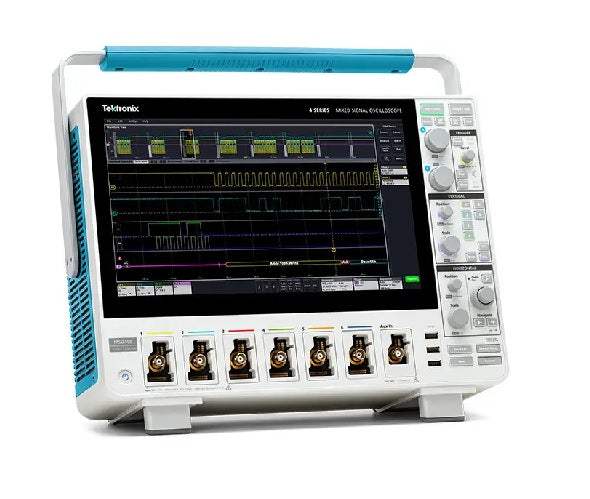
In summary, the Tektronix MSO46B is a 6-channel Mixed Signal Oscilloscope from the 4 Series B platform, configured with 350 MHz of analog bandwidth on 6 FlexChannel® inputs. It delivers a 12-bit ADC (16-bit in High Res mode), 6.25 GS/s real-time sample rate on all channels, 31.25 Mpoints standard record length (62.5 Mpoints optional), and a 13.3-inch optically-bonded 1,920 × 1,080 HD capacitive multi-touch display. Each unit ships with one TPP0500B passive probe per channel. The 4 Series B is the second generation of the 4 Series, with a new processing platform that more than doubles responsiveness and significantly accelerates measurements and data transfers.
The MSO46B 350 MHz is used to verify and debug embedded systems, validate power converters, and characterize complex multi-channel designs requiring simultaneous time-domain, frequency-domain, and digital logic visibility. Tektronix identifies the platform as ideal for embedded systems, three-phase power electronics, automotive electronics, power supply design, and DC-to-DC power converters. FlexChannel® lets each input act as analog, eight digital inputs (with TLP058), or simultaneous analog + spectrum — so the instrument is reconfigurable without buying additional hardware.
The 4 Series B uses a 12-bit ADC providing 16× the vertical resolution of traditional 8-bit ADCs, with High Res mode extending to 16 bits at ≤125 MS/s. Lower-noise front-end amplifiers further improve fine-detail resolution — critical for engineers measuring millivolt-level switching ripple on high-voltage rails.
Quantitatively, the MSO46B 350 MHz delivers >500,000 wfms/s standard capture (FastFrame™ to >5,000,000 wfms/s), ≤ 7 ps RMS trigger jitter in sample/edge mode, 36 automated measurements, and an auxiliary trigger input rated ≤ 300 VRMS. Standard 1 MΩ DC gain accuracy is ±1.0% (±2.0% at 1 mV/Div and 500 µV/Div). Time base accuracy is ±2.5 × 10⁻⁶ over any ≥ 1 ms interval. Operating range 0 °C to +50 °C; Measurement CAT II (300 V).
The 4 Series B aligns with standards engineers expect: LXI Core 2016 v1.5; 10/100/1000BASE-T Ethernet; USB 2.0 Host, USB 3.0 SuperSpeed, USB 2.0 Device (USBTMC); the TekVPI® probe interface; IVI-COM drivers for LabVIEW, LabWindows/CVI, MATLAB, .NET, Python, and C/C++/C#; and three-phase harmonics analysis per IEEE-519 via optional 4-3PHASE. Optional three-phase electrical analysis (4-3PHASE) is available on the 6-channel model only. Safety: UL 61010-1, 61010-2-030; CAN/CSA-C22.2 No. 61010.1, 61010.2.030; EN 61010-1; IEC 61010-1, 61010-2-030; CE marked; RoHS compliant.
| Passive probes | One TPP0500B per channel — 500 MHz probes (350/500 MHz models) |
|---|---|
| Installation & safety manual | Printed |
| Embedded Help | Built into the instrument |
| Power cord | Selected by region at order |
| Calibration certificate | Documenting traceability to National Metrology Institute(s); ISO 9001 / ISO 17025 quality system registration |
| Warranty | One year on instrument and one year on included probes |
The 4 Series B pairs a 13.3-inch HD optically-bonded display — the largest in its class — with a streamlined front panel: color-coded LED light rings, dedicated Run/Stop, Single Sequence, Force Trigger, Default Setup, Autoset, and Quick-save buttons. Stacked display mode automatically gives each waveform its own graticule slice so every channel uses the full ADC range simultaneously, eliminating the visibility-vs-accuracy trade-off. Variable font sizing (12–20 point) scales the entire UI, and the capacitive touchscreen supports drag, pinch, expand, and swipe gestures.
Behind each FlexChannel®, Tektronix's patented Spectrum View architecture provides both a time-domain decimator and a frequency-domain digital downconverter (DDC). The two acquisition paths run independently, so time-domain settings (sample rate, record length, time/div) and frequency-domain settings (center frequency, span, RBW) can be optimized simultaneously — something math-based FFTs cannot do. Channel Power (CHP), ACPR, and Occupied Bandwidth (OBW) measurements are integrated as standard on each channel.
| FlexChannel inputs / max analog | 6 / 6 |
|---|---|
| Max digital channels (with TLP058) | 48 |
| Configured analog bandwidth | 350 MHz |
| Bandwidth upgrade path | 200 → 350 → 500 → 1000 → 1500 MHz (node-locked / floating license) |
| ADC resolution | 12 bits (extending to 16 bits in High Res mode) |
| Vertical resolution by sample rate | 8b @ 6.25 GS/s; 12b @ 3.125 GS/s; 13b @ 1.25 GS/s; 14b @ 625 MS/s; 15b @ 250 MS/s; 16b @ ≤125 MS/s |
| Sample rate | 6.25 GS/s on all channels (160 ps resolution); 12.5–500 GS/s interpolated |
| Record length (std / opt) | 31.25 Mpoints / 62.5 Mpoints (4-RL-1) |
| Waveform capture rate (typ.) | >500,000 wfms/s; FastFrame™ >5,000,000 wfms/s |
| Aux trigger input | ≤ 300 VRMS (Edge Trigger only) |
| DC Gain Accuracy | 1 MΩ: ±1.0% (±2.0% at 1 mV/Div and 500 µV/Div); 50 Ω: ±1.0% (±2.5% at 1 mV/Div and 500 µV/Div) |
| Input coupling / impedance | DC, AC · 50 Ω ± 1%; 1 MΩ ± 1% with 13.0 pF ± 1.5 pF |
| Input sensitivity | 1 MΩ: 500 µV/div to 10 V/div (1-2-5); 50 Ω: 500 µV/div to 1 V/div (1-2-5) |
| Max input voltage | 50 Ω: 5 VRMS (peaks ≤ ±20 V, DF ≤ 6.25%); 1 MΩ: 300 VRMS (derated above 4.5 MHz) |
| Time base range / accuracy | 20 ps/div to 1,000 s/div · ±2.5 × 10⁻⁶ over any ≥ 1 ms interval |
| Channels per probe / max digital | 8 (D7–D0) per TLP058, traded for 1 analog channel · max 48 |
|---|---|
| Threshold range / resolution / accuracy | ±40 V · 10 mV · ± [100 mV + 3% of threshold setting] |
| Input dynamic range / min swing (typ.) | 30 Vpp ≤200 MHz, 10 Vpp >200 MHz · 400 mVpp minimum |
| Min pulse width / abs max input / impedance | 1 ns · ±42 V peak · 100 kΩ · 2 pF (typ.) |
| Modes / coupling / holdoff | Auto, Normal, Single · DC, HF Reject (>50 kHz), LF Reject (<50 kHz), Noise Reject · Holdoff 0 ns to 20 s |
|---|---|
| Standard triggers | Edge, Pulse Width, Runt, Timeout, Window, Logic, Setup & Hold, Rise/Fall Time, Parallel Bus, Sequence, Visual Trigger; Video (opt.); RF vs. Time (opt.) |
| Trigger jitter (typ.) | ≤ 7 ps RMS (sample mode, edge-type trigger) |
| Acquisition modes | Sample · Peak Detect (640 ps glitches at all sweep speeds) · Averaging (2–10,240) · Envelope · High Res · FastAcq® · Roll · History · FastFrame™ |
| FastAcq® rate | >500,000 wfms/s one channel; >100,000 wfms/s all channels |
| FastFrame™ trigger rate | >5,000,000 wfms/s; up to 1,500,000 frames at 50-pt frames |
I²C, SPI, eSPI, I3C, RS-232/422/485/UART, SPMI, SMBus, CAN, CAN FD, LIN, FlexRay, SENT, PSI5, CXPI, USB 2.0 (LS/FS/HS), eUSB2, Ethernet (10/100), EtherCAT, Audio (I²S/LJ/RJ/TDM), MIL-STD-1553, ARINC 429, Spacewire, NRZ, Manchester, SVID, SDLC, 1-Wire, MDIO, and NFC. Parallel buses up to 48 bits wide are standard and may combine analog and digital channels.
The instrument uses the TekVPI® probe interface, supporting direct attachment of TekVPI active, differential, and current probes — including TIVP Series IsoVu™ isolated probes — without external power. Up to 80 W is available at the front-panel connectors. Each MSO46B ships with one passive probe per channel matched to model bandwidth: TPP0250 (200 MHz models), TPP0500B (350/500 MHz models), TPP1000 (1 GHz/1.5 GHz models).
Important — Probe Selection: Included passive probes match the configured bandwidth. To realize the full 350 MHz at the probe tip, ensure any connected probe is rated at or above the instrument bandwidth. For low-voltage / low-loading work, the optional TPP0502 (500 MHz, 2× attenuation, 12.7 pF) is recommended. For floating, high-common-mode, or high-voltage differential measurements (inverters, SiC/GaN power, current shunts), the TIVP Series IsoVu™ optically isolated probes are appropriate — up to 1 GHz bandwidth, 120 dB CMRR @ 100 MHz, 2,500 V differential dynamic range, 60 kV common-mode range.
| Display | 13.3 in (338 mm) optically-bonded LCD · 1,920 × 1,080 HD · capacitive multi-touch · Overlay/Stacked modes · variable font 12–20 pt |
|---|---|
| Processor / OS / storage | Intel x6413E Elkhart Lake 4-core at 1.5 / 3.0 GHz · Closed Linux · 64 GB eMMC |
| Interfaces | Front: 3× USB 2.0 Hi-Speed Host · Rear: 2× USB 3.0 SuperSpeed Host, 1× USB 2.0 Device (USBTMC), 10/100/1000BASE-T Ethernet, HDMI 1080p, external 10 MHz reference (±4 ppm), Aux BNC out · LXI Core 2016 v1.5 · Kensington lock |
| Power / dimensions / weight | 400 W max · 100–240 V ±10% · H 11.299 in · W 15.9 in · D 6.1 in · MSO46B: <16.55 lbs (7.5 kg) · 7U rackmount with optional RM4 kit |
| Operating temperature / altitude / humidity | 0 °C to +50 °C · up to 3,000 m operating (12,000 m non-op) · 5–90% RH to +40 °C, 5–50% RH +40 to +50 °C, non-condensing |
| Safety / regulatory | UL 61010-1 & 61010-2-030; CAN/CSA-C22.2 No. 61010.1 & 61010.2.030; EN 61010-1; IEC 61010-1 & 61010-2-030; CE; RoHS; CAT II (300 V) |
Important Note — Software Options: Software options ship as license keys and are not always pre-installed. Contact your Test Architect before ordering if a specific bundle, decode option, or analysis package is required for your application — we will confirm which options can be activated on the unit you are quoted and whether perpetual or subscription licensing best matches your budget cycle.
This webpage was written by a human with an A.I. "Intern", which may contain errors. Please review the Manufacturer's Data Sheet to verify published specifications. Feedback on this webpage is always welcome — please reach out to your Test Architect at any time for questions or concerns. Thank you, we truly appreciate you being our customer.
Model No
MSO46B
Condition
New
Manufacturer
Tektronix
Channels
6
Frequency
350 MHz
Record length
31.25 MPts
Sampling rate
6.25 GS/s
1.00 GHz Bandwidth
1.00 GHz Bandwidth Model
1.50 GHz Bandwidth
1.50 GHz Bandwidth Model
200 MHz Bandwidth
200 MHz Bandwidth Model
350 MHz Bandwidth
350 MHz Bandwidth Model
500 MHz Bandwidth
500 MHz Bandwidth Model


30+ Years in Business

Secure Payments

Sell Test Equipments

Knowledgeable Staff

On-site Lab
30+ Years in Business
Secure Payments
Sell Test Equipments
Knowledgeable Staff
On-site Lab
Request A Quote

