Chat Live
 Contact Us
 sales@valuetronics.com


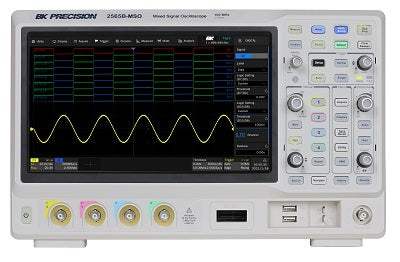
The B&K Precision 2560B Series is a family of four-channel digital storage and mixed-signal oscilloscopes built around a 10.1 inch capacitive touchscreen and a 200 Mpts deep acquisition memory. The series spans three bandwidth tiers — 100 MHz (2565B), 200 MHz (2567B), and 350 MHz (2569B) — each available as a DSO or as an MSO variant with 16 integrated digital channels. All models share a 2 GSa/s interleaved sample rate, a 50 MHz arbitrary waveform generator, and a feature set that includes power analysis, Bode plot, serial bus decoding, and mask testing.
The 2560B Series is designed for hardware design and debug, power supply and switching converter characterization, embedded systems development using common serial buses, and frequency-response evaluation through the built-in Bode plot function. The integrated power analysis tool evaluates eleven different parameters including power quality, current harmonics, inrush current, switching loss, slew rate, modulation, output ripple, turn-on/turn-off, transient response, PSRR, and efficiency. Standard serial protocols supported include I2C, SPI, UART, CAN, and LIN, with optional licenses available for CAN FD, FlexRay, I2S, MIL-STD-1553B, SENT, and Manchester.
B&K Precision Corporation has been producing test and measurement instruments for more than 70 years from its headquarters in Yorba Linda, California. The company's European presence operates as Sefram (St. Etienne, France) and its Asian operations as B+K Precision Taiwan (Taipei). B&K Precision Corporation maintains an ISO 9001:2015 quality management system certified by NSF-ISR.
The 2560B Series comprises three bandwidth tiers — 2565B at 100 MHz, 2567B at 200 MHz, and 2569B at 350 MHz — each offered in two configurations: a base DSO with four analog channels, or an MSO variant that adds 16 integrated digital channels and the LA2560B logic analyzer license as standard. The shared architecture across all six SKUs means a single set of features, a single user interface, and a single accessory ecosystem; the differences between models live in bandwidth, rise time, and the matched passive probe set shipped with each tier.
Every 2560B model shares the same 10.1 inch capacitive touchscreen, the same 2 GSa/s interleaved sample rate, the same 200 Mpts deep memory in interleaved mode, the same 120,000 wfms/s normal-mode update rate, the same 50 MHz arbitrary waveform generator, and the same trigger, decode, math, and analysis feature set. Choosing between models is primarily a bandwidth decision driven by the highest-frequency signals the bench needs to characterize, with the MSO-versus-DSO decision driven by whether digital bus capture and time-correlated mixed-signal analysis are required.
Each new 2560B Series model linked below is its own dedicated product page with condition-matched pricing. Specifications, accessories, and the warranty terms applicable to that page are listed directly on the model's listing — click through to the specific model and configuration that fits your application.
The three bandwidth tiers differ in headline analog performance: the 2565B provides 100 MHz bandwidth with a 3.5 ns rise time, the 2567B provides 200 MHz bandwidth with a 1.7 ns rise time, and the 2569B provides 350 MHz bandwidth with a 1 ns rise time. Each tier ships with a passive probe set matched to the instrument's bandwidth — PR150B (150 MHz) with the 2565B, PR250B (250 MHz) with the 2567B, and PR500B (500 MHz) with the 2569B — so the probe choice doesn't become the measurement bottleneck out of the box.
DSO and MSO variants of each bandwidth tier are identical in analog performance; the MSO version adds 16 digital channels (D0 through D15) sampled at up to 500 MSa/s with 50 Mpts/ch of digital memory, a 3.3 ns pulse-detect window, and selectable logic-family thresholds (TTL, CMOS, LVCMOS3.3, LVCMOS2.5, or custom). The LP2560 16-channel logic probe and the LA2560B logic analyzer license are both included with MSO models and are available as a pair of optional upgrades for any DSO model in the series. The comparison table below summarizes the specification differences across the family.
| Model | Bandwidth | Rise Time | Analog Channels |
|---|---|---|---|
| 2565B-MSO | 100 MHz | 3.5 ns | 4 |
| 2565B | 100 MHz | 3.5 ns | 4 |
| 2567B | 200 MHz | 1.7 ns | 4 |
| 2567B-MSO | 200 MHz | 1.7 ns | 4 |
Additional differences in specifications beyond the few shown above are not listed here — see each model's full specifications below.
| Specification | Value |
|---|---|
| Performance Characteristics | |
| Bandwidth | 100 MHz |
| Rise Time | 3.5 ns |
| Input Channels | 4 analog channels + EXT; 16 digital channels (standard) |
| Sample Rate | 2 GSa/s (interleaving mode); 1 GSa/s (non-interleaving mode) |
| Memory Depth | 200 Mpts/ch (interleaving mode), 100 Mpts/ch (non-interleaving mode) |
| Waveform Update Rate | Normal mode: 120,000 waveforms per second; Sequence mode: 500,000 waveforms per second |
| Included Probe (Standard) | PR150B passive probe, 150 MHz bandwidth, X1/X10 attenuation (one per channel) |
| MSO Digital Channels | |
| Logic Probe Model | LP2560 (standard) |
| MSO Channels | 16 Ch: D0 to D7, D8 to D15 |
| Sample Rate (Digital) | 500 MSa/s (Maximum) |
| Memory Depth (Digital) | 50 Mpts/ch |
| Pulse Detect | 3.3 ns |
| Level Range | -10 V to +10 V |
| Logic Type | TTL, CMOS, LVCMOS3.3, LVCMOS2.5, Custom |
Please review the Manufacturer's Data Sheet to verify published specifications. Feedback on this webpage is always welcome — please reach out to your Test Architect at any time for questions or concerns. Thank you, we truly appreciate you being our customer.
Model No
B&K
Condition
New
Manufacturer
B&K Precision
Channels
4
Frequency
100 MHz
Record length
200 MPts
Sampling rate
2 GS/s


30+ Years in Business

Secure Payments

Sell Test Equipments

Knowledgeable Staff

On-site Lab
30+ Years in Business
Secure Payments
Sell Test Equipments
Knowledgeable Staff
On-site Lab
Request A Quote