 Chat Live
 Contact Us
 sales@valuetronics.com


🎓 Request a Quote To Get An EDU Discount
Couldn't load pickup availability
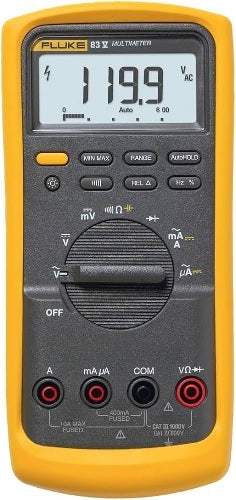
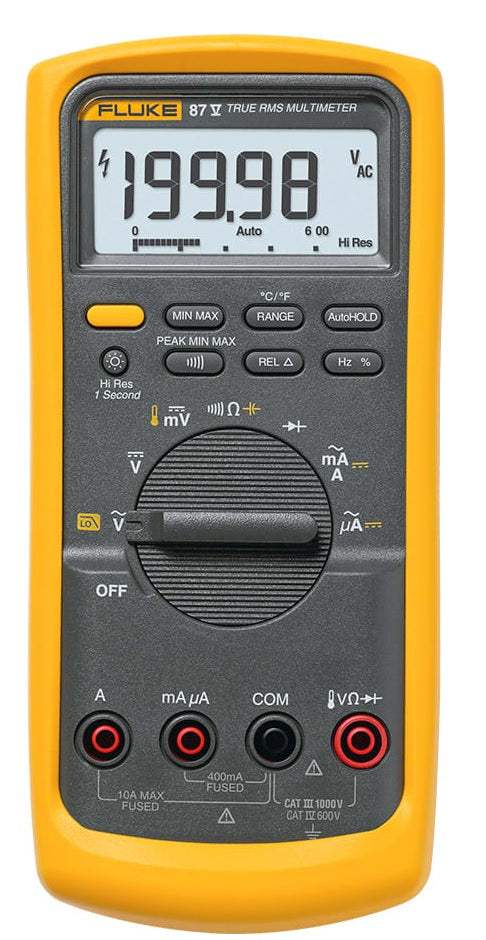
In summary, the Fluke 87V is the industrial-standard true-rms responding digital multimeter for field electricians, motor-drive technicians, and plant maintenance crews who measure non-sinusoidal current and voltage waveforms from variable-frequency drives, switching power supplies, and other non-linear loads. The 87V provides ± (0.05 % + 1) basic DC voltage accuracy, a 6,000-count default display with a selectable 19,999-count (4½-digit) high-resolution mode, integrated K-type thermocouple temperature measurement from −200 °C to +1090 °C, a switchable low pass filter for clean VFD measurements, and 250 µs peak MIN MAX capture for transient events. Safety compliance covers 1000 V Overvoltage Category III and 600 V Overvoltage Category IV per ANSI/ISA, CSA, IEC 664, UL3111-1, and TÜV EN61010-1.
The Fluke 87V is used by industrial electricians, plant maintenance technicians, motor-drive specialists, and field service engineers to measure voltage, current, resistance, capacitance, frequency, and temperature in industrial electrical environments — particularly where variable-frequency drives, switching power supplies, and other non-linear loads produce non-sinusoidal waveforms that require true-rms measurement. It is the meter that pulls out of the tool bag at every motor cabinet, every VFD enclosure, and every switching-supply troubleshooting call. Its 1000 V rms terminal rating, 11 A FAST fuse on the A input, and 1000 V Overvoltage Category III / 600 V Overvoltage Category IV safety compliance make it appropriate for work on distribution wiring, panels, bus bars, and the utility service entrance.
The 87V is true-rms responding, with tighter accuracy specifications across DC voltage, resistance, and current; a selectable 4½-digit (19,999 count) high-resolution mode; integrated K-type thermocouple temperature measurement; a switchable low pass filter for VFD measurements; and a 250 µs peak MIN MAX capture mode. The 83V is average-responding rms indicating, with the 6,000-count digital display only, no temperature measurement, no low pass filter, and standard MIN MAX recording at 100 ms nominal response. Both meters share the same Fluke 80V-series industrial form factor and the same 1000 V CAT III / 600 V CAT IV safety rating.
Every professional DMM owner replaces leads every 1–2 years, more frequently in harsh environments. The accessory list below covers the standard pairings for the Fluke 80V-series industrial meters; none of these are required to order the meter — they are listed as options to pair at quote time.
The digital multimeter is the most widely deployed test instrument in the world. It measures the three fundamental electrical quantities — voltage (AC and DC), current, and resistance — and it is carried daily by every electrician, every field service technician, every HVAC/R professional, every industrial maintenance engineer, and every facilities crew that touches an electrical system. When a professional says "I need a meter," the conversation almost always lands on the same name: Fluke. The brand has earned that position through decades of rugged, accurate, category-defining field instruments — a trust anchor that sets the standard against which every competing DMM is measured.
The Fluke 87V sits in the Fluke 80V industrial series — the line that established the modern field DMM form factor. The 87V is the unambiguous standard for field electricians and industrial maintenance — the meter that pulls out of the tool bag at every motor drive panel, every variable-frequency drive cabinet, and every switching-supply troubleshooting call. Both the 83V and the 87V share the same industrial-grade housing, the same 1000 V rms terminal rating, the same 1000 V Overvoltage Category III / 600 V Overvoltage Category IV safety compliance, and the same 1-meter drop tolerance per IEC 61010-1:2001 with the holster installed. The differences between the two models live in measurement architecture, accuracy class, and feature set — choose the model that matches the waveforms in your work and the documentation standard of your trade.
The Fluke 87V is a true-rms responding meter. That distinction is not marketing — it is the difference between a correct reading and a wrong one on any non-sinusoidal load. Variable-frequency drives, switching power supplies, LED drivers, electronic ballasts, and rectified DC buses all produce current and voltage waveforms that are visibly distorted. An average-responding meter calibrated for sine waves will under-read those signals — sometimes by 20 % or more. A true-rms meter computes the actual heating value of the waveform regardless of shape, which is the measurement an engineer or electrician actually needs when sizing a circuit, troubleshooting a motor trip, or auditing a non-linear load.
Per the datasheet: "The Fluke 87V is a true-rms responding meter. When the input leads are shorted together in the ac functions, the meter may display a residual reading between 1 and 30 counts. A 30-count residual reading will cause only a 2-digit change for readings over 3 % of range. Using REL to offset this reading may produce a much larger constant error in later measurements."
Per the datasheet's general specifications: "Complies with ANSI/ISA S82.01-2004, CSA 22.2 No. 1010.1:2004 to 1000 V Overvoltage Category III, IEC 664 to 600 V Overvoltage Category IV. UL listed to UL3111-1. Licensed by TÜV to EN61010-1." Translated into practical terms: CAT III at 1000 V is the firm minimum rating for work on distribution wiring, panels, and bus bars — anything between the service entrance and the branch circuits. CAT IV at 600 V is the rating required for work at the utility service entrance, on outdoor conductors, and on the supply side of the main disconnect. A meter rated only CAT II should never be used on permanently installed distribution wiring; the Fluke 87V meets both the CAT III and CAT IV thresholds that professional electrical work demands.
The 87V displays measurements at 6,000 counts (3¾ digits) by default with the digital bar graph updating four times per second — the industry-standard field DMM resolution. For applications where finer reading granularity matters, the 87V offers a selectable 4½-digit high-resolution mode that expands the digital display to 19,999 counts. In high-resolution mode, the accuracy specification's "number of least significant digits" multiplies by ten. The 87V is purpose-built as a field instrument for electricians and industrial maintenance — not a bench precision DMM.
The 87V accepts a K-type thermocouple probe for direct temperature measurement from −200 °C to +1090 °C (−328 °F to +1994 °F) without a separate instrument. HVAC/R technicians measuring superheat and subcooling, motor maintenance crews tracking bearing temperatures, process technicians verifying thermal-overload trip points, and electrical contractors documenting connection temperatures with the same instrument they already carry — all of those workflows collapse into a single tool. The temperature specification: ± (1 % + 10) at the meter, ± (1 % + 18) for the °F range, with accuracy that does not include thermocouple-probe error. Ambient temperature must be stable to ± 1 °C for stated accuracy; for ambient changes of ± 5 °C, the rated accuracy applies after a one-hour stabilization period.
The 87V includes a switchable low pass filter on its AC voltage function. When a true-rms meter measures the output of a variable-frequency drive, the high-frequency PWM carrier component can swamp the fundamental motor-drive frequency, producing readings that bear little resemblance to what the motor actually sees. The 87V's low pass filter attenuates frequencies above approximately 1 kHz, surfacing the fundamental waveform that determines motor performance.
Beyond standard MIN MAX recording at 100 ms nominal response (specified accuracy ± 12 counts for changes longer than 200 ms in duration on DC functions; ± 40 counts for AC changes longer than 350 ms), the 87V provides a 250 µs peak-capture mode that resolves transients invisible to standard DMM sampling. Inrush currents, motor-start surges, capacitor-charge transients, contactor-bounce events — measurements requiring sub-millisecond response live in this mode. For repetitive peaks, the 1 ms specification applies to single events.
Per the datasheet: "Accuracy is given as ±([% of reading] + [number of least significant digits]) at 18 °C to 28 °C, with relative humidity up to 90 %, for a period of one year after calibration." "For Model 87 in the 4½-digit mode, multiply the number of least significant digits (counts) by 10." "AC conversions are ac-coupled and valid from 3 % to 100 % of range. Model 87 is true-rms responding. AC crest factor can be up to 3 at full scale, 6 at half scale. For non-sinusoidal wave forms add −(2 % Rdg + 2 % full scale) typical, for a crest factor up to 3."
Accuracy is given as ±([% of reading] + [number of least significant digits]) at 18 °C to 28 °C, with relative humidity up to 90 %, for a period of one year after calibration. For Model 87 in the 4½-digit mode, multiply the number of least significant digits (counts) by 10. AC conversions are ac-coupled and valid from 3 % to 100 % of range. Model 87 is true-rms responding. AC crest factor can be up to 3 at full scale, 6 at half scale. For non-sinusoidal wave forms add −(2 % Rdg + 2 % full scale) typical, for a crest factor up to 3.
| Function | Range | Resolution | Accuracy | ||||||
|---|---|---|---|---|---|---|---|---|---|
| 45 – 65 Hz | 30 – 200 Hz | 200 – 440 Hz | 440 Hz – 1 kHz | 1 – 5 kHz | 5 – 20 kHz1 | ||||
| V~2,4 | 600.0 mV | 0.1 mV | ± (0.7 % + 4) | ± (1.0 % + 4) | ± (2.0 % + 4) | ± (2.0 % + 20) | |||
| 6.000 V | 0.001 V | ± (0.7 % + 2) | ± (2.0 % + 4)3 | unspecified | |||||
| 60.00 V | 0.01 V | ||||||||
| 600.0 V | 0.1 V | ||||||||
| 1000 V | 1 V | ± (1.0 % + 4) | unspecified | unspecified | |||||
| Using low pass filter | ± (0.7 % + 2) | ± (1.0 % + 4) | + 1 % + 4 / −6 % − 45 | unspecified | unspecified | unspecified | |||
| Function | Range | Resolution | Fluke 87V Accuracy |
|---|---|---|---|
| V— | 6.000 V | 0.001 V | ± (0.05 % + 1) |
| 60.00 V | 0.01 V | ± (0.05 % + 1) | |
| 600.0 V | 0.1 V | ± (0.05 % + 1) | |
| 1000 V | 1 V | ± (0.05 % + 1) | |
| mV— | 600.0 mV | 0.1 mV | ± (0.1 % + 1) |
| Ω | 600.0 Ω | 0.1 Ω | ± (0.2 % + 2)1 |
| 6.000 kΩ | 0.001 kΩ | ± (0.2 % + 1) | |
| 60.00 kΩ | 0.01 kΩ | ± (0.2 % + 1) | |
| 600.0 kΩ | 0.1 kΩ | ± (0.6 % + 1) | |
| 6.000 MΩ | 0.001 MΩ | ± (0.6 % + 1) | |
| 50.00 MΩ | 0.01 MΩ | ± (1.0 % + 3)2 | |
| nS | 60.00 nS | 0.01 nS | ± (1.0 % + 10)1 |
| Temperature | Resolution | Accuracy1, 2 |
|---|---|---|
| −200 °C to +1090 °C | 0.1 °C | 1 % + 10 |
| −328 °F to +1994 °F | 0.1 °F | 1 % + 18 |
| Function | Range | Resolution | Model 87 Accuracy | Burden Voltage (typical) |
|---|---|---|---|---|
| A~ (45 Hz to 2 kHz) |
60.00 mA | 0.01 mA | ± (1.0 % + 2) | 1.8 mV/mA |
| 400.0 mA6 | 0.1 mA | ± (1.0 % + 2) | 1.8 mV/mA | |
| 6.000 A | 0.001 A | ± (1.0 % + 2) | 0.03 V/A | |
| 10.00 A4 | 0.01 A | ± (1.0 % + 2) | 0.03 V/A | |
| A— | 60.00 mA | 0.01 mA | ± (0.2 % + 4) | 1.8 mV/mA |
| 400.0 mA6 | 0.1 mA | ± (0.2 % + 2) | 1.8 mV/mA | |
| 6.000 A | 0.001 A | ± (0.2 % + 4) | 0.03 V/A | |
| 10.00 A4 | 0.01 A | ± (0.2 % + 2) | 0.03 V/A | |
| µA~ (45 Hz to 2 kHz) |
600.0 µA | 0.1 µA | ± (1.0 % + 2) | 100 µV/µA |
| 6000 µA | 1 µA | ± (1.0 % + 2) | 100 µV/µA | |
| µA— | 600.0 µA | 0.1 µA | ± (0.2 % + 4) | 100 µV/µA |
| 6000 µA | 1 µA | ± (0.2 % + 2) | 100 µV/µA |
| Function | Range | Resolution | Accuracy |
|---|---|---|---|
| Capacitance | 10.00 nF | 0.01 nF | ± (1 % + 2)1 |
| 100.0 nF | 0.1 nF | ± (1 % + 2)1 | |
| 1.000 µF | 0.001 µF | ± (1 % + 2) | |
| 10.00 µF | 0.01 µF | ± (1 % + 2) | |
| 100.0 µF | 0.1 µF | ± (1 % + 2) | |
| 9999 µF | 1 µF | ± (1 % + 2) | |
| Diode | 3.000 V | 0.001 V | ± (2 % + 1) |
| Model | Nominal Response | Accuracy |
|---|---|---|
| 87V (dc functions) | 100 ms to 80 % | Specified accuracy ± 12 counts for changes > 200 ms in duration > 25 % of range |
| 87V (ac functions) | 120 ms to 80 % | Specified accuracy ± 40 counts for changes > 350 ms and inputs |
| 87V — Peak (Model 87 only)1 | 250 µs (peak) | Specified accuracy ± 100 counts for changes > 250 µs in duration (add ± 100 counts for readings over 6000 counts) (add ± 100 counts for readings in Low Pass mode) |
| Function | Overload Protection1 | Input Impedance (nominal) | Common Mode Rejection Ratio (1 kΩ unbalance) | Normal Mode Rejection |
|---|---|---|---|---|
| V dc | 1000 V rms | 10 MΩ < 100 pF | > 120 dB at dc, 50 Hz or 60 Hz | > 60 dB at 50 Hz or 60 Hz |
| mV dc | 1000 V rms | 10 MΩ < 100 pF | > 120 dB at dc, 50 Hz or 60 Hz | > 60 dB at 50 Hz or 60 Hz |
| V ac (ac-coupled) | 1000 V rms | 10 MΩ < 100 pF | > 60 dB, dc to 60 Hz | — |
| Function | Open Circuit Test Voltage | Full Scale Voltage | Typical Short Circuit Current | ||||||
|---|---|---|---|---|---|---|---|---|---|
| To 6.0 MΩ | 50 MΩ or 60 nS | 600 Ω | 6 kΩ | 60 kΩ | 600 kΩ | 6 MΩ | 50 MΩ | ||
| Ω | 1000 V rms | < 7.3 V dc | < 4.1 V dc | 1 mA | 100 µA | 10 µA | 1 µA | 1 µA | 0.5 µA |
| Diode | 1000 V rms | < 3.9 V dc | 3.000 V dc | 0.6 mA typical | |||||
| Function | Range | Resolution | Accuracy |
|---|---|---|---|
| Frequency (0.5 Hz to 200 kHz, pulse width > 2 µs) |
199.99 | 0.01 Hz | ± (0.005 % + 1) |
| 1999.9 | 0.1 Hz | ± (0.005 % + 1) | |
| 19.999 kHz | 0.001 kHz | ± (0.005 % + 1) | |
| 199.99 kHz | 0.01 kHz | ± (0.005 % + 1) | |
| > 200 kHz | 0.1 kHz | unspecified |
| Input Range1 | Minimum Sensitivity (RMS Sine wave) | Approximate Trigger Level (DC Voltage Function) | |
|---|---|---|---|
| 5 Hz – 20 kHz | 0.5 Hz – 200 kHz | ||
| 600 mV dc | 70 mV (to 400 Hz) | 70 mV (to 400 Hz) | 40 mV |
| 600 mV ac | 150 mV | 150 mV | — |
| 6 V | 0.3 V | 0.7 V | 1.7 V |
| 60 V | 3 V | 7 V (≤ 140 kHz) | 4 V |
| 600 V | 30 V | 70 V (≤ 14.0 kHz) | 40 V |
| 1000 V | 100 V | 700 V (≤ 1.4 kHz) | 100 V |
Duty Cycle Range: 0.0 to 99.9 % — Accuracy: Within ± (0.2 % per kHz + 0.1 %) for risetimes < 1 µs
The Fluke 87V delivers ± (0.05 % + 1) basic DC voltage accuracy across all five DC voltage ranges (6.000 V, 60.00 V, 600.0 V, 1000 V), ± (0.2 % + 1) basic resistance accuracy on the mid-decade ranges, ± (0.2 % + 2) basic DC current accuracy on the 400 mA and 10 A ranges, and 0.005 % + 1 frequency counter accuracy from 0.5 Hz to 200 kHz. Battery life is 400 hours typical with an alkaline 9 V zinc battery (NEDA 1604 / 6F22 / 006P), with backlight off. Operating temperature is −20 °C to +55 °C; storage temperature is −40 °C to +60 °C; operating altitude is 2000 m. The instrument is vibration-tested per MIL-PRF-28800 for a Class 2 instrument and shock-tested to a 1 Meter drop per IEC 61010-1:2001. Net weight is 12.5 oz (355 g); with holster and flex-stand, 22.0 oz (624 g). Total accuracy in an RF field of 3 V/m equals the specified accuracy — a robust electromagnetic compatibility specification for noisy industrial environments.
Fluke Corporation was founded in 1948 in Seattle by John Fluke Sr. and is now part of Fortive Corporation (previously Danaher). Fluke is the dominant global brand in field test instruments and the unambiguous reference standard for handheld digital multimeters in industrial, electrical contracting, and facilities maintenance markets. The Fluke 80V industrial series carries safety compliance to ANSI/ISA S82.01-2004, CSA 22.2 No. 1010.1:2004 (1000 V Overvoltage Category III), IEC 664 (600 V Overvoltage Category IV), UL3111-1 listing, and TÜV licensing to EN61010-1. Vibration testing follows MIL-PRF-28800 for a Class 2 instrument; shock testing follows IEC 61010-1:2001 for a 1 Meter drop. The CAT III and CAT IV ratings define the IEC transient overvoltage protection level required for work on distribution wiring, panels, bus bars (CAT III), and the utility service entrance (CAT IV).
Model No
Fluke-87-5
Condition
New
Manufacturer
Fluke
Ac voltage
1 kV
Dc voltage
1 kV
Resolution
3.75
Type
Handheld
[""NEW" IN BOX..NEVER OPENED
NEVER OPENED
Five Extra Fuses
FUSE-440MA 1000VB5- 5PK
One Extra Fuse
FUSE-440MA/1000VB1"]


30+ Years in Business

Secure Payments

Sell Test Equipments

Knowledgeable Staff

On-site Lab
30+ Years in Business
Secure Payments
Sell Test Equipments
Knowledgeable Staff
On-site Lab
Request A Quote


