Chat Live
 Contact Us
 sales@valuetronics.com


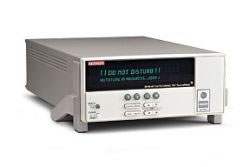
The Keithley 2510 TEC SourceMeter Instrument and the 2510-AT Autotuning TEC SourceMeter Instrument are 50W bipolar source-measure instruments designed to control the temperature of Thermo-Electric Coolers (TECs, also called Peltier devices) in laser diode modules and other actively cooled optical components. Both instruments combine precision DC sourcing and measurement functions with closed-loop temperature control in a single compact, half-rack chassis. The 2510-AT adds an autotuning function that automatically determines the P, I, and D coefficients for the temperature control loop using a modified Ziegler-Nichols algorithm; in all other respects the two models share identical features and specifications.
According to the datasheet, the 2510 and 2510-AT are intended for control and production testing of thermoelectric coolers in laser diode modules, IR charge-coupled device (CCD) arrays and charge-injection devices (CID), cooled photodetectors, thermal-optic switches, and temperature-controlled fixtures. In a typical laser diode CW (Continuous Wave) LIV test stand, the instrument maintains the internal temperature of the laser diode module within ±0.005°C of the user-defined setpoint by driving power through the module's TEC while reading back the internal temperature sensor. Active temperature control of this kind matters because laser diode output wavelength shifts with temperature, which can cause signal overlap and crosstalk in wavelength-multiplexed networks.
Keithley Instruments was founded in 1946 in Cleveland, Ohio, and built its reputation on precision low-level electrical measurement instruments. Keithley was acquired by Danaher Corporation in 2010, and in 2016 the test and measurement businesses (including Keithley and Tektronix) were spun off as Fortive Corporation. The Keithley brand and product lines, including the 2510 series, continue under the Fortive group.
The 2510 family consists of two models: the 2510 TEC SourceMeter Instrument and the 2510-AT Autotuning TEC SourceMeter Instrument. Per the datasheet, both instruments share identical hardware capabilities, identical output specifications, identical control system performance, and identical sensor compatibility. They are both 50W bipolar instruments designed to control the temperature of TECs in laser diode modules and similar actively cooled optical components.
The single distinction between the two models is the autotuning function. The 2510-AT adds a software-implemented autotuning capability that automatically determines the proportional, integral, and derivative coefficients for the closed-loop temperature controller, using a modified Ziegler-Nichols algorithm. The base 2510 requires the user to determine these coefficients through experimentation. Once tuned, the underlying P-I-D control loop, hardware, and measurement performance are the same on both models.
Each new 2510 or 2510-AT listed below is its own dedicated product page with condition-matched pricing. Use the comparison to select the model that fits your workflow — the autotuning capability on the 2510-AT is the only functional difference between the two.
The functional difference between the two models is narrow but operationally meaningful. On the base 2510, configuring the temperature control loop for a new module design or test fixture requires the user to experimentally determine the best combination of P, I, and D coefficients. On the 2510-AT, the autotuning function performs that work automatically with a choice of minimum settling time or minimum overshoot optimization. For a lab that frequently changes fixtures or characterizes new module designs, that workflow difference can be substantial; for a lab running a single, well-characterized production fixture, the base 2510 delivers the same measurement and control performance once tuned.
All other specifications — 50W bipolar output, ±10V at ±5A DC, -50°C to +225°C setpoint range, ±0.001°C setpoint resolution, ±0.005°C short-term stability, sensor compatibility across thermistors, RTDs, and IC sensors, and the IEEE-488 and RS-232 interfaces — are identical across both models. The comparison table that follows shows the side-by-side detail.
| Model | Autotuning | Output Power | Setpoint Range |
|---|---|---|---|
| 2510-AT | Yes (modified Ziegler-Nichols algorithm) | 50 W (±10 VDC at up to ±5 ADC) | -50°C to +225°C |
| 2510 | No | 50 W (±10 VDC at up to ±5 ADC) | -50°C to +225°C |
Additional differences in specifications beyond the few shown above are not listed here — see each model's full specifications below.
| Category | Specification | Value |
|---|---|---|
| Control System | Set | Constant Peltier Temperature, Constant Peltier Voltage, Constant Peltier Current, Constant Thermistor Resistance |
| Control Method | Programmable software PID loop. Proportional, Integral, and Derivative gains independently programmable. | |
| Setpoint Short Term Stability | ±0.005°C rms | |
| Setpoint Long Term Stability | ±0.01°C | |
| Setpoint Range | -50°C to 225°C | |
| Upper Temperature Limit | 250°C max | |
| Lower Temperature Limit | -50°C max | |
| Setpoint Resolution & Limits | Setpoint Resolution | ±0.001°C, <±400µV, <±200µA, 0.01% of nominal (25°C) thermistor resistance |
| Hardware Current Limit | 1.0 A to 5.25 A ±5% | |
| Software Voltage Limit | ±0.5 to 10.5 V ±5% | |
| TEC Output | Output Range | ±10 VDC at up to ±5 ADC |
| Output Ripple | <5 mV rms (10 Hz to 10 MHz, 5 A output into 2Ω load) | |
| AC Resistance Excitation | ±(9.6 mA ± 90 µA) | |
| TEC Measurement Accuracy (1 Year, 23°C ±5°C) | Operating Resistance | ±(2.0% of rdg + 0.1Ω) |
| Operating Voltage | ±(0.1% of rdg + 4 mV) | |
| Operating Current | ±(0.4% of rdg + 8 mA) | |
| AC Resistance | ±(0.10% of rdg + 0.02Ω) | |
| TEC Output Isolation | Load Impedance | Stable into 1 µF typical |
| Common Mode Voltage | 30 VDC maximum | |
| Common Mode Isolation | >10⁹Ω, <1500 pF | |
| Max. Voltage Drop Between Input/Output Sense Terminals | 1 V | |
| Max. Sense / Force Lead Resistance | Sense: 1Ω for rated accuracy; Force: 0.1Ω | |
| Thermistor Measurement Accuracy | 100 Ω (0°C / 25°C / 50°C / 100°C) | 0.021°C / 0.035°C / 0.070°C / 0.27°C |
| 1 kΩ (0°C / 25°C / 50°C / 100°C) | 0.015°C / 0.023°C / 0.045°C / 0.18°C | |
| 10 kΩ (0°C / 25°C / 50°C / 100°C) | 0.006°C / 0.012°C / 0.026°C / 0.15°C | |
| 100 kΩ (0°C / 25°C / 50°C / 100°C) | 0.009°C / 0.014°C / 0.026°C / 0.13°C | |
| Open/Shorted Element Detection (Thermal Feedback) | Linearization | Software linearization for thermistor and RTD |
| Common Mode Voltage | 30 VDC | |
| Common Mode Isolation | >10⁹Ω, <1000 pF | |
| Max. Voltage Drop Between Input/Output Sense Terminals | 1 V | |
| Max. Sense Lead Resistance / Sense Input Impedance | 100Ω for rated accuracy; >10⁸Ω input impedance | |
| Noise Rejection | Speed | Normal |
| NPLC | 1.00 | |
| NMRR / CMRR | 60 dB / 120 dB | |
| General | Source Output Modes | Fixed DC level |
| Programmability | IEEE-488 (SCPI-1995.0), RS-232; 3 user-definable power-up states plus factory default and *RST | |
| Power Supply | 90 V to 260 V rms, 50–60 Hz, 75 W | |
| EMC | Complies with European Union Directive 98/336/EEC (CE marking requirements), FCC part 15 class B, CTSPR 11, IEC 801-2, IEC 801-3, IEC 801-4 | |
| Vibration | MIL-PRF-28800F Class 3 Random Vibration | |
| Physical & Environmental | Warm-Up | 1 hour to rated accuracies |
| Dimensions (Rack) | 89 mm H × 213 mm W × 370 mm D (3½ in × 8⅜ in × 14 9/16 in) | |
| Dimensions (Bench, with handle and feet) | 104 mm H × 238 mm W × 370 mm D (4⅛ in × 9⅜ in × 14 9/16 in) | |
| Net Weight | 3.21 kg (7.08 lbs) | |
| Environment | Operating / Storage | Operating: 0°–50°C, 70% R.H. up to 35°C, derate 3% R.H./°C from 35°–50°C. Storage: -25° to 65°C. |
Please review the Manufacturer's Data Sheet to verify published specifications. Feedback on this webpage is always welcome — please reach out to your Test Architect at any time for questions or concerns. Thank you, we truly appreciate you being our customer.
Model No
Keithley
Condition
New
Manufacturer
Keithley
Volts
10 V
Volts
50 W
Amps
5 A


30+ Years in Business

Secure Payments

Sell Test Equipments

Knowledgeable Staff

On-site Lab
30+ Years in Business
Secure Payments
Sell Test Equipments
Knowledgeable Staff
On-site Lab
Request A Quote