Chat Live
 Contact Us
 sales@valuetronics.com


This selection guide covers the Fluke Calibration family of industrial thermometer readouts and reference probes used together to calibrate PRTs, RTDs, thermistors, and thermocouples. The readouts profiled include the 1502A, 1504, 1523, 1524, 1529, and 1586A Super-DAQ, paired with reference probes from the 5615 Secondary Reference, 5627A Precision Industrial, 5628 Secondary Standard, 5606 Full Immersion, and 5610 Thermistor Secondary product lines. The guide presents a five-step method for matching a readout and reference probe to a specific calibration application: choosing the readout, selecting the reference probe by temperature range and immersion depth, determining combined system accuracy, verifying test accuracy ratio against the sensor under test, and evaluating whether additional calibration is required.
Industrial temperature sensors are typically calibrated by placing them in a stable temperature source — a dry-well, furnace, or calibration bath — and comparing their output to a reference standard probe connected to a thermometer readout. The guide is written for calibration laboratory and field applications that include improving calibration accuracy in a bath or dry-well, and comparing against process instrumentation in-situ such as a thermowell next to a gauge or transmitter. Selection criteria addressed include the sensor types to be calibrated, field versus laboratory use, channel count, data logging and graphing requirements, and whether temperature source control is needed to automate sensor calibration.
Beyond cataloging Fluke Calibration readouts and probes, ValueTronics carries this family of instruments in both new and pre-owned condition out of its 20,000 sq ft secure warehouse at 1675 Cambridge Drive, Elgin, Illinois. All inventory is stored, inspected, and tested in-house rather than drop-shipped from a third party, so the readout, the matching probe with the correct connector type, and any accessory cables can be staged and verified as a complete calibration system before shipment.
The instruments covered in this guide form a coordinated calibration system family: industrial thermometer readouts (1502A, 1504, 1523, 1524, 1529, 1586A Super-DAQ) paired with Fluke Calibration reference probes (5615, 5627A, 5628, 5606, 5610). The guide is structured around matching the right readout to the right probe for a given sensor calibration application, with combined system accuracy tabulated for each readout/probe pairing across the temperature range supported.
Within the readout family, models differ in sensor type compatibility, channel count, portability, data logging depth, graphing, and whether the readout can control a Fluke Calibration dry-well, bath, or furnace. Within the probe family, models differ in probe range, transition junction range, dimensions, basic accuracy, minimum immersion depth, and the type of factory calibration (ISO 17025 accredited, NIST traceable, or optional) supplied with the probe.
Each new model linked in the comparison has its own dedicated product page with condition-matched pricing, lead time, and accessory detail. Use this comparison to narrow on the readout and probe combination, then move to the individual product page for the exact configuration and connector type required.
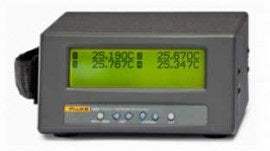
Readout differences track directly to the application. The 1523 is a single-channel handheld; the 1524 is a two-channel handheld with data logging up to 15,000 readings and dual-channel graphing. The 1502A is a single-channel benchtop for PRT and RTD work; the 1504 adds thermistor measurement. The 1529 Chub-E4 is a four-channel benchtop with up to 8,000 stored readings and automated data logging across PRT, thermistor, and thermocouple inputs depending on version (the standard 1529 supports two thermocouple and two PRT/thermistor inputs, the 1529-R is four PRT/thermistor, and the 1529-T is four thermocouple).
Probe differences track to temperature range, accuracy class, and mechanical fit. The 5628 Secondary Standard PRT carries the tightest basic accuracy (±0.006 °C at 0 °C) and the widest range (−200 °C to 661 °C) but the narrowest transition junction range (0 °C to 80 °C). The 5615 Secondary Reference PRT (±0.013 °C at 0.010 °C) and the 5627A Precision Industrial PRT (±0.05 °C at 0 °C) cover −200 °C to 300 °C or 420 °C depending on length, with a wider −50 °C to 200 °C transition junction range. The 5606 Full Immersion PRT covers −200 °C to 160 °C for both probe and transition junction — the correct choice for freezer applications below the −50 °C transition limit of the 5615 and 5627A.
| Model | Type | Channels | Temperature Sensors |
|---|---|---|---|
| 1529-T | Benchtop Thermometer Readout | 4 Thermocouple | Thermocouple (Type T, Type K) |
| 1523 | Handheld Thermometer Readout | 1 | PRT/RTD, Thermistor, Thermocouple |
| 1524 | Handheld Thermometer Readout | 2 (max) | PRT/RTD, Thermistor, Thermocouple |
| 1502A | Benchtop Thermometer Readout | 1 | PRT/RTD |
Additional differences in specifications beyond the few shown above are not listed here — see each model's full specifications below.
| Probe Family | Model | Probe Range | Transition Junction Range | Size | Basic Accuracy | Minimum Immersion Depth |
|---|---|---|---|---|---|---|
| Secondary Reference PRT | 5615-6 | −200 °C to 300 °C | −50 °C to 200 °C | 152 mm x 4.76 mm (6.0 in x 0.188 in) | ± 0.013 °C at 0.010 °C | 100 mm (4.0 in) |
| Secondary Reference PRT | 5615-9 | −200 °C to 420 °C | −50 °C to 200 °C | 229 mm x 4.76 mm (9.0 in x 0.188 in) | ± 0.013 °C at 0.010 °C | 100 mm (4.0 in) |
| Secondary Reference PRT | 5615-12 | −200 °C to 420 °C | −50 °C to 200 °C | 305 mm x 6.35 mm (12.0 in x 0.250 in) | ± 0.013 °C at 0.010 °C | 127 mm (5.0 in) |
| Precision Industrial PRT | 5627A-6 | −200 °C to 300 °C | 0 °C to 150 °C | 152 mm x 4.7 mm (6.0 in x 0.187 in) | ± 0.05 °C at 0 °C | 100 mm (4.0 in) |
| Precision Industrial PRT | 5627A-9 | −200 °C to 300 °C | 0 °C to 150 °C | 229 mm x 4.7 mm (9.0 in x 0.187 in) | ± 0.05 °C at 0 °C | 100 mm (4.0 in) |
| Precision Industrial PRT | 5627A-12 | −200 °C to 420 °C | 0 °C to 150 °C | 305 mm x 6.35 mm (12.0 in x 0.250 in) | ± 0.05 °C at 0 °C | 127 mm (5.0 in) |
| Secondary Standard PRT | 5628 | −200 °C to 661 °C | 0 °C to 80 °C | 305 or 381 mm x 6.35 mm (12.0 or 15.0 in x 0.250 in) | ± 0.006 °C at 0 °C | 127 mm (5.0 in) |
| Full Immersion PRT | 5606 | −200 °C to 160 °C | −200 °C to 160 °C | 50 mm x 3.1 mm (2.0 in x 0.125 in) | ± 0.05 °C | 76 mm (3.0 in) |
| Thermistor Secondary Probe | 5610 | 0 °C to 100 °C | 0 °C to 100 °C | 152 or 229 mm x 3.2 mm (6.0 or 9.0 in x 0.125 in) | ± 0.01 °C | 76 mm (3.0 in) |
Please review the Manufacturer's Data Sheet to verify published specifications. Feedback on this webpage is always welcome — please reach out to your Test Architect at any time for questions or concerns. Thank you, we truly appreciate you being our customer.
Model No
Fluke
Condition
New
Manufacturer
Fluke


30+ Years in Business

Secure Payments

Sell Test Equipments

Knowledgeable Staff

On-site Lab
30+ Years in Business
Secure Payments
Sell Test Equipments
Knowledgeable Staff
On-site Lab
Request A Quote