Chat Live
 Contact Us
 sales@valuetronics.com


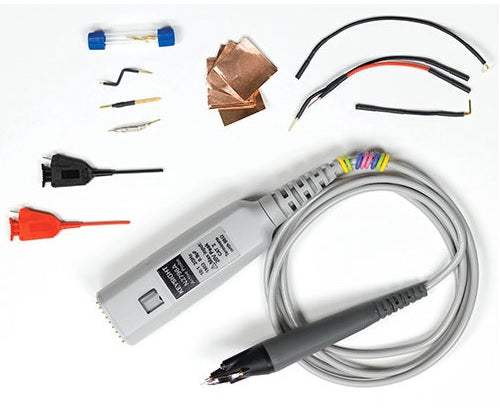
Keysight's InfiniiVision Oscilloscope Probes and Accessories form a complete family of probes and accessories designed to deliver optimal performance with InfiniiVision Series oscilloscopes. The lineup spans passive probes, InfiniiMax and InfiniiMode active probes, high-voltage passive and differential probes, single-ended active probes, clamp-on and Rogowski coil current probes, high-sensitivity current probes, and mixed-signal logic probes, supporting the 1000 X-, 2000 X-, 3000A/T X-, 4000 X-, 6000 X-, 5000, 6000, and 7000 Series.
Across the family, these probes target a broad range of measurement tasks: high-speed digital design and debug, high-voltage power measurements on wide-bandgap power devices, power converters and motor drives, switching power supply and DC-DC converter characterization, class D amplifier testing, automotive and vehicle bus measurements including CAN, CAN FD, and FlexRay, environmental-chamber testing at extreme temperatures, and high-sensitivity current measurements to characterize the current consumption of battery-powered devices and integrated circuits. A dedicated selection set also covers low- and mid-speed bus measurements such as LIN, I2C/SMBus, RS232/UART, RS422/485, SPI, USB 2.0, and MIL-Std 1553.
ValueTronics stocks and holds its own inventory in a 20,000-square-foot secure warehouse at 1675 Cambridge Drive in Elgin, Illinois. Because we maintain our own inventory on site, every used unit is inspected and functionally verified in-house before it ships, while new units ship factory-sealed exactly as received from the manufacturer. That combination lets engineers source the right InfiniiVision probe or accessory with confidence in both availability and condition.
Keysight Technologies traces its origins to the test and measurement business of Hewlett-Packard, which was spun off as Agilent Technologies in 1999. In 2014, Agilent's electronic measurement business was established as the independent company Keysight Technologies.
The InfiniiVision probe and accessory family is organized by probe type rather than by a single performance tier: passive probes, InfiniiMax and InfiniiMode active probes, high-voltage passive and differential probes, single-ended active probes, current probes, and mixed-signal logic probes. Each type is matched to specific oscilloscope series and measurement needs across the 1000 X- through 7000 Series.
Within each type the lineup includes multiple models that differ chiefly in bandwidth, attenuation ratio, and maximum input voltage, along with whether they use a standard 1 MΩ BNC connection or the Keysight AutoProbe interface for automatic configuration and probe power.
Each pre-owned model linked below is its own dedicated product page with condition-matched pricing. Select the specific probe or accessory model that fits your oscilloscope series and measurement requirements to see its current pre-owned availability and price.
The clearest differences across the family are bandwidth and voltage handling. Passive probes range from 20 MHz to 700 MHz, single-ended and differential active probes extend from the tens of MHz into the GHz range, and the InfiniiMax active system reaches 7 GHz, while high-voltage probes trade bandwidth for input range up to 3.7 kV (passive) and 7 kV mains isolated (differential).
Current probes form their own sub-family, differentiated by sensing method and range: clamp-on hybrid probes, clip-around Rogowski coils for currents up to 3,000 A peak, and high-sensitivity probes resolving down to 50 µA. The comparison table that follows lays out the per-model bandwidth, attenuation, and input-voltage figures so you can match a probe to your application.
| Model | Probe Type | Bandwidth | Attenuation Ratio |
|---|---|---|---|
| N2795A | Single-Ended Active | 1 GHz | 10:1 ± 0.5% |
| 10070D | Passive | 20 MHz | 1:1 |
| 10073D | Passive | 500 MHz | 10:1 |
| 10074D | Passive | 150 MHz | 10:1 |
Additional differences in specifications beyond the few shown above are not listed here — see each model's full specifications below.
| Specification | Value |
|---|---|
| Probe bandwidth (–3 dB) | 1 GHz |
| Risetime | 350 ps |
| Attenuation ratio (at dc) | 10:1 ± 0.5% |
| Input dynamic range | –8 to +8 V (DC or peak AC) |
| Non-destructive input voltage | –20 to +20 V |
| Offset range | ± 8 V |
| DC offset error (output zero) | ± 1 mV |
| Low frequency accuracy | 0.5% at 70 Hz, 1 Vpp |
| Input resistance | 1 MΩ |
| Input capacitance | 1 pF |
| Output impedance | 50 Ω |
Important: The 1000 X- and 2000 X-Series do not support AutoProbe interface active probes.
Important: The 01650-61607 logic probe cable is no longer available for purchase. Without the 01650-61607, 40-pin to 40-pin cable, 40-pin Mictor, Samtec or Soft Touch probes you may already own cannot be used with InfiniiVision MSOs.
Important: MSO/DSO6000A 100-MHz models do not support any Keysight active probes with AutoProbe interface.
Important: DP0001A is not compatible with the 3000A X-Series oscilloscope.
Important: The N2780B Series current probes (N2780B/81B/82B/83B/83L) require the companion power supply (model N2779A), which is not part of the probe; with the N2779A they can be used with any oscilloscope having a high-impedance BNC input.
Important: To achieve the widest input range on the N7026A (up to 30 Arms or 40 Apk), you must use the external AC power adapter that comes with the probe; without it the probe achieves up to 5 Arms or 5 Apeak.
Important: The N2791A and N2891A probe power is supplied by included 4x AA batteries or the USB host port of the scope or PC via a supplied USB power cable.
Important: The InfiniiMax 1130B Series probe amplifiers (1130B/1131B/1132B/1134B) are ordered separately from their probe heads — order one or more probe heads or connectivity kits per amplifier for the probe to be usable.
Recommended pairing: the N2780B, N2781B, N2782B, N2783B, and N2783L current probes use the N2779A power supply, which can power up to three of these probes from a single unit.
This pre-owned unit is inspected and functionally verified in-house before it ships and is backed by our pre-owned warranty. To confirm its exact condition, firmware revision, installed options, or included accessories for your application before ordering, contact our Test Architects.
ValueTronics supplies both new and used test and measurement equipment. New units ship factory-sealed, exactly as received from the manufacturer; every used unit is inspected and functionally verified in-house at our 20,000 sq ft secure facility in Elgin, Illinois before it ships. Our Test Architects can help you select the condition, calibration, and configuration that fit your application.
Please review the Manufacturer's Data Sheet to verify published specifications. Feedback on this webpage is always welcome — please reach out to your Test Architect at any time for questions or concerns. Thank you, we truly appreciate you being our customer.
Model No
Keysight
Condition
Pre-Owned
Manufacturer
Keysight Technologies
Act_prob_freq
1 GHz


30+ Years in Business

Secure Payments

Sell Test Equipments

Knowledgeable Staff

On-site Lab
30+ Years in Business
Secure Payments
Sell Test Equipments
Knowledgeable Staff
On-site Lab
Request A Quote