Chat Live
 Contact Us
 sales@valuetronics.com


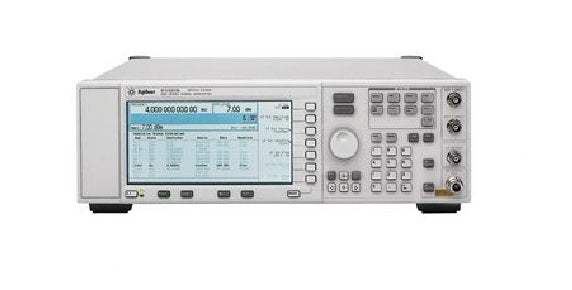
The Agilent E4432B is a 3 GHz ESG-D series RF signal generator covering 250 kHz to 3 GHz, designed for testing both analog and digital communications systems. As part of the ESG family, it incorporates a broad array of capabilities and accepts flexible option additions, providing a test solution that addresses the requirements of numerous current and proposed air interface standards. The instrument's expandable architecture allows it to be configured for a wide variety of tests, from altering aspects of a digital signal or signal operating environment to creating experimental signals.
The E4432B is applied across analog and digital communications system testing, including transmitter and receiver evaluation for wireless protocols. The datasheet identifies digital modulation formats for DECT, GSM, NADC, PDC, PHS, and TETRA, and option-enabled personalities support multichannel CDMA, W-CDMA, cdma2000, EDGE, and GSM/EDGE base station bit error rate testing. The instrument supports CDMA base station amplifier testing, GSM transmitter measurements for base transceiver stations and mobile stations, and component testing for wireless and proprietary nonstandard wireless protocols.
Hewlett-Packard's test and measurement division was spun out as Agilent Technologies in 1999. In 2014, Agilent's electronic measurement business was transferred to Keysight Technologies, which is the current corporate successor for instruments originally branded as HP or Agilent in the test and measurement product lines.
The ESG family of RF signal generators consists of four series spanning the same 250 kHz to 4 GHz frequency range: the ESG-A series (analog only), the ESG-AP series (analog with high spectral purity), the ESG-D series (digital and analog), and the ESG-DP series (digital and analog with high spectral purity). Within each series, four frequency-ceiling models are offered (1 GHz, 2 GHz, 3 GHz, and 4 GHz), enabling buyers to match the instrument's top frequency to their application.
All four series share the same core architecture — expandable design, choice of electronic or mechanical attenuator, superior level accuracy, wideband FM and ΦM, step sweep modes, built-in function generator, and lightweight rack-mountable form factor. The series differ in two primary dimensions: whether digital modulation capability (broadband analog I/Q inputs, coherent carrier output, and option-enabled digital communications personalities) is included, and whether the high spectral purity configuration is selected for improved SSB phase noise and reduced residual FM.
Each pre-owned model below is its own dedicated product page with condition-matched pricing and individually verified specifications. Compare the headline specs across the family on the comparison table, then navigate to the specific model page that matches your application's frequency range and modulation requirements.
The E4432B is the 3 GHz model in the ESG-D series, providing digital and analog modulation capabilities across 250 kHz to 3 GHz. It supports the option-enabled real-time I/Q baseband generator (Option UN8), dual arbitrary waveform generator (Option UND), multichannel CDMA and W-CDMA personalities, real-time 3GPP W-CDMA and cdma2000 personalities, real-time EDGE personality, and internal bit-error-rate analyzer (Option UN7).
The four ESG series differ primarily in modulation capability and spectral purity. The ESG-A and ESG-AP series provide analog modulation only (FM, ΦM, AM, and pulse), while the ESG-D and ESG-DP series add digital modulation with broadband analog I/Q inputs, I/Q adjustment and internal calibration, and coherent carrier output. The high spectral purity series (ESG-AP and ESG-DP) provide improved SSB phase noise — for example, less than -120 dBc/Hz at 3 GHz (20 kHz offset) on the ESG-DP versus less than -104 dBc/Hz typical on the ESG-D — and reduced residual FM (less than N × 1 Hz versus N × 2 to 4 Hz on the standard series).
Within each series, the four frequency-ceiling models (1 GHz, 2 GHz, 3 GHz, and 4 GHz) share the same modulation architecture but differ in maximum operating frequency. The comparison table below reflects the frequency range, output power range, and key spectral performance differences across the family. Select the frequency model that exceeds your highest test signal frequency with appropriate headroom, then select the series that matches your modulation needs (analog only or digital plus analog) and spectral purity requirements.
| Model | Frequency Range | Series Type | Spectral Purity |
|---|---|---|---|
| E4422B | 250 kHz to 4 GHz | ESG-A (Analog) | Standard |
| E4400B | 250 kHz to 1 GHz | ESG-A (Analog) | Standard |
| E4420B | 250 kHz to 2 GHz | ESG-A (Analog) | Standard |
| E4421B | 250 kHz to 3 GHz | ESG-A (Analog) | Standard |
Additional differences in specifications beyond the few shown above are not listed here — see each model's full specifications below.
| Category | Specification | Value |
|---|---|---|
| Frequency | Underrange | 100 kHz |
| Resolution | 0.01 Hz | |
| Accuracy | Same as timebase | |
| Switching speed (ESG-A/D, modulation off) | <40 ms typical | |
| Switching speed (ESG-AP/DP, modulation off) | <55 ms typical | |
| Phase offset | Adjustable via GPIB or front panel in nominal 0.1° increments | |
| Sweep Modes | Operating modes | Frequency step, amplitude step and arbitrary list |
| Dwell time | 1 ms to 60 s | |
| Number of points | 2 to 401 | |
| Internal Reference Oscillator (Standard) | Aging rate (ESG-A/ESG-D std) | <±1 ppm/yr |
| Aging rate (ESG-AP/ESG-DP std, ESG-A/D Opt 1E5) | <±0.1 ppm/yr or <±0.0005 ppm/day after 45 days | |
| Temperature (0 to 55 °C, std) | <±1 ppm, typical | |
| Line voltage (+5%, –10%, std) | <±0.1 ppm, typical | |
| Timebase Reference Output | Frequency | 10 MHz |
| Amplitude | >0.35 Vrms into 50 Ω load | |
| External Reference Input | Frequency | 1, 2, 5, 10 MHz ± typical 10 ppm |
| Amplitude | >0.15 Vrms | |
| Input impedance | 50 Ω | |
| Output - Amplitude | Resolution | 0.02 dB |
| Output impedance | 50 Ω | |
| Amplitude switching speed (without power search) | <30 ms, typical | |
| Amplitude switching speed (with power search) | <300 ms, typical | |
| Reverse Power Protection | 250 kHz to 2 GHz | 50 watts |
| >2000 MHz to 4 GHz | 25 watts | |
| Max DC voltage | 50 V | |
| Spectral Purity - Harmonics | Harmonics (≤+4 dBm; ≤+7.5 dBm Opt UNB) | <–30 dBc (typical below 1 GHz) |
| Subharmonics (ESG-AP/DP) | None | |
| Frequency Modulation | Max deviation (ESG-A/ESG-D) | N × 10 MHz |
| Max deviation (ESG-AP/ESG-DP) | N × 1 MHz | |
| Resolution | 0.1% of deviation or 1 Hz, whichever is greater | |
| FM1 3 dB bandwidth, typical | dc/5 Hz to 10 MHz | |
| FM2 3 dB bandwidth, typical | dc/5 Hz to 1 MHz | |
| Deviation accuracy (1 kHz rate, dev < N × 100 kHz) | <±(3.5% of FM deviation + 20 Hz) | |
| Amplitude Modulation (fc > 500 kHz) | Range | 0 to 100% |
| Resolution | 0.1% | |
| Rates (3 dB bandwidth) | dc/10 Hz to 10 kHz | |
| Accuracy (1 kHz rate) | <±(6% of setting + 1%) | |
| Distortion (30% AM, 1 kHz rate, THD) | <1.5% | |
| Pulse Modulation | On/off ratio (≤3 GHz) | >80 dB |
| On/off ratio (>3 GHz) | >60 dB | |
| Rise/fall times | 150 ns, typical | |
| Pulse repetition frequency (ALC On) | 10 Hz to 250 kHz, typical | |
| Internal Modulation Source | Waveforms | Sine, square, ramp, triangle, pulse, noise |
| Rate range (sine) | 0.1 Hz to 50 kHz | |
| Resolution | 0.1 Hz | |
| Frequency accuracy | 0.005%, typical | |
| General | Power requirements | 90 to 254 V; 50, 60, or 400 Hz; 200 W maximum |
| Operating temperature range | 0 to 55 °C | |
| Storage temperature range | –40 to 71 °C | |
| Shock and vibration | Meets MIL-STD-28800E Type III, Class 3 | |
| Weight | <13.5 kg (28 lb.) net, <19.5 kg (42 lb.) shipping | |
| Dimensions | 133 mm H × 426 mm W × 432 mm D (5.25 in H × 16.8 in W × 17 in D) | |
| Remote Programming | Interface | GPIB (IEEE-488.2-1987) with listen and talk, RS-232 |
| Control languages | SCPI version 1992.0, also compatible with 8656B and 8657A/B/C/D/J mnemonics | |
| Functions controlled | All front panel functions except power switch and knob | |
| IEEE-488 functions | SH1, AH1, T6, TE0, L4, LE0, SR1, RL1, PP0, DC1, DT0, C0, E2 |
Please review the Manufacturer's Data Sheet to verify published specifications. Feedback on this webpage is always welcome — please reach out to your Test Architect at any time for questions or concerns. Thank you, we truly appreciate you being our customer.
Model No
Agilent
Condition
Used
Manufacturer
Agilent
Frequency
4 GHz
100
Multicarrier , multichannel W-CDMA personality for Option UND
101
Multichannel CDMA2000 personality
100000
High-stability timebase
1000000
High-performance pulse modulation
1EM
Moves front panel connectors to rear
200
Adds real-time 3GPP W-CDMA personality
201
Real-time cdma2000 personality
202
Real-time EDGE personality
300
GSM/EDGE Base-station Loop-back test capability
404
Signal Studio for 1xEV-DO
BER
Bit Error Rate Analysis
H03
Single Channel CDMA option
H97
WCDMA , special option (per Keysight)
H99
Improves ACP performance for TETRA , CDMA , and W-CDMA
UN3
Internal I/Q baseband generator
UN4
I/Q Baseband Generator with 8 Mbit Pattern RAM
UN5
Multichannel , multicarrier CDMA personality
UN7
Internal bit-error-rate analyzer
UN8
Real-time I/Q baseband generator
UN9
Add 7 Mbits RAM to Option UN8
UNA
Alternate timeslot power level control
UNB
High power with mechanical attenuator
UND
Internal dual arbitrary waveform generator


30+ Years in Business

Secure Payments

Sell Test Equipments

Knowledgeable Staff

On-site Lab
30+ Years in Business
Secure Payments
Sell Test Equipments
Knowledgeable Staff
On-site Lab
Request A Quote