Chat Live
 Contact Us
 sales@valuetronics.com


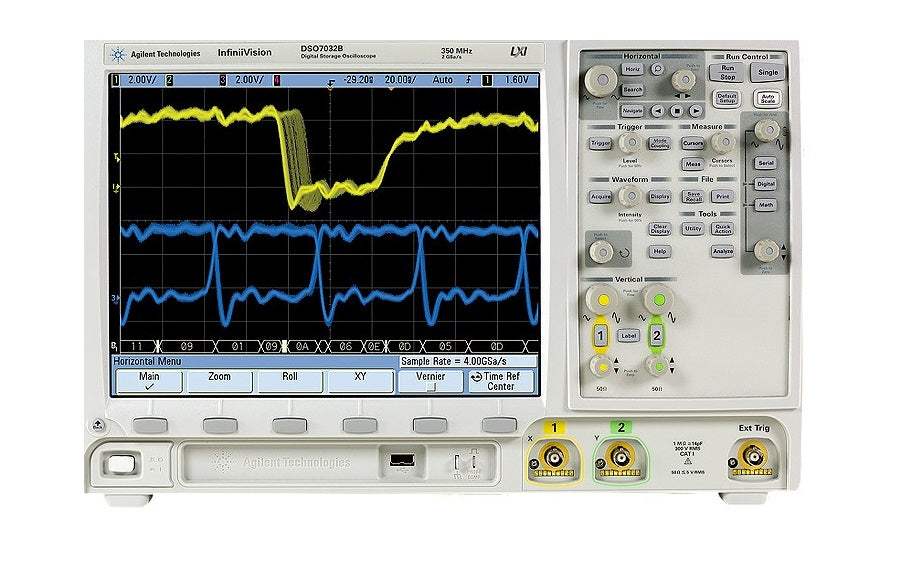
The Agilent InfiniiVision 7000B Series is a family of digital storage oscilloscopes (DSO) and mixed-signal oscilloscopes (MSO) engineered for signal visibility on benches that need to view analog, digital, and serial signals together. The family spans 14 models across 100 MHz, 350 MHz, 500 MHz, and 1 GHz bandwidth tiers, in 2-channel and 4-channel configurations, with MSO variants adding 16 digital timing channels. Every model carries the same 12.1-inch XGA TFT display, the same MegaZoom III acquisition architecture, and the same shallow 6.5-inch-deep, 13-pound chassis.
Application coverage described in the datasheet centers on capturing the signal detail and infrequent events that slower-updating oscilloscopes miss. The 7000B Series is positioned for mixed analog-and-digital debug (MSO models pair scope channels with 16 digital timing channels and a mixed-signal trigger), serial bus development (hardware-accelerated decode and trigger for I2C, SPI, CAN, LIN, RS-232/UART, I2S, FlexRay, and MIL-STD-1553), FPGA validation (with the Xilinx and Altera dynamic-probe applications), automated compliance and mask testing, segmented-memory acquisition for bursty signals, and analog HDTV/EDTV and broadcast video work. Standard triggering covers edge, pulse width, pattern, TV, duration, sequence, and Nth-edge-burst modes.
Agilent Technologies was spun out of Hewlett-Packard in 1999 to carry forward HP's test and measurement business. In 2014, Agilent's electronic measurement division was separated again as Keysight Technologies, which is the current corporate home of the InfiniiVision oscilloscope line. Instruments built and sold under the Agilent brand, including the 7000B Series, trace directly to that lineage.
The InfiniiVision 7000B Series is structured as a single platform offered across four bandwidth tiers (100 MHz, 350 MHz, 500 MHz, and 1 GHz) and two channel counts (2 or 4 analog channels), with each configuration available as a DSO or as an MSO that adds 16 digital timing channels. All fourteen models share the same MegaZoom III acquisition engine, the same 12.1-inch XGA display, the same 8 Mpts of standard acquisition memory, and the same I/O, software, and trigger feature set described in the datasheet.
Differences across the family are concentrated in three places: bandwidth and the corresponding sample rate, the number of simultaneously-acquired analog channels, and whether the model includes the 16 digital timing channels of the MSO configuration. The discussion below covers how those three axes interact and which model number maps to which combination.
Each pre-owned model in the table below is its own product page with condition-matched pricing and stock. Selecting the bandwidth tier and channel-count configuration that matches the intended application generally matters more than selecting between adjacent tiers on bandwidth alone, because the digital-channel and channel-count decisions cannot be added later as a software option.
Bandwidth and sample rate scale together across the family. The 100 MHz and 350 MHz models (DSO/MSO 701xB and 703xB) acquire at 2 GSa/s on each channel. The 500 MHz models (705xB) acquire at 2 GSa/s on each channel or 4 GSa/s in half-channel mode (one channel in each input pair active). The 1 GHz models (710xB) acquire at 2 GSa/s on each channel or 4 GSa/s in half-channel mode, with single-shot bandwidth reaching the full 1 GHz only in half-channel mode.
Channel-count and MSO differences are structural rather than scalar. Two-channel models (the 7xx2B variants) acquire on channels 1 and 2 simultaneously; four-channel models (7xx4B) acquire on channels 1 through 4 simultaneously. MSO models (the MSO prefix) add 16 digital timing channels and the mixed-signal trigger, and they include the 54620-68701 flying-lead logic probe with 20 IC clips and five ground leads. A previously-purchased DSO in this family can be field-upgraded to the equivalent MSO configuration using the DSO-to-MSO upgrade kit referenced in the datasheet (N2741A for 701xB, N2735A for 703xB, N2736A for 705xB, N2737A for 710xB).
| Model | Bandwidth | Sample Rate | Analog Channels |
|---|---|---|---|
| DSO7052B | 500 MHz | 4 GSa/s | 2 |
| DSO7012B | 100 MHz | 2 GSa/s | 2 |
| DSO7014B | 100 MHz | 2 GSa/s | 4 |
| MSO7012B | 100 MHz | 2 GSa/s | 2 |
Additional differences in specifications beyond the few shown above are not listed here — see each model's full specifications below.
| Display System | |
|---|---|
| Display | 12.1-inch (255 mm x 184 mm) diagonal color TFT LCD |
| Throughput of scope channels | Up to 100,000 waveforms/sec in real-time mode |
| Resolution | XGA — 768 vertical by 1024 horizontal points (screen area); 640 vertical by 1000 horizontal points (waveform area); 256 levels of intensity scale |
| Controls | Waveform intensity on front panel. Vectors on/off; infinite persistence on/off, 8 x 10 grid with intensity control |
| Built-in help system | Key-specific help; language support for 11 languages (English, German, French, Russian, Japanese, Traditional Chinese, Simplified Chinese, Korean, Spanish, Portuguese, Italian) |
| Real-time clock | Time and date (user adjustable) |
| Acquisition: Scope Channels | |
| Maximum memory depth (Standard) | 8 Mpts (2 channels) / 4 Mpts (4 channels) |
| Vertical resolution | 8 bits |
| Averaging | Selectable from 2, 4, 8, 16, 32, 64 ... to 65536 |
| High resolution mode | Up to 12 bits of resolution when ≥10 μs/div at 4 GSa/s or ≥20 μs/div at 2 GSa/s |
| Equivalent-time sample rate | 400 GSa/s (when real-time mode is turned off) |
| Filter | Sin(x)/x interpolation (single shot BW = sample rate/4 or bandwidth of scope, whichever is less) with vectors on and in real-time mode |
| Acquisition: Digital Channels (MSO or MSO-upgraded DSO) | |
| Sample rate | 2 GSa/sec one pod, 1 GSa/sec each pod |
| Maximum input frequency | 250 MHz |
| Maximum memory depth | 8 Mpts/4 Mpts (scope channels off); 2.5 Mpts/1.25 Mpts (scope channels on) |
| Vertical resolution | 1 bit |
| Glitch detection | 2 ns (min pulse width) |
| Vertical System: Scope Channels | |
| Range | 2 mV/div to 5 V/div (1 MΩ or 50 Ω); MSO/DSO710xB: 2 mV/div to 5 V/div (1 MΩ), 2 mV/div to 1 V/div (50 Ω) |
| Maximum input | CAT I 300 Vrms, 400 Vpk; transient overvoltage 1.6 kVpk. With 10073C/D 10:1 probe: CAT I 500 Vpk |
| Offset range | ±5 V on ranges <10 mV/div; ±20 V on ranges 10 mV/div to 200 mV/div; ±75 V on ranges >200 mV/div |
| Dynamic range | ±8 div |
| Input impedance | 1 MΩ ±1% || 14 pF or 50 Ω ±1.5%, selectable |
| Coupling | AC, DC |
| BW limit | 25 MHz selectable |
| Channel-to-channel isolation | DC to max bandwidth >40 dB |
| ESD tolerance | ±2 kV |
| DC vertical gain accuracy | ±2.0% full scale |
| DC vertical offset accuracy | ≤200 mV/div: ±0.1 div ±2.0 mV ±0.5% offset value; >200 mV/div: ±0.1 div ±2.0 mV ±1.5% offset value |
| Vertical System: Digital Channels (MSO) | |
| Number of channels | 16 logic timing channels — labeled D15 - D0 |
| Threshold groupings | Pod 1: D7 - D0; Pod 2: D15 - D8 |
| Threshold selections | TTL, CMOS, ECL and user-definable (selectable by pod) |
| User-defined threshold range | ±8.0 V in 10 mV increments |
| Maximum input voltage | ±40 V peak CAT I; transient overvoltage 800 Vpk |
| Threshold accuracy | ±(100 mV + 3% of threshold setting) |
| Input dynamic range | ±10 V about threshold |
| Minimum input voltage swing | 500 mV peak-to-peak |
| Input capacitance | ~8 pF with flying leads |
| Input resistance | 100 kΩ ±2% at probe tip |
| Channel-to-channel skew | 2 ns typical, 3 ns maximum |
| Horizontal | |
| Resolution | 2.5 ps |
| Time scale accuracy | ≤ ±(15 + 2 * (instrument age in years)) ppm |
| Vernier | 1-2-5 increments when off, ~25 minor increments between major settings when on |
| Delay range | Pre-trigger: Greater of 1 screen width or 1 ms; Post-trigger: 1 s to 500 seconds |
| Modes | Main, zoom, roll, XY, segmented (optional) |
| Reference positions | Left, center, right |
| Segmented memory re-arm time | 8 μs (minimum time between trigger events) |
| Trigger System | |
| Modes | Auto, normal (triggered), single |
| Holdoff time | ~60 ns to 10 seconds |
| Trigger jitter | 15 ps rms |
| Selections | Edge, pulse width, pattern, TV, duration, sequence, CAN, LIN, USB, I2C, SPI, Nth edge burst, RS-232 with Option 232 |
| Measurement Features | |
| Automatic measurements | 23 automatic measurements with statistics; up to 4 displayed simultaneously |
| Voltage (scope channels) | Peak-to-peak, maximum, minimum, average, amplitude, top, base, overshoot, preshoot, RMS, standard deviation (AC RMS), Ratio (dB) |
| Time | Frequency, period, +width, −width, duty cycle on any channel. Rise time, fall time, X at max Y, X at min Y, delay, phase on scope channels. |
| Counter | Built-in 5-digit frequency counter; up to 8 digits with external 10 MHz reference |
| Waveform math | 1-2, 1+2, 1x2, 3-4, 3+4, 3x4, FFT, differentiate, integrate, square root |
| Precision Mode | Automatic measurements, waveform math and FFT performed on up to 128 Kpts data record |
| FFT | |
| Points | Up to 128 Kpts in precision mode |
Please review the Manufacturer's Data Sheet to verify published specifications. Feedback on this webpage is always welcome — please reach out to your Test Architect at any time for questions or concerns. Thank you, we truly appreciate you being our customer.
Model No
Agilent
Condition
Used
Manufacturer
Agilent
Channels
2
Frequency
500 MHz
Record length
8 MPts
Sampling rate
4 GS/s


30+ Years in Business

Secure Payments

Sell Test Equipments

Knowledgeable Staff

On-site Lab
30+ Years in Business
Secure Payments
Sell Test Equipments
Knowledgeable Staff
On-site Lab
Request A Quote