Chat Live
 Contact Us
 sales@valuetronics.com


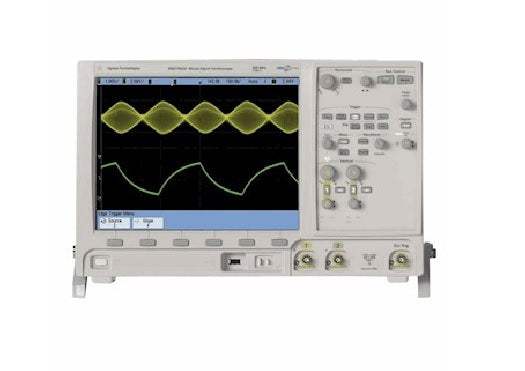
The Agilent InfiniiVision 7000A Series is a family of fourteen digital storage and mixed-signal oscilloscope models spanning 100 MHz, 350 MHz, 500 MHz, and 1 GHz bandwidth tiers, with 2- or 4-channel analog input configurations and optional 16 integrated digital channels on MSO models. Each instrument combines an XGA-resolution 12.1-inch display, 8 Mpts of standard acquisition memory, and Agilent's MegaZoom III acquisition ASIC into a benchtop chassis 6.5 inches deep weighing approximately 13 pounds.
Agilent positions the 7000A Series for hardware design and debug work where engineers need to view analog signals, digital buses, and serial protocol traffic simultaneously. The integrated mixed-signal capability and hardware-accelerated serial decode support common embedded development tasks including I2C, SPI, CAN/LIN, RS-232/UART, I2S, USB low/full-speed, FlexRay, and MIL-STD 1553 protocol analysis. FPGA dynamic probe options provide internal visibility into Xilinx and Altera designs, and a vector signal analysis software pairing extends the platform into wireless and radar waveform evaluation.
ValueTronics stocks and tests Agilent InfiniiVision 7000A Series oscilloscopes at our 20,000-square-foot facility at 1675 Cambridge Drive in Elgin, Illinois. Every {{CONDITION}} 7000A Series instrument is verified against the manufacturer's published specifications by our in-house technicians before shipment, with bandwidth, sample rate, trigger function, and channel performance documented in the condition report. Operating from one secure location rather than a drop-ship network means the unit you order is the unit we have physically tested, and the seller you work with has visibility into its actual configuration including installed software options.
Hewlett-Packard's test and measurement business was spun out as Agilent Technologies in 1999. In 2014, Agilent's electronic measurement division was further separated to form Keysight Technologies, which is the current entity supporting and producing the InfiniiVision oscilloscope line. Instruments branded "Agilent InfiniiVision" are functionally part of the same product lineage as current Keysight-branded models, and calibration, service, and software support flow through the Keysight channel.
The InfiniiVision 7000A Series is structured as fourteen models distributed across four bandwidth tiers (100 MHz, 350 MHz, 500 MHz, 1 GHz) and two analog channel counts (2 or 4). Each bandwidth/channel combination is offered as either a DSO (analog-only) or an MSO (analog plus 16 integrated digital channels with mixed-signal triggering). All fourteen models share the same 12.1-inch XGA display, MegaZoom III acquisition architecture, 8 Mpts standard memory, and connectivity feature set; the differences between models are confined to bandwidth, sample rate, channel count, and the presence or absence of the 16 digital channels.
Within the series, the 500 MHz and 1 GHz tiers step the sample rate up to 4 GSa/s in half-channel mode, and the 1 GHz models reduce peak detect resolution to 250 ps. DSO models can be upgraded to MSO capability in the field using bandwidth-tier-specific upgrade kits (N2741A for 100 MHz, N2735A for 350 MHz, N2736A for 500 MHz, N2737A for 1 GHz), which Agilent describes as a five-minute installation.
Each pre-owned 7000A Series model below is presented on its own product page with condition-matched pricing and availability. Select the specific bandwidth, channel count, and DSO/MSO configuration that fits your application; if a field upgrade to MSO is being considered for a DSO unit, contact a Test Architect to verify the corresponding upgrade kit availability.
The four bandwidth tiers (100 MHz, 350 MHz, 500 MHz, 1 GHz) correspond directly to the highest-frequency signal each model can accurately measure. The 100 MHz and 350 MHz tiers share a 2 GSa/s sample rate and a 500 ps peak detect specification; the 500 MHz and 1 GHz tiers move to 4 GSa/s in half-channel mode and tighten peak detect to 250 ps. Calculated rise times track bandwidth as expected: 3.5 ns at 100 MHz, 1 ns at 350 MHz, 700 ps at 500 MHz, and 350 ps at 1 GHz.
DSO versus MSO is the second differentiation axis: MSO models add 16 digital timing channels with their own threshold groupings, mixed-signal triggering across analog and digital channels, and 250 MHz maximum digital input frequency. The 2-channel versus 4-channel distinction affects external trigger input characteristics (1 MΩ on 2-channel models versus 2.14 kΩ on 4-channel models) and is required for the optional serial decode applications, which the datasheet specifies are available only on 4-channel DSO or MSO configurations. Refer to the comparison table below for the bandwidth, sample rate, channel count, and digital channel breakdown across all fourteen models.
| Model | Bandwidth | Sample Rate | Analog Channels |
|---|---|---|---|
| DSO7032A | 350 MHz | 2 GSa/s | 2 |
| DSO7012A | 100 MHz | 2 GSa/s | 2 |
| DSO7014A | 100 MHz | 2 GSa/s | 4 |
| MSO7012A | 100 MHz | 2 GSa/s | 2 |
Additional differences in specifications beyond the few shown above are not listed here — see each model's full specifications below.
| Category | Specification | Value |
|---|---|---|
| Acquisition: scope channels | Sample rate | MSO/DSO701xA: 2 GSa/s each channel; MSO/DSO703xA: 2 GSa/s each channel; MSO/DSO705xA/710xA: 4 GSa/s half channel, 2 GSa/s each channel; Equivalent-time sample rate: 400 GSa/s (when real-time mode is turned off) |
| Acquisition | Memory depth (Standard) | 8 Mpts (2 channels) / 4 Mpts (4 channels) |
| Acquisition | Vertical resolution | 8 bits |
| Acquisition | Peak detection | MSO/DSO701xA: 500 ps; MSO/DSO703xA: 500 ps; MSO/DSO705xA/710xA: 250 ps |
| Acquisition | Averaging | Selectable from 2, 4, 8, 16, 32, 64 ... to 65536 |
| Acquisition | High resolution mode | Average mode with avg = 1; 12 bits of resolution when ≥10 µs/div at 4 GSa/s or ≥20 µs/div at 2 GSa/s |
| Acquisition | Filter | Sinx/x interpolation (single shot BW = sample rate/4 or bandwidth of scope, whichever is less) with vectors on and in real-time mode |
| Digital channels | Sample rate | 2 GSa/s one pod, 1 GSa/s each pod |
| Digital channels | Maximum input frequency | 250 MHz |
| Digital channels | Memory depth (with scope channels off) | Standard 8 Mpts (one pod) / 4 Mpts (both pods) |
| Digital channels | Memory depth (with scope channels on) | Standard 2.5 Mpts (one pod) / 1.25 Mpts (both pods) |
| Digital channels | Vertical resolution | 1 bit |
| Digital channels | Glitch detection | 2 ns (min pulse width) |
| Vertical: scope channels | Bandwidth (-3 dB) | MSO/DSO701xA: DC to 100 MHz; MSO/DSO703xA: DC to 350 MHz; MSO/DSO705xA: DC to 500 MHz; MSO/DSO710xA: DC to 1 GHz |
| Vertical | AC coupled | 3.5 Hz to model bandwidth |
| Vertical | Calculated rise time (=0.35/bandwidth) | MSO/DSO701xA: 3.5 ns; MSO/DSO703xA: 1 ns; MSO/DSO705xA: 700 ps; MSO/DSO710xA: 350 ps |
| Vertical | Single-shot bandwidth | MSO/DSO701xA: 100 MHz; MSO/DSO703xA: 350 MHz; MSO/DSO705xA: 500 MHz; MSO/DSO710xA: 1 GHz (in half-channel mode) |
| Vertical | Range | MSO/DSO701xA, 703xA, 705xA: 2 mV/div to 5 V/div (1 MΩ or 50 Ω); MSO/DSO710xA: 2 mV/div to 5 V/div (1 MΩ), 2 mV/div to 1 V/div (50 Ω) |
| Vertical | Maximum input | CAT I 300 Vrms, 400 Vpk; transient overvoltage 1.6 kVpk; CAT II 100 Vrms, 400 Vpk; With 10073C 10:1 probe: CAT I 500 Vpk, CAT II 400 Vpk |
| Vertical | Offset range | ±5 V on ranges <10 mV/div; ±20 V on ranges 10 mV/div to 200 mV/div; ±75 V on ranges >200 mV/div |
| Vertical | Dynamic range | ±8 div |
| Vertical | Input impedance | 1 MΩ ±1% || 14 pF or 50 Ω ±1.5%, selectable |
| Vertical | Coupling | AC, DC |
| Vertical | BW limit | 25 MHz selectable |
| Vertical | Channel-to-channel isolation | DC to max bandwidth >40 dB |
| Vertical | ESD tolerance | ±2 kV |
| Vertical | Noise, RMS, input shorted | MSO/DSO701xA: 0.50% FS or 300 µV; MSO/DSO703xA: 0.50% FS or 300 µV; MSO/DSO705xA: 0.50% FS or 360 µV; MSO/DSO710xA: 0.65% FS or 360 µV |
| Vertical | DC vertical gain accuracy | ±2.0% full scale |
| Vertical | DC vertical offset accuracy | ≤200 mV/div: ±0.1 div ±2.0 mV ±0.5% offset value; >200 mV/div: ±0.1 div ±2.0 mV ±1.5% offset value |
| Vertical: digital | Number of channels | 16 logic timing channels - labeled D15 - D0 |
| Vertical: digital | Threshold groupings | Pod 1: D7-D0; Pod 2: D15-D8 |
| Vertical: digital | Threshold selections | TTL, CMOS, ECL and user-definable (selectable by pod) |
| Vertical: digital | User-defined threshold range | ±8.0 V in 10 mV increments |
| Vertical: digital | Maximum input voltage | ±40 V peak CAT I; transient overvoltage 800 Vpk |
| Vertical: digital | Threshold accuracy | ±(100 mV + 3% of threshold setting) |
| Vertical: digital | Input dynamic range | ±10 V about threshold |
| Vertical: digital | Minimum input voltage swing | 500 mV peak-to-peak |
| Vertical: digital | Input capacitance | ~8 pF with flying leads |
| Vertical: digital | Input resistance | 100 kΩ ±2% at probe tip |
| Vertical: digital | Channel-to-channel skew | 2 ns typical, 3 ns maximum |
| Horizontal | Range | MSO/DSO701xA: 2 ns/div to 50 s/div; MSO/DSO703xA: 2 ns/div to 50 s/div; MSO/DSO705xA: 1 ns/div to 50 s/div; MSO/DSO710xA: 500 ps/div to 50 s/div |
| Horizontal | Resolution | 2.5 ps |
| Horizontal | Time scale accuracy | ≤±(15+2*(instrument age in years)) ppm |
| Horizontal | Delay range | Pre-trigger (negative delay): Greater of 1 screen width or 1 ms; Post-trigger (positive delay): 1 s to 500 seconds |
| Horizontal | Modes | Main, zoom, roll, XY, segmented (optional) |
Please review the Manufacturer's Data Sheet to verify published specifications. Feedback on this webpage is always welcome — please reach out to your Test Architect at any time for questions or concerns. Thank you, we truly appreciate you being our customer.
Model No
Agilent
Condition
Used
Manufacturer
Agilent
Channels
2
Frequency
350 MHz
Record length
8 MPts
Sampling rate
2 GS/s


30+ Years in Business

Secure Payments

Sell Test Equipments

Knowledgeable Staff

On-site Lab
30+ Years in Business
Secure Payments
Sell Test Equipments
Knowledgeable Staff
On-site Lab
Request A Quote