Chat Live
 Contact Us
 sales@valuetronics.com


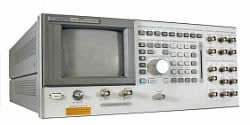
The Agilent 8922M GSM MS Test Set is a one-box test solution designed for GSM mobile manufacturers who need to verify transmitter and receiver performance under realistic call-processing conditions. Switching the instrument on brings up a GSM base station emulator that allows a mobile under test to camp on the network and place a call within seconds, opening the door to the full battery of transmitter and receiver measurements the instrument was built to perform.
According to the datasheet, the 8922M is used for GSM mobile production test where throughput and measurement repeatability are the primary requirements. The instrument supports BS-originated and MS-originated call setup (full-rate and enhanced full-rate speech), MS camp-on, BS and MS call disconnect, hand-overs, channel assignments, Tx power control commands, and SMS cell broadcast — the call-processing features required to exercise a mobile as if it were operating on a real network. A companion 8922S service test set is documented for repair and troubleshooting workflows, and the 83220E extension adds DCS1800 and PCS1900 coverage.
The 8922 family carries Hewlett-Packard's test and measurement lineage. HP's test and measurement business was spun off as Agilent Technologies in 1999, and Agilent's electronic measurement division was subsequently transferred to Keysight Technologies in 2014. Instruments labeled HP, Agilent, and Keysight on the same product line are part of a continuous engineering and support heritage.
The Agilent 8922 family is structured around two GSM test sets — the 8922S service test set and the 8922M production test set — with the 83220E extension available to add DCS1800 and PCS1900 coverage. All three share the same chassis, the same base station emulator, and the same toolkit of general-purpose instruments, with the differentiation centered on measurement speed, production-test features, and frequency band coverage.
The datasheet positions the 8922S for service and repair workflows where ease-of-use and reduction of false failures are the primary requirements, while the 8922M is positioned for manufacturers who need the highest measurement throughput in the family. The 83220E is documented as a frequency-band extension rather than a standalone instrument, and is intended to be ordered alongside an 8922S or 8922M.
Each pre-owned model below is offered as its own product page with condition-matched pricing and a separate listing. Specifications and accessory configurations vary by individual unit, so confirm the exact options and any included accessories on the specific listing of interest before placing an order.
The 8922M is the production-oriented variant of the family. The datasheet identifies it as offering the highest speed of test in its class while maintaining accurate and repeatable measurements, and several production-test features — including 0.3 GMSK clock and data inputs, pulse modulation, 30 dB pulse modulation for adjacent timeslot rejection, AM for level control, 0.3 GMSK data recovery output, FM demodulation output, and pulse demodulation output — are documented as 8922M-only capabilities.
The 8922S and 8922M share the same RF generator and RF analyzer measurement architecture, the same GSM base station emulator, and the same toolkit instruments. The 8922M adds the production-test signal interfaces documented above, and supports an additional measurement (Rx adjacent channel rejection at different frequency / same timeslot, and Rx co-channel rejection, and Rx intermodulation rejection) that the 8922S does not.
The 83220E extends either base test set into the DCS1800 (1805 to 1990 MHz) and PCS1900 frequency ranges with its own RF generator and RF analyzer specifications documented separately. See the comparison table below for the per-model differences in supported features and frequency coverage.
| Model | Application | Frequency Range | RF Generator Level Range |
|---|---|---|---|
| 8922M | GSM mobile manufacturing | 10 MHz to 1 GHz | -14 to -127 dBm |
| 8922S | GSM mobile service and repair | 10 MHz to 1 GHz | -14 to -127 dBm |
| 83220E | DCS1800/PCS1900 mobile test (extension to 8922S/M) | 1710 to 1990 MHz | -19 to -127 dBm |
Additional differences in specifications beyond the few shown above are not listed here — see each model's full specifications below.
| Specification | Value |
|---|---|
| RF Generator | |
| Frequency Range | 10 MHz to 1 GHz |
| Frequency Resolution | 1 Hz |
| Frequency Accuracy | Reference accuracy ± 0.5 Hz |
| RF In/Out Level Range | -14 to -127 dBm, max overrange power > -12 dBm max |
| RF In/Out Level Resolution | 0.1 dB |
| RF In/Out Level Accuracy (GSM bands) | ±1.0 dB, levels ≥ -127 dBm |
| RF In/Out Reverse Power | 15 W continuous; 100 W for 10 seconds/minute |
| RF In/Out SWR | 1.5:1 |
| Aux RF Out Level Range | +4 to -127 dBm |
| Aux RF Out SWR | 2.0:1, level < -4 dBm |
| Harmonics | < -25 dBc |
| Non-harmonics | < -50 dBc, > 5 kHz offset from carrier |
| 0.3 GMSK Phase Error | ≤ 1° rms |
| 0.3 GMSK Peak Phase Error | ≤ 4° peak |
| 0.3 GMSK Frequency Error | ±[0.02 ppm (18 Hz) + reference accuracy], for normal bursts |
| Amplitude Flatness | ±0.25 dB peak |
| RF Analyzer | |
| Frequency Range | 10 MHz to 1 GHz |
| Frequency Resolution | 1 Hz |
| CW RF Frequency Measurement Range | 10 MHz to 1 GHz |
| CW RF Power Measurement Range | 90 MHz to 1 GHz; -5 to +41 dBm |
| Peak Transmitter Carrier Power Range | -5 to +41 dBm |
| Peak Carrier Power Accuracy | (+4 to +41 dBm) ±0.6 dB ± noise effects (0.2 mW) |
| RF In/Out SWR | < 1.5:1 |
| RMS Phase Error Accuracy | ≤ 1° rms |
| Peak Phase Error Accuracy | ≤ 4° peak |
| Spectrum Analyzer (Option 006) | |
| Frequency Range | 10 MHz to 1 GHz |
| Display | Log, 10 dB/div |
| Display Range | 80 dB |
| Log Linearity | ±1.1 dB |
| Reference Level (RF in/out) | +44 to -24 dBm |
| Reference Level (Aux RF in) | +23 to -55 dBm |
| Residual Responses | < -70 dBm (no input signal, 0 dB attenuation) |
| Image Rejection | > 50 dB |
| Audio Source | |
| Frequency Range | DC to 25 kHz |
| Frequency Accuracy | 0.025% of setting |
| Output Level Range | 0.1 mV to 4 Vrms |
| Maximum Output Current | 20 mA peak |
| Output Impedance | < 1 ohm |
| Output Level Accuracy | ±(2% of setting + resolution) |
| Residual Distortion (THD + noise) | 0.1%, 20 Hz to 25 kHz in 80 kHz BW (amplitude > 200 mVrms) |
| Audio Analyzer | |
| Frequency Measurement Range | 20 Hz to 400 kHz |
| Frequency Measurement Accuracy | ±(0.02% + 1 count + reference accuracy) |
| AC Voltage Range | 0 V to 30 Vrms |
| AC Voltage Accuracy (20 Hz to 15 kHz, input > 1 mVrms) | ±3% of reading |
| DC Voltage Range | 100 mV to 42 V |
| DC Voltage Accuracy | ±(1.0% of reading + DC offset) |
| Distortion Fundamental Frequency | 1 kHz ± 5 Hz |
| Distortion Display Range | 0.1% to 100% |
| Distortion Accuracy | ±1 dB (0.5 to 100% distortion) |
| Oscilloscope | |
| Frequency Range (3 dB) | 2 Hz to 50 kHz |
| Scale/Division | 10 mV to 10 V in 1, 2, 5 and 10 steps |
| Amplitude Accuracy (20 Hz to 10 kHz) | ±1.5% of reading ± 0.1 division |
| Time/Division | 10 µs to 100 µs in 1, 2, 5 and 10 steps |
| External Trigger Level | TTL |
| Max Voltage (Scope in) | 5 V peak |
| Max Voltage (Audio in) | 30 Vrms |
| Remote Programming | |
| GPIB | Agilent's implementation of IEEE Standard 488.2 |
| GPIB Functions | SH1, AH1, T6, L4, SR1, RL1, LE0, TE0, PP0, DC1, DT1, C4, C11, E2 |
| RS-232 | 3-wire RJ-11 connector, serial data in/out |
| Baud Rates | 1200, 2400, 4800, 9600, 19200 selectable |
| General | |
| Size | 177 H x 426 W x 574 D mm (7 x 16.75 x 23 in) |
| Weight | 32 kg (70 lb) |
| Operating Temperature | 0° to +55°C |
| Storage Temperature | -40° to +70°C |
| Power | 100, 120, 220, 240 Vac, 48 to 440 Hz, ±10% of line voltage, max 450 VA |
| EMI | Meets European EMC directive 89/336/EEC |
Please review the Manufacturer's Data Sheet to verify published specifications. Feedback on this webpage is always welcome — please reach out to your Test Architect at any time for questions or concerns. Thank you, we truly appreciate you being our customer.
Model No
Agilent
Condition
Used
Manufacturer
Agilent


30+ Years in Business

Secure Payments

Sell Test Equipments

Knowledgeable Staff

On-site Lab
30+ Years in Business
Secure Payments
Sell Test Equipments
Knowledgeable Staff
On-site Lab
Request A Quote