Chat Live
 Contact Us
 sales@valuetronics.com


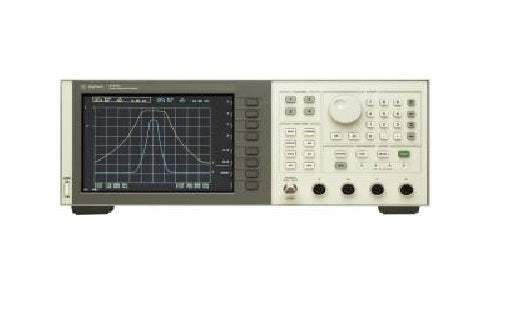
The Agilent 8757D is a scalar network analyzer covering 10 MHz to 110 GHz when paired with compatible detectors and directional bridges. The instrument processes signals from Agilent 85037 series precision detectors, 85025 and 85026 series detectors, and 85027 series directional bridges for logarithmic display in single channel or ratio mode. Four independent display channels and three standard detector inputs (with an optional fourth) provide flexibility for transmission and reflection measurements across a wide dynamic range.
The 8757D is used for accurate measurement of transmission and reflection characteristics in scalar network analysis applications. The datasheet specifies amplifier measurements (gain, gain compression, return loss, SWR), filter characterization, frequency-translating device measurements, and voltage-controlled device measurements. With the optional internal power calibrator and 85037 series precision detectors, the instrument supports absolute power measurements in dBm. The system interface enables coordinated operation with Agilent PSG signal generators (Option 007), 8360 series synthesized sweepers, and 8370 series synthesized sweepers.
Hewlett-Packard's test and measurement business was spun out as Agilent Technologies in 1999, and the electronic measurement portion of Agilent then became Keysight Technologies in 2014. Instruments originally branded HP, then Agilent, and now Keysight share this continuous engineering lineage. The 8757D was introduced under the Agilent brand following the 1999 spin-off.
The Agilent 8757D scalar network analyzer is offered in four configurations distinguished by the inclusion of a fourth detector input and/or the internal 50 MHz power calibrator. All configurations share the same core measurement architecture: four display channels, GPIB programmability, the dedicated system interface for source and peripheral control, and compatibility with the full range of Agilent 85025, 85026, 85027, and 85037 series accessories.
Selection between the four configurations is driven by two questions: whether a fourth detector input is needed for the measurement setup, and whether the internal power calibrator is required to achieve the corrected absolute power accuracy specifications of the 85037 series precision detectors.
Each pre-owned 8757D configuration listed below is its own dedicated product page with condition-matched pricing and availability. Configurations 001, 002, and 012 add the indicated options to the standard 700 base configuration.
The 8757D-700 is the standard four-channel scalar network analyzer with three detector inputs. The 8757D-001 adds a fourth detector input for measurement setups that require simultaneous monitoring of an additional signal path. The 8757D-002 adds the internal 50 MHz power calibrator, which is required to achieve the corrected dynamic accuracy and absolute accuracy specifications of the 85037A and 85037B precision detectors (per the datasheet's Precision Detector Summary).
The 8757D-012 combines both options, providing the fourth detector input and the internal power calibrator in a single unit. The comparison table below summarizes the configurations across the dimensions that differentiate them.
| Model | Configuration | Detector Inputs | Internal Power Calibrator |
|---|---|---|---|
| 8757D | Standard | 3 | No |
Additional differences in specifications beyond the few shown above are not listed here — see each model's full specifications below.
| Specification | Value |
|---|---|
| Display | |
| Display Channels | Four independent |
| Horizontal Resolution (1 trace) | 101, 201, 401, 801, 1601 points |
| Horizontal Resolution (2 traces) | 101, 201, 401, 801 points |
| Horizontal Resolution (3, 4 traces) | 101, 201, 401 points |
| Color Settings | Up to 8 operator-selectable colors |
| Display Modes | |
| Log Magnitude (dBm) — Scale Resolution | 0.1 to 20 dB/div (1/2/5 sequence) |
| Log Magnitude (dBm) — Display Range | −80 to +80 dBm |
| Log Magnitude (dBm) — Vertical Resolution | 0.003 dB (0.01 dB for display cursor) |
| Log Magnitude (dB) — Scale Resolution | 0.1 to 20 dB/div (1/2/5 sequence) |
| Log Magnitude (dB) — Display Range | −90 to +90 dB |
| Log Magnitude (dB) — Vertical Resolution | 0.006 dB (0.01 dB for display cursor) |
| Normalized Ratio — Scale Resolution | 0.1 to 20 dB/div (1/2/5 sequence) |
| Normalized Ratio — Display Range | −180 to +180 dB |
| Normalized Ratio — Vertical Resolution | 0.01 dB |
| SWR — Scale Resolution | 0.02 to 10 units/div (1/2/4 sequence) |
| SWR — Display Range | 1.0 to 37.0 |
| SWR — Vertical Resolution | 0.01 at 1, 0.1 at 10, 0.27 at 30 |
| AUX Voltage — Scale Resolution | 0.025 to 5 V/div (1/2.5/5 sequence) |
| AUX Voltage — Display Range | −10 to +10 V |
| AUX Voltage — Vertical Resolution | 0.001 V |
| AUX Voltage — Typical Maximum Error | 60 mV |
| Sweep Time (minimum, log magnitude format) | |
| 101 points / 1 trace | 40 ms |
| 201 points / 1 trace | 50 ms |
| 401 points / 1 trace | 100 ms |
| 801 points / 1 trace | 200 ms |
| 1601 points / 1 trace | 400 ms |
| Averaging & Smoothing | |
| Averaging | 2, 4, 8, 16, 32, 64, 128, or 256 successive traces |
| Smoothing Aperture | 0.1% to 20% of trace width |
| Limit Lines | |
| Segments | Up to 12 (flat or sloped lines or single points) |
| Availability | Channels 1 and 2 only, traces with 401 points or fewer |
| Storage | Save/recall registers 1 through 4 |
| Save/Recall Registers | |
| Total Registers | 9 complete front panel states |
| Registers 1–4 | Instrument state plus memory traces for channels 1 and 2 |
| Registers 5–9 | Instrument state only |
| Modulation Requirements (AC Mode) | |
| Square-Wave AM Frequency | 27,778 Hz ±20 Hz |
| On/Off Ratio | ≥30 dB |
| Symmetry | 45% to 55% |
| Rear Panel Connectors | |
| Sweep Voltage Input | 0 to 10 volts |
| Blanked Voltage (Pos z blank) | +5 V typical |
| Unblanked Voltage | 0 V typical |
| Marker Voltage | −4 V typical |
| Active Marker Voltage | −8 V typical |
| Modulator Drive Frequency | 27,778 Hz ±12 Hz |
| Modulator Drive Symmetry | 50% ±1% |
| ADC In Range | −10 to +10 V |
| Control 1 and Control 2 | TTL open-collector digital output |
| Video Outputs | |
| LCD Monitor Output | VGA compatible |
| CRT Monitor Output | RGB BNC inputs (sync on green), 75 ohm input impedance, 26.5 kHz horizontal scan rate, 60 Hz vertical refresh rate, 1 V p-p |
| GPIB | |
| Standards | IEEE 488-1978, IEC-625 |
| Interface Function Codes | SH1, AH1, T6, TE0, L4, LE0, SR1, RL1, PP0, DC1, DT0, C0, E1 |
| Transfer Formats | ASCII strings or 16-bit integers |
| Transfer Speed (ASCII, 401-point trace) | 500 ms typical |
| Transfer Speed (ASCII, single point) | 10 ms typical |
| Transfer Speed (Binary, 401-point trace) | 30 ms typical |
| Transfer Speed (Binary, single point) | 7 ms typical |
| General | |
| Operating Temperature | 0 to 55 °C |
| Storage Temperature | −40 to 75 °C |
| Power Requirements | 48 to 66 Hz, 100/120/220/240 V ±10%, typically 155 VA |
| Dimensions (H × W × D) | 178 × 425 × 482 mm (7.0 × 16.75 × 19.0 in) |
| Net Weight | 22 kg (48 lb) |
| Shipping Weight | 28 kg (61.5 lb) |
| Power Calibrator (Option 002 only) | |
| Frequency | 50 MHz ±0.2 MHz |
| Output Power Range | +20 to −50 dBm |
| Accuracy at 0 dBm | ±0.05 dB |
| Linearity (+20 to +10 dBm) | ±0.08 dB |
| Linearity (+10 to −30 dBm) | ±0.04 dB |
| Linearity (−30 to −50 dBm) | ±0.06 dB |
| SWR | ≤1.05 |
| Modes of Operation | DC Mode (unmodulated); AC Mode (modulated at 27,778 Hz ±12 Hz) |
| Connector | Type-N (f) |
Please review the Manufacturer's Data Sheet to verify published specifications. Feedback on this webpage is always welcome — please reach out to your Test Architect at any time for questions or concerns. Thank you, we truly appreciate you being our customer.
Model No
Agilent
Condition
Used
Manufacturer
Agilent
Frequency
60 GHz
1
Adds fourth detector input
2
Adds internal power calibrator
12
Adds fourth detector and internal calibrator


30+ Years in Business

Secure Payments

Sell Test Equipments

Knowledgeable Staff

On-site Lab
30+ Years in Business
Secure Payments
Sell Test Equipments
Knowledgeable Staff
On-site Lab
Request A Quote