Chat Live
 Contact Us
 sales@valuetronics.com


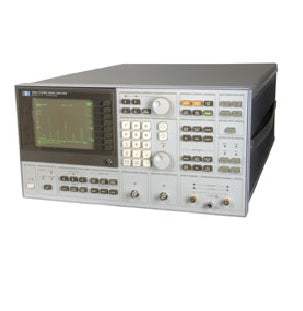
The HP 3563A and 3562A are dual-channel dynamic signal analyzers designed for measurement and analysis of analog signals, with the HP 3563A extending capability to digital signals and devices as well. Both instruments cover a measurement range from 64 µHz to 100 kHz on both channels in single- or dual-channel operation, with 80 dB dynamic range and full alias protection. The HP 3563A is positioned as a control systems analyzer for engineers working with electrical, mechanical, or electromechanical loops, while the HP 3562A is well suited for test and analysis of mechanical systems and predominantly analog electrical and electromechanical systems.
According to the datasheet, the HP 3563A supports network analysis of digital or analog devices through accurate, high-resolution frequency response measurements of mechanical and analog, digital, or mixed analog/digital electronic systems. Measurements can be performed with linear resolution FFT, logarithmic resolution FFT, or swept-sine analysis. The instruments also support online analysis of distortion, drift, modulation, and phase noise, and can analyze transient events in both the time and frequency domain or capture time records for later recall and analysis. The HP 3563A adds extraction of system models with s- and z-domain curve fitting and modeling of systems using frequency response synthesis.
Hewlett-Packard's test and measurement business was spun out as Agilent Technologies in 1999, and that electronic measurement business became Keysight Technologies in 2014. Instruments originally branded HP — including the HP 3563A and HP 3562A dynamic signal analyzers — trace their support and successor lineage through that path. The HP signal analyzer family from this era remains in active use in legacy control-systems test setups and mechanical-vibration laboratories where the original test procedures reference these instruments by name.
The HP 3563A and HP 3562A are companion dynamic signal analyzers from Hewlett-Packard sharing a common dual-channel FFT-based architecture, 64 µHz to 100 kHz measurement range, 80 dB dynamic range, and front-panel analog source. The datasheet describes the HP 3563A as a compatible superset of the popular HP 3562A, with the FFT-based design offering the versatility required for spectrum, network, and waveform measurements across both instruments.
The most significant difference between the two instruments, as stated in the datasheet, is that the HP 3562A cannot be used to measure and analyze digital signals and devices. The HP 3563A adds 16-bit digital input capability (TTL or CMOS), a digital signal source, mixed analog/digital frequency response measurement, and additional analog source waveforms (step, pulse, ramp, and arbitrary).
Each pre-owned HP 3563A or HP 3562A listed below is its own dedicated product page with condition-matched pricing and accessories documented per unit. Confirm the specific configuration, included accessories, and current calibration status on the individual product listing for the unit you are evaluating.
Within this family, the HP 3563A is positioned as the control systems analyzer for next-generation systems involving electrical, mechanical, or electromechanical loops, including mixed analog and digital inputs and outputs. It is the model to specify when digital signal acceptance, digital source output, or s- and z-domain curve fitting for system modeling is required.
The HP 3563A and HP 3562A differ primarily in digital capability, source waveform set, and the inclusion of curve-fitting and frequency-response-synthesis tools on the HP 3563A. The HP 3562A handles mechanical systems and predominantly analog electrical and electromechanical systems; the HP 3563A handles those plus digital signals and devices and mixed analog/digital systems.
See the comparison table that follows for the specific differences as printed in the datasheet — digital input acceptance, digital source availability, analog source waveform set, and curve-fitting capability are the primary differentiators between the two models in this family.
| Model | Frequency Range | Channels | Digital Input |
|---|---|---|---|
| 3562A | 64 µHz to 100 kHz | 2 (dual-channel) | No (analog-only) |
| 3563A | 64 µHz to 100 kHz | 2 (dual-channel) | Yes (16-bit, TTL or CMOS) |
Additional differences in specifications beyond the few shown above are not listed here — see each model's full specifications below.
| Specification | Value |
|---|---|
| Frequency | |
| Measurement Range | 64 µHz to 100 kHz, both channels, single- or dual-channel operation |
| Resolution | Span/800, both channels, single- or dual-channel operation, linear resolution mode |
| Number of Spans (Baseband / Zoom) | 66 / 64 |
| Min. Span (Baseband / Zoom) | 10.24 mHz / 20.48 mHz |
| Max. Span (Baseband / Zoom) | 100 kHz / 100 kHz |
| Time Record (sec) | 800/span |
| Window Functions | Flat top, Hann, uniform, force, exponential, user-defined |
| Typical Real-Time Bandwidths | Single-channel, fast averaging: 10 kHz |
| Throughput to CS/80 disk (Single channel) | 12.5 kHz |
| Throughput to CS/80 disk (Dual channel) | 6.25 kHz |
| Amplitude | |
| Absolute Accuracy | Single channel (channel 1 or 2): ±0.15 dB ±0.015% of input range (+27 to -40 dBV); ±0.25 dB ±0.025% of input range (-41 to -51 dBV) |
| Window Flatness (Flat top) | +0, -0.01 dB |
| Window Flatness (Hann) | +0, -1.5 dB |
| Noise Floor | With flat top window, 50Ω source impedance and input set to -51 dBV range: 20 Hz to 1 kHz (1 kHz span) < -126 dBV (-134 dBV√Hz); 1 to 100 kHz (100 kHz span) < -115 dBV (-144 dBV√Hz) |
| Frequency Response Channel Match (Analog/analog) | For input signals at full scale on any pair of ranges, accuracy is ±0.1 dB, ±0.5 degree (HP 3562A and 3563A) |
| Dynamic Range | ≥ 80 dB below full-scale input range |
| Analog Input | |
| Input Impedance | 1 MΩ ±5% shunted by < 100 pF |
| Input Coupling | Inputs can be ac or dc coupled; ac rolloff is < 3 dB at 1 Hz |
| Crosstalk | -140 dB (50-Ω source, 50-Ω input termination, input connectors shielded) |
| Common Mode Rejection | 0 to 60 Hz: 80 dB; 66 to 500 Hz: 65 dB |
| External Sampling Input | TTL-compatible input for signals ≤ 256 kHz (nominal maximum sampling rate) |
| Trigger | |
| Trigger Modes | Free run, input channel 1 or 2, source and external trigger |
| Trigger Delay | Pre- and post-trigger delay resolution is 1 sample (1/2048 of a time record) |
| Pre-Trigger | A measurement can be based on data that starts from 1 to 4096 samples (1/2048 to 2 time records) before trigger conditions are met |
| Post-Trigger | A measurement is initiated from 1 to 65,536 samples (1/2048 to 32 time records) after the trigger conditions are met |
| Analog Source | |
| Source Types | Random noise, burst random, sine chirp, burst chirp, fixed sine, and swept sine available from the front-panel source. Users can select dc offset. |
| Output Impedance | 50 Ω (nominal) |
| Output Level | Between +10 and -10 V peak (ac + dc) into a ≥ 10 kΩ, < 1000-pF load. Maximum current is 20 mA. |
| AC Level | ±5 V peak (≥ 10 kΩ, < 1000 pF load) |
| DC Offset | ±10 V peak in 100-mV steps. Residual offset at 0V offset ≤ 10 mV |
| Distortion (25.6 µHz to 10 kHz) | -55 dB |
| Distortion (10 to 100 kHz) | -40 dB |
| General | |
| Operating Conditions | Specifications apply when AUTO CAL is enabled or within 5°C and 2 hours of last internal calibration |
| Power | 86 to 127 Vac, 48 to 66 Hz; 196 to 253 Vac, 48 to 66 Hz; 450 VA maximum |
| Weight | Net: 27 kg (58 lb); Shipping: 36 kg (79 lb) |
| Size (W × H × D) | 426 mm × 222 mm × 578 mm (16.75 in × 8.75 in × 22.75 in) |
Please review the Manufacturer's Data Sheet to verify published specifications. Feedback on this webpage is always welcome — please reach out to your Test Architect at any time for questions or concerns. Thank you, we truly appreciate you being our customer.
Model No
HP
Condition
Used
Manufacturer
Agilent
Frequency
100 kHz


30+ Years in Business

Secure Payments

Sell Test Equipments

Knowledgeable Staff

On-site Lab
30+ Years in Business
Secure Payments
Sell Test Equipments
Knowledgeable Staff
On-site Lab
Request A Quote