Chat Live
 Contact Us
 sales@valuetronics.com


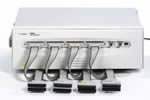
The Agilent 1680 and 1690 Series Logic Analyzers are digital design debug instruments designed to help engineers solve critical digital design problems faster. The family covers state analysis, timing analysis, and transitional timing in a single instrument, with a Windows-based user interface that puts navigation, triggering, and analysis on a single screen. The 1680 Series is a self-contained benchtop instrument with a 12.1-inch color display, front-panel knobs and hot keys, and cable access from either the front or back of the chassis. The 1690 Series is a PC-hosted instrument that connects to a host PC through an IEEE 1394 port, allowing engineers to carry out debug work in their existing PC environment at the lowest price point in the family.
Per the datasheet, the analyzers are positioned for board turn-on and system debug work, where engineers need to identify the root cause of a problem by capturing every aspect of the design — from a simple stuck bit through to the complex sequence of events leading up to a timing problem. State analysis captures microprocessor and bus cycles synchronously to the system under test, with inverse-assembly support that converts captured data into processor mnemonics or bus transactions. Timing analysis uses the analyzer's internal clock to sample system activity, and transitional timing stores samples only when a signal transitions — extending the effective capture window for systems with bursts of activity followed by quiet periods.
Agilent Technologies was spun out of Hewlett-Packard in 1999 as HP's test, measurement, and medical-instrument business. In 2014, Agilent's electronic measurement business was transferred to Keysight Technologies, which now holds the support and product-continuation responsibility for instruments originally branded Agilent.
The Agilent 1680 and 1690 Series is a 16-model family of Windows-based logic analyzers that share the same core measurement engine — 200 MHz state, 400/800 MHz timing (full/half channel), 200 MHz transitional timing — across two form factors and two memory tiers. The benchtop 1680 Series integrates a 12.1-inch color display, front-panel knobs, hot keys, hard drive, floppy drive, CD-ROM, LAN, and standard PC peripheral ports into a self-contained instrument. The 1690 Series PC-hosted variant moves the display, storage, and connectivity to a host PC connected via IEEE 1394, yielding a smaller-footprint, lower-price acquisition module.
Within each form factor, four channel counts are offered — 136, 102, 68, and 34 channels — and each is available in either a Standard memory configuration or a Deep memory configuration (the 'AD' suffix). The number of available trigger timers is the only sequencer resource that scales with channel count: 3 timers on the 136-channel models, 2 on the 102-channel, 1 on the 68-channel, and 0 on the 34-channel model.
Each model in the table below has its own ValueTronics product page with pre-owned-matched pricing and inventory. Selecting the correct model number — including the form factor (1680 vs. 1690), the channel count (the second digit), and the memory tier (the optional 'D' suffix) — ensures the listing detail reflects the specific instrument the buyer is evaluating.
The two form factors differ structurally rather than in measurement performance. The 1680 Series benchtop models — 1680A, 1681A, 1682A, 1683A and their AD deep-memory variants — include the 12.1-inch display, front-panel controls, internal storage, and standard PC ports. The 1690 Series PC-hosted models — 1690A, 1691A, 1692A, 1693A and their AD variants — provide the same channel count and the same memory depth as the corresponding 1680 model but rely on a host PC (500 MHz minimum Intel Celeron or AMD K-6 II equivalent running Windows 2000 Professional) connected through IEEE 1394 for display, storage, and user interface.
Standard-memory models provide 256 K state memory and 512 K/1 M timing memory (full/half channel); the deep-memory 'AD' variants extend these to 1 M state and 2 M/4 M timing. Channel count differences affect physical pod count, the timer resource (3/2/1/0 timers for 136/102/68/34 channel models), and the number of state clock/qualifier inputs (4 on 136/102/68-channel models, 2 on the 34-channel model). The comparison table that follows summarizes these per-model specifications.
| Model | Form Factor | Channels | Memory Depth |
|---|---|---|---|
| 1690A | PC-Hosted | 136 | Standard (256K state / 512K-1M timing) |
| 1680A | Benchtop | 136 | Standard (256K state / 512K-1M timing) |
| 1681A | Benchtop | 102 | Standard (256K state / 512K-1M timing) |
| 1682A | Benchtop | 68 | Standard (256K state / 512K-1M timing) |
Additional differences in specifications beyond the few shown above are not listed here — see each model's full specifications below.
| Specification | Value |
|---|---|
| Channels | |
| Channel counts available | 136, 102, 68, 34 |
| State Analysis | |
| State speed | 200 MHz |
| State memory depth | Standard: 256K; Deep: 1M |
| Minimum state clock pulse width | 1.2 ns |
| Time tag resolution | 4 ns or +/-0.1%, whichever is greater |
| Maximum time count between states | 17 seconds |
| State clock/qualifiers | 4 (2 on 34 channel models) |
| Minimum master-to-master clock time | 5.0 ns |
| Minimum master-to-slave clock time | 2.0 ns |
| Minimum slave-to-master clock time | 5.0 ns |
| Setup/hold time (Single clock, single edge) | 2.5 ns window adjustable from 4.5/-2 ns to -2.0/4.5 ns in 100 ps increments per channel |
| Setup/hold time (Multiple clock, multi edge) | 3.0 ns window adjustable from 5.0/-2 ns to -1.5/4.5 ns in 100 ps increments per channel |
| Timing Analysis | |
| Timing speed | 400/800 MHz (full/half channel) |
| Timing memory depth | Standard: 512K/1M (full/half channel); Deep: 2M/4M (full/half channel) |
| Sample period, full channels | 2.5 ns to 1 ms |
| Sample period, half channels | 1.25 ns |
| Sample period accuracy | +/-(0.01% of Sample period +/- 100 ps) |
| Channel-to-channel skew | <1.5 ns typical |
| Time interval accuracy | +/-(Sample period accuracy + channel-to-channel skew + 0.01% of reading) |
| Triggering | |
| Sequencer speed | 200 MHz |
| Maximum occurrence counter | 16,777,215 |
| Range width | 32 bits |
| Timer value range | 100 ns to 5497 seconds |
| Timer resolution | 5 ns |
| Timer accuracy | 10 ns +/-0.01% of setting |
| Trigger resources | 16 patterns; 15 ranges |
| Timers | 3 (136 channels); 2 (102 channels); 1 (68 channels); 0 (34 channels) |
| Occurrence counters | 1 per sequence level |
| Trigger sequence levels | 16 |
| Trigger in arms logic analyzer | 15 ns typical delay |
| Trigger to Trigger out | 150 ns typical delay |
| Probes | |
| Input resistance | 100 K Ohms +/- 2% |
| Parasitic tip capacitance | 1.5 pF |
| Maximum input voltage | +/- 40 V peak |
| Minimum voltage swing | 500 mV p-p |
| Threshold range | -6 V to +6 V in 10 mV increments |
| Threshold accuracy | +/-(65 mV + 1.5% of setting) |
| Transitional Timing | |
| Transitional timing speed | 200 MHz |
| Transitional timing memory depth | Standard: 256K; Deep: 1M |
Please review the Manufacturer's Data Sheet to verify published specifications. Feedback on this webpage is always welcome — please reach out to your Test Architect at any time for questions or concerns. Thank you, we truly appreciate you being our customer.
Model No
Agilent
Condition
Used
Manufacturer
Agilent
Channels
68


30+ Years in Business

Secure Payments

Sell Test Equipments

Knowledgeable Staff

On-site Lab
30+ Years in Business
Secure Payments
Sell Test Equipments
Knowledgeable Staff
On-site Lab
Request A Quote