Chat Live
 Contact Us
 sales@valuetronics.com


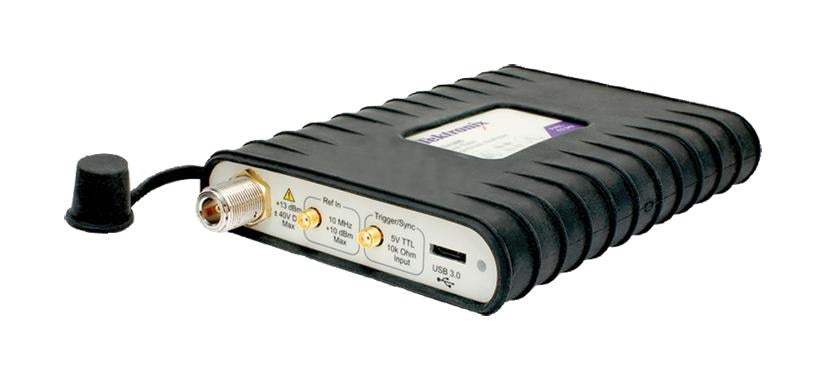
The Tektronix RSA306 is a USB real time spectrum analyzer that pairs with a PC and Tektronix SignalVu-PC RF signal analysis software to deliver real-time spectrum analysis, streaming capture, and deep signal analysis for signals from 9 kHz to 6.2 GHz. It packages this capability in a low-cost, highly portable form factor intended for field, factory, or academic use.
Tektronix lists the RSA306 for academic and education work; maintenance, installation and repair in the factory or field; value-conscious design and manufacturing; and interference hunting. The 40 MHz real-time bandwidth combined with SignalVu-PC processing is positioned to capture interference so problems are seen the first time, every time.
ValueTronics stocks this equipment in our own 20,000 sq ft secure warehouse at 1675 Cambridge Drive in Elgin, Illinois. Every pre-owned unit is inspected and functionally verified in-house before it ships, while new units ship factory-sealed exactly as received from the manufacturer.
Tektronix has operated under its own name since its founding in 1946. It was acquired by Danaher Corporation in 2007 and, following Danaher's 2016 spinoff of its test and measurement businesses, became part of Fortive Corporation.
| Specification | Value |
|---|---|
| Frequency | |
| RF input frequency range | 9 kHz to 6.2 GHz |
| Frequency reference accuracy, Initial (18 °C to 28 °C ambient, after 20 minute warm up) | ±3 ppm + aging |
| Frequency reference accuracy, Initial (-10 °C to 55 °C ambient, after 20 minute warm up), typical | ±25 ppm + aging |
| Aging (typical) | ±3 ppm (1st year), ±1 ppm/year thereafter |
| External frequency reference input, Input frequency range | 10 MHz ±10 Hz |
| External frequency reference input, Input level range | -10 dBm to +10 dBm sinusoid |
| External frequency reference input, Impedance | 50 Ω |
| Center frequency resolution, Block IQ samples | 1 Hz |
| Center frequency resolution, Streamed ADC samples | 500 kHz |
| Amplitude | |
| RF input impedance | 50 Ω |
| RF input VSWR (typical) | ≤ 1.8:1 (10 MHz to 6200 MHz, reference level ≥ +10 dBm) |
| Maximum RF input level without damage, DC voltage | ±40 VDC |
| Maximum RF input level without damage, Reference level ≥ –10 dBm | +23 dBm (continuous or peak) |
| Maximum RF input level without damage, Reference level < –10 dBm | +15 dBm (continuous or peak) |
| Maximum RF input operating level, Center frequency < 22 MHz (low-frequency path) | +15 dBm |
| Maximum RF input operating level, Center frequency ≥22 MHz (RF path) | +20 dBm |
| Amplitude accuracy, 9 kHz - < 3 GHz, Warranted (18 °C to 28 °C) | ±2.0 dB |
| Amplitude accuracy, 9 kHz - < 3 GHz, Typical (95% confidence, 18 °C to 28 °C) | ±1.25 dB |
| Amplitude accuracy, 9 kHz - < 3 GHz, Typical (-10 °C to 55 °C) | ±3.0 dB |
| Amplitude accuracy, ≥ 3 GHz - 6.2 GHz, Warranted (18 °C to 28 °C) | ±2.75 dB |
| Amplitude accuracy, ≥ 3 GHz - 6.2 GHz, Typical (95% confidence, 18 °C to 28 °C) | ±2.0 dB |
| Amplitude accuracy, ≥ 3 GHz - 6.2 GHz, Typical (-10 °C to 55 °C) | ±3.0 dB |
| Intermediate frequency and acquisition system | |
| IF bandwidth | 40 MHz |
| ADC sample rate and bit width | 112 Ms/s, 14 bits |
| Real-time IF acquisition data (uncorrected) | 112 Ms/s, 16-bit integer real samples; 40 MHz BW, 28 ±0.25 MHz Digital IF, uncorrected |
| Block streaming data | average rate of 224 MB/s |
| Block baseband acquisition data (corrected), Maximum acquisition time | 1 second |
| Block baseband acquisition data (corrected), Bandwidths | ≤ 40 /( 2N) MHz, 0 Hz Digital IF, N ≥ 0 |
| Block baseband acquisition data (corrected), Sample rates | ≤ 56 / (2N) Msps, 32-bit float complex samples, N ≥ 0 |
| Channel amplitude flatness | ±1.0 dB, 18 °C to 28 °C; ±2.0 dB, -10 °C to 55 °C, typical; ±3.0 dB, 22 MHz - 24 MHz, -10 °C to 55 °C, typical |
| Trigger | |
| Trigger/sync input, Voltage range | TTL, 0.0 V – 5.0 V |
| Trigger level, positive-going threshold voltage | 1.6 V minimum; 2.1 V maximum |
| Trigger level, negative-going threshold voltage | 1.0 V minimum; 1.35 V maximum |
| Trigger/sync input, Impedance | 10 kΩ |
| IF power trigger, Threshold range | 0 dB to -50 dB from reference level, for trigger levels > 30 dB above the noise floor |
| IF power trigger, Type | Rising or falling edge |
| Trigger re-arm time | ≤100 μs |
| Noise and distortion | |
| DANL, < 22 MHz (LF path), 100 kHz - 42 MHz | -130 dBm/Hz (-133 typical) |
| DANL, ≥ 22 MHz (RF path), 2 MHz - 5 MHz | -145 dBm/Hz (-148 typical) |
| DANL, ≥ 22 MHz (RF path), > 5 MHz - 1.0 GHz | -160 dBm/Hz (-163 typical) |
| DANL, ≥ 22 MHz (RF path), > 1.0 GHz - 2.0 GHz | -158 dBm/Hz (-161 typical) |
| DANL, ≥ 22 MHz (RF path), > 2.0 GHz - 4.0 GHz | -155 dBm/Hz (-158 typical) |
| DANL, ≥ 22 MHz (RF path), > 4.0 GHz - 6.2 GHz | -150 dBm/Hz (-153 typical) |
| Phase noise (1 GHz CW at 0 dBm), 1 kHz offset | -85 dBc/Hz |
| Phase noise, 10 kHz offset | -84 dBc/Hz |
| Phase noise, 100 kHz offset | -90 dBc/Hz |
| Phase noise, 1 MHz offset | -118 dBc/Hz |
| Residual spurious response | < -78 dBm (Reference level ≤ -50 dBm, RF input terminated with 50 Ω) |
| Input related spurious response (SFDR) | ≤ -50 dBc, 18 °C to 28 °C, with auto settings on and signals 10 dB below reference level of -30 dBm, span ≤ 40 MHz, input frequencies ≤ 8 GHz |
| Residual FM | < 10 HzP-P (95% confidence) |
| 3RD order IM distortion, Center frequency 2130 MHz | ≤ -60 dBc at reference level -15 dBm, 18 °C to 28 °C |
| 3RD order intercept (TOI), Center frequency 2130 MHz | ≥ +10 dBm at reference level -15 dBm, 18 °C to 28 °C |
| 2ND harmonic distortion, typical | < -55 dBc, 10 MHz to 300 MHz, reference level = 0 dBm; < -60 dBc, 300 MHz to 3.1 GHz, reference level = 0 dBm |
| 2ND harmonic intercept (SHI) | +55 dBm, 10 MHz to 300 MHz, reference level = 0 dBm; +60 dBm, 300 MHz to 3.1 GHz, reference level = 0 dBm |
| Local oscillator feedthrough to input connector | < -75 dBm at reference level = -30 dBm |
| Audio Output | |
| Audio output Types | AM, FM |
| IF bandwidth range | Five selections, 8 kHz – 200 kHz |
| Audio output frequency range | 50 Hz – 10 kHz |
| PC audio output | 16 bits at 32 ks/s |
| Audio file output format | .wav format, 16 bit, 32 ks/s |
| SignalVu-PC base performance summary | |
| Maximum span | 40 MHz real-time; 9 kHz - 6.2 GHz swept |
| Maximum acquisition time | 1.0 s |
| Minimum IQ resolution | 17.9 ns (acquisition BW = 40 MHz) |
| Signal Strength display | |
| Signal strength indicator | Located at right side of display |
| Measurement bandwidth | Up to 40 MHz, dependent on span and RBW setting |
| Tone type | Variable frequency based on received signal strength |
| Spectrum display | |
| Traces | Three traces + 1 math trace + 1 trace from spectrogram for spectrum display |
| Trace functions | Normal, Average (VRMS), Max Hold, Min Hold, Average of Logs |
| Detector | Average (VRMS), Average, CISPR peak, +Peak, -Peak, Sample |
| Spectrum trace length | 801, 2401, 4001, 8001, 10401, 16001, 32001, and 64001 points |
| RBW range | 10 Hz to 10 MHz |
| DPX spectrum display | |
| Spectrum processing rate (RBW = auto, trace length 801) | 10,000/s |
| DPX bitmap resolution | 201x801 |
| Marker information | Amplitude, frequency, signal density |
| Minimum signal duration for 100% probability of detection | 100 μs (Span: 40 MHz, RBW = Auto, Max-hold on) |
| Span range (continuous processing) | 1 kHz to 40 MHz |
| Span range (swept) | Up to maximum frequency range of instrument |
| Dwell time per step | 50 ms to 100 s |
Important: For full performance of the real-time features, the RSA306 requires a USB 3.0 connection and an Intel Core i7 4th-generation processor; processors of lower performance can be used with reduced real-time performance.
Important: Storage of streaming data requires that the PC be equipped with a drive capable of streaming storage rates of 300 MB/sec.
Important: Recording of signals requires storage with write rates of 300 MB/sec; playback of recorded files at live rates requires storage with read rates of 300 MB/sec.
Important: Antennas, RF cables, adapters, and pre-filters needed to connect the instrument to a signal source or device under test are not included with the base unit; select the appropriate items from the datasheet's Recommended Accessories list and order them separately.
Recommended pairing: the DF-A0047 directional antenna (20–8500 MHz, with optional 9 kHz–20 MHz extension via DF-A0047-01) is listed as part of a complete interference hunting solution for the RSA306.
This pre-owned unit is inspected and functionally verified in-house before it ships and is backed by our pre-owned warranty. To confirm its exact condition, firmware revision, installed options, or included accessories for your application before ordering, contact our Test Architects.
ValueTronics supplies both new and used test and measurement equipment. New units ship factory-sealed, exactly as received from the manufacturer; every used unit is inspected and functionally verified in-house at our 20,000 sq ft secure facility in Elgin, Illinois before it ships. Our Test Architects can help you select the condition, calibration, and configuration that fit your application.
Please review the Manufacturer's Data Sheet to verify published specifications. Feedback on this webpage is always welcome — please reach out to your Test Architect at any time for questions or concerns. Thank you, we truly appreciate you being our customer.
Model No
Tektronix
Condition
Pre-Owned
Manufacturer
Tektronix
Spec_ana_freq
9 kHz to 6.2 GHz


30+ Years in Business

Secure Payments

Sell Test Equipments

Knowledgeable Staff

On-site Lab
30+ Years in Business
Secure Payments
Sell Test Equipments
Knowledgeable Staff
On-site Lab
Request A Quote