Chat Live
 Contact Us
 sales@valuetronics.com


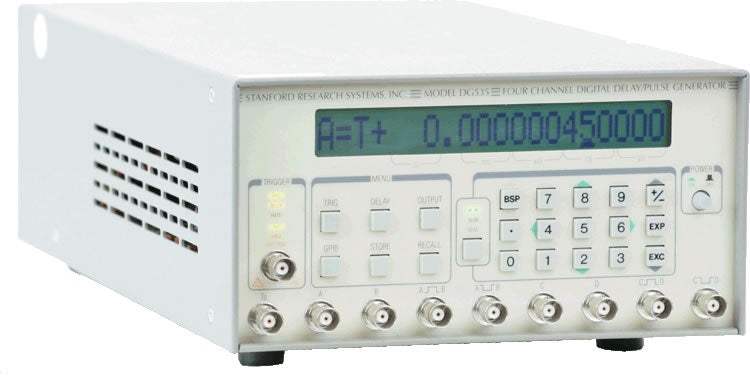
The DG535 is a digital delay/pulse generator that provides four precisely-timed logic transitions or two independent pulse outputs. Its four delay output channels — A, B, C and D — can be delayed from an internal or external trigger by up to 1000 seconds in 5 ps increments, with a T0 pulse marking the beginning of each timing cycle. Front-panel BNC outputs deliver TTL, ECL, NIM, or variable-level pulses into 50 Ω or high-impedance loads, giving an engineer direct control over both the timing and the electrical form of every transition. Delays for each channel may be linked to T0 or to any other channel, so that, for example, two outputs defining a pulse can hold a constant width while the pulse is moved in time.
The combination of high accuracy, low jitter, and a wide delay range suits the DG535 to laser timing systems, automated testing, and precision pulse applications. In an ATE setup-time measurement, the unit can characterize the data, preset, and clear setup times of a flip-flop with picosecond resolution, driving the device-under-test at programmable logic thresholds and controlling the entire sequence over GPIB. In precision time-sequencing systems, a single unit supplies four transitions for system timing, and several units can be combined — sharing a common 10 MHz reference — when more channels are required. In laser timing, the T0 output can fire a flashlamp while the A, B, and C delays sequence the Q-switch firing, an experimental trigger, and a gated-integrator trigger.
ValueTronics stocks and holds its own inventory in a 20,000-square-foot secure warehouse at 1675 Cambridge Drive in Elgin, Illinois, so the instruments we list are equipment we keep on hand. Every used unit is inspected and functionally verified in-house by our technicians before it ships, while new units leave our facility factory-sealed exactly as received from the manufacturer.
| Specification | Value |
|---|---|
| Delays | |
| Channels | Four independent delay outputs |
| Range | 0 to 999.999,999,999,995 seconds |
| Resolution | 5 ps |
| Accuracy | 1500 ps + timebase error × delay |
| Timebase | Standard: 25 ppm crystal oscillator; Optional: 1 ppm TCXO (opt. 03); External: 10.0 MHz reference input |
| RMS jitter | <50 ps + 10−8 × delay (T0 to any output); <60 ps + 10−8 × delay (ext. trigger to any output) |
| Trigger delay (typ.) | 85 ns (ext. trigger to T0 output) |
| External Trigger | |
| Rate | DC to 1/(1 µs + longest delay) |
| Threshold | ±2.56 VDC |
| Resolution | 10 mV |
| Slope | Trigger on rising or falling edge |
| Impedance | 1 MΩ + 40 pF or 50 Ω |
| Internal Rate Generator | |
| Rate | Single shot, 0.001 Hz to 1.000 MHz, or line |
| Resolution | Four digits, 0.001 Hz below 10 Hz |
| Accuracy | Same as timebase |
| Jitter | 1:10,000 |
| Settling | <2 seconds for any rate change |
| Burst mode | 2 to 32766 pulses per burst at integer multiples (4 to 32767) of the trigger period |
| Outputs | |
| Load | 50 Ω or high impedance |
| Rise time | 2 to 3 ns (typ.) |
| Slew rate | 1 V/ns |
| Overshoot | <100 mV + 10 % of pulse amplitude |
| Levels | TTL: 0 to 4 VDC (normal or inverted); ECL: −1.8 to −0.8 VDC (normal or inverted); NIM: −0.8 to 0.0 VDC (normal or inverted); VAR: Adjustable offset and amplitude between −3 and +4 VDC with 10 mV resolution. 4 V maximum transition. |
| Accuracy | ±(50 mV + 3 % of pulse amplitude) |
| Option 02 | |
| Option 02 | Rear panel 1 µs pulses corresponding to T0, A, B, C, D outputs with nominal amplitude of 8× the front-panel outputs (1 kHz rep. rate). Output level is reduced by 2V/mA of additional average output current. |
| Fast Rise Time (opt. O4A) | |
| Output amplitude | +0.5 to 2.0 VDC |
| Output offset | −0.8 VDC (typ.) |
| Transition time, Rise (20/80 %) | 100 ps (max.) |
| Transition time, Fall (20/80 %) | 2000 ps (max.) |
| Pulse aberrations, Foot | 4 % (typ.) |
| Pulse aberrations, Ring | ±5 % (typ.) |
| Fast Fall Time (opt. O4B) | |
| Output amplitude | −0.5 to −2.0 VDC |
| Output offset | +0.8 VDC (typ.) |
| Transition time, Rise (20/80 %) | 2500 ps (max.) |
| Transition time, Fall (20/80 %) | 100 ps (max.) |
| Pulse aberrations, Foot | 4 % (typ.) |
| Pulse aberrations, Ring | ±5 % (typ.) |
| General | |
| Display | backlit 20-character LCD |
| Computer interface | GPIB (IEEE-488). All instrument functions and settings may be controlled over the interface bus. Interface queue can be viewed from the front panel. |
| Dimensions | 8.5" × 4.75" × 14" (WHD) |
| Weight | 10 lbs. |
| Power | 70 W, 100/120/220/240 VAC, 50/60 Hz |
| Warranty | One year parts and labor on defects in materials and workmanship |
| Timebase Error | |
| Standard | <25 ppm, 0 to 50 °C |
| Option 03 | <1 ppm, 0 to 50 °C |
| External | Source spec + 0.0002 ppm |
Important: Each output's variable level is adjustable between −3 V and +4 V with 10 mV resolution, and the maximum transition for each output is limited to 4 V.
Usage tip: in laser timing applications, the DG535 pairs with the SR250 Gated Integrator — the C delay output triggers the gated integrator monitoring the detector output.
This pre-owned unit is inspected and functionally verified in-house before it ships and is backed by our pre-owned warranty. To confirm its exact condition, firmware revision, installed options, or included accessories for your application before ordering, contact our Test Architects.
ValueTronics supplies both new and used test and measurement equipment. New units ship factory-sealed, exactly as received from the manufacturer; every used unit is inspected and functionally verified in-house at our 20,000 sq ft secure facility in Elgin, Illinois before it ships. Our Test Architects can help you select the condition, calibration, and configuration that fit your application.
Please review the Manufacturer's Data Sheet to verify published specifications. Feedback on this webpage is always welcome — please reach out to your Test Architect at any time for questions or concerns. Thank you, we truly appreciate you being our customer.
Model No
Stanford
Condition
Pre-Owned
Manufacturer
Stanford Research Systems
Func_gen_freq
1 MHz


30+ Years in Business

Secure Payments

Sell Test Equipments

Knowledgeable Staff

On-site Lab
30+ Years in Business
Secure Payments
Sell Test Equipments
Knowledgeable Staff
On-site Lab
Request A Quote