Chat Live
 Contact Us
 sales@valuetronics.com


In summary, the Rigol DSG5202 is a 2-channel benchtop microwave signal generator covering 9 kHz to 20 GHz in a 2U rack-mountable form factor, designed to deliver high signal quality, accurate signal level, and a wide output power range across complex test scenarios including superconducting quantum computation, radar signal generation, MIMO, and EMS testing. It pairs channel-to-channel phase stability of < 1° at 10 GHz with SSB phase noise below -133 dBc/Hz @ 1 GHz (10 kHz offset, typ.) and a fast 3 ms typical switching time, all controlled through a touch-screen interface, an HDMI-extended display, or remote SCPI operation over USB 3.0 and LAN (LXI-C).
The Rigol DSG5202 is used to generate high-quality, accurately-leveled microwave stimulus signals across 2 simultaneous output channels for complex multi-channel test setups. Typical applications include superconducting quantum computation (where coherent multi-channel microwave drive is required), MIMO transceiver characterization, radar signal generation, EMS/EMC immunity testing, and any multi-DUT or phased-array test scenario that demands tightly correlated channel-to-channel phase relationships within a single instrument.
Engineers reach for a 2-channel microwave generator like the DSG5202 when a single-channel CW generator no longer satisfies the test architecture — for example, when an MIMO antenna array needs simultaneous drive, when a quantum computing experiment requires multiple coherent microwave tones, or when a radar simulator must present multiple phase-controlled signals to a receiver under test. The 2-channel 20 GHz configuration is the practical answer to those test problems without resorting to multiple chassis, multiple PC controllers, and the synchronization complexity that comes with daisy-chained single-channel generators.
A single-channel microwave generator outputs one RF signal at a time; the DSG5202 outputs 2 independent signals simultaneously from one 2U chassis, each independently configurable for frequency, level, modulation, and sweep, while sharing a high-stability internal reference for tight inter-channel phase stability. The result is one instrument, one IP address, one calibration record, and one user interface in place of 2 separately-cabled generators — saving rack space, cabling, sync hardware, and the engineering time required to keep multiple chassis aligned.
The Rigol DSG5202 delivers 9 kHz to 20 GHz frequency coverage with 0.01 Hz frequency resolution, <3 ms typical frequency setting time (CW mode, 20 ℃ to 30 ℃, to within 0.1 ppm of final frequency), and a maximum output setting level reaching +25 dBm in the 2 MHz to 10 GHz band. SSB phase noise is specified at <-130 dBc/Hz with <-133 dBc/Hz typical at 1 GHz (10 kHz offset, 1 Hz measurement bandwidth) and <-102 dBc/Hz / <-105 dBc/Hz (typ.) at 20 GHz. Channel-to-channel phase stability is specified at ±1° (10 GHz, temperature variation ≤ 1℃) with phase deviation adjustable in 0.01° steps over a ±180° range. Internal flash storage is 10 GB (nom.). The mainframe weighs <14 kg, fits a standard 2U rack opening (with RM2031 kit), draws <650 W with all options working, and is supported with a Three-year warranty (mainframe, excluding accessories).
Rigol Technologies (founded 1998) sits in the value-tier of the global test & measurement market alongside Siglent and GW Instek, offering professional-grade instruments at a price point that disrupts the traditional premium-tier (Keysight, Rohde & Schwarz, Anritsu) microwave generator market. The DSG5000 series specifically targets multi-channel microwave test applications — superconducting quantum computation, MIMO, radar, EMS — that previously required either multiple single-channel generators from premium brands or a custom-integrated rack system. The instrument family conforms to EMC Directive 2014/30/EU, IEC 61326-1: 2013 / EN 61326-1: 2013 (Class A), CISPR 11:2009+A1 Class A, and EN 61010-1:2010+A1:2019 / IEC 61010-1:2010+A1:2016 / UL 61010-1: 2012 R7.19 / CAN/CSA-C22.2 No. 61010-1-12 + GI1 + GI2 (R2017) + A1 safety standards. LAN interface is LXI-C compliant; the instrument supports the standard SCPI command set over USB 3.0 and LAN, with integrations into Excel, LabVIEW, Visual Basic, and Visual C++ for batch automation.
| Item | Description |
|---|---|
| Power Cord | AC power cord, region-appropriate |
| Option Order No. | Description |
|---|---|
| DSG5000-PUL | Pulse Modulation |
| DSG5000-PUG | Pulse Train Generator |
| DSG5000-AMD | Analog Modulation (AM / FM / PM) |
| OCXO-D08 | High Stability Clock (OCXO) |
| RM2031 | Rack Mount Kit |
The DSG5000 series microwave signal generator can generate high quality signals, accurate signal level, and a wide output power range, capable of meeting the complex test scenarios such as superconducting quantum computation, radar signal generation, MIMO, and EMS. The architecture starts with 2 independent RF channels in this DSG5202 configuration, each channel independent of the others and independently controlled. Multiple DSG5000 chassis can be integrated in a rack-mount installation to scale the channel count further, saving space and the integration time that would otherwise be spent cabling and synchronizing single-channel generators.
The instrument is designed for multi-device cabinet deployment. Standard 2U rack size combined with the RM2031 rack mount kit lets a customer extend the channel count of a DSG5000-based test system by stacking additional units. Front- and rear-panel ventilation provides adequate cooling to ensure signal accuracy and stability even when multiple devices are stacked in a single cabinet — an important detail for production environments where instruments operate continuously. Every DSG5000 ships with a standard PC software configuration to realize integrated control of multiple instruments; the operator can run remote control and make global parameter configuration across multiple channels to meet integrated test application scenarios.
The DSG5000 series is equipped with a touch screen, which enables operation and control of the instrument with touch-enabled gestures. The front panel has no physical keys to operate except the power key. For larger displays, the instrument allows external connection to a PAD, monitor, or projector via the HDMI interface for user-friendly viewing across the lab or production cell. For headless or rack-deep installations, entering the instrument's IP address into a web browser opens the Web Control software — the display in the web control page is consistent with that on the instrument itself, and the operator can click menus, set parameters, and modify network configuration entirely from a browser. For full automation, the standard SCPI command set is supported over USB 3.0 or LAN, with example integrations using Excel, LabVIEW, Visual Basic, and Visual C++ for batch command transmission.
| Number of Channels | 2 |
| Frequency Range | 9 kHz to 20 GHz |
| Frequency Resolution | 0.01 Hz |
| Setting Time (CW mode, 20℃ to 30℃, to within 0.1 ppm of final frequency) | <3 ms (typ.) |
| Band | Frequency Range | N |
|---|---|---|
| 1 | 9 kHz ≤ f ≤ 1.5 GHz | 1 |
| 2 | 1.5 GHz < f ≤ 2.825 GHz | 0.25 |
| 3 | 2.825 GHz < f ≤ 5.65 GHz | 0.5 |
| 4 | 5.65 GHz < f ≤ 11.3 GHz | 1 |
| 5 | 11.3 GHz < f ≤ 20 GHz | 2 |
N is a factor used to help define certain specifications in this manual.
| Conditions | f = 10 GHz, temperature variation ≤1℃ |
| Channel-to-Channel Phase Stability | ±1° |
| Clock Reference Output | ||
| Frequency | 10 MHz | |
| Initial Calibration Accuracy | ± 0.1 ppm | ±10 ppb (with option OCXO-D08) |
| Temperature Stability, temperature range 0℃ to 50℃, reference to 25℃ | ± 0.5 ppm | ±5 ppb (with option OCXO-D08) |
| Aging Rate (after 30 consecutive days of working) | ± 1 ppm/year | ±30 ppb/year (with option OCXO-D08) |
| Output Amplitude | +5 dBm to +10 dBm | |
| Interface | BNC female | |
| External Reference Input | ||
| Frequency | 10 MHz | |
| Input Amplitude | 0 dBm to +10 dBm | |
| Max. Deviation | ± 1 ppm | |
| Interface | BNC female | |
| Sync Ref Frequency Output/Input | ||
| Freq | 4.8 GHz | |
| Amplitude | -3 dBm to +3 dBm | |
| Interface | SMA female | |
| Phase Deviation Range | ±180° |
| Phase Deviation Resolution | 0.01° |
| Frequency / Condition | Harmonic |
|---|---|
| 10 MHz ≤ f ≤ 4 GHz, output level ≤ +10 dBm | <-30 dBc |
| 4 GHz < f ≤ 10 GHz, output level ≤ +10 dBm | <-50 dBc |
| 10 GHz < f ≤ 20 GHz, output level ≤ +7 dBm | <-30 dBc |
| 11.3 GHz < f ≤ 20 GHz (CW mode) | <-60 dBm, <-70 dBc (typ.) |
| 1 MHz ≤ f ≤ 1.5 GHz | <-60 dBm, <-70 dBc (typ.) |
| 1.5 GHz < f ≤ 2.825 GHz | <-70 dBm, <-75 dBc (typ.) |
| 2.825 GHz < f ≤ 5.65 GHz | <-64 dBm, <-69 dBc (typ.) |
| 5.65 GHz < f ≤ 11.3 GHz | <-58 dBm, <-63 dBc (typ.) |
| 11.3 GHz < f ≤ 20 GHz | <-52 dBm, <-57 dBc (typ.) |
| f = 1 GHz | <-130 dBc/Hz, <-133 dBc/Hz (typ.) |
| f = 2 GHz | <-120 dBc/Hz, <-123 dBc/Hz (typ.) |
| f = 4 GHz | <-114 dBc/Hz, <-117 dBc/Hz (typ.) |
| f = 10 GHz | <-108 dBc/Hz, <-111 dBc/Hz (typ.) |
| f = 20 GHz | <-102 dBc/Hz, <-105 dBc/Hz (typ.) |
| 50 MHz ≤ f ≤ 1 GHz | <-140 dBc/Hz |
| 1 GHz < f ≤ 10 GHz | <-135 dBc/Hz |
| 10 GHz < f ≤ 20 GHz | <-130 dBc/Hz |
| Frequency | Min Output Spec Level | Min Output Setting Level | Max Output Spec Level | Max Output Setting Level |
|---|---|---|---|---|
| 9 kHz ≤ f < 100 kHz | – | -30 dBm | – | +10 dBm |
| 100 kHz ≤ f < 2 MHz | -30 dBm | -30 dBm | +5 dBm | +15 dBm |
| 2 MHz ≤ f ≤ 10 GHz | -30 dBm | -30 dBm | +13 dBm | +25 dBm |
| 10 GHz < f ≤ 17 GHz | -30 dBm | -30 dBm | +13 dBm | +20 dBm |
| 17 GHz < f ≤ 20 GHz | -30 dBm | -30 dBm | +10 dBm | +20 dBm |
Setting Resolution: 0.01 dB · Setting Time (CW mode, 20℃ to 30℃, fixed frequency, to within 0.1 dB of final level): <3 ms (typ.)
| Frequency | Specification | Typical |
|---|---|---|
| 100 kHz ≤ f ≤ 1.5 GHz | ±0.7 dB | ±0.5 dB |
| 1.5 GHz < f ≤ 10 GHz | ±0.9 dB | ±0.7 dB |
| 10 GHz < f ≤ 17 GHz | ±1.1 dB | ±0.9 dB |
| 17 GHz < f ≤ 20 GHz | ±1.3 dB | ±1.1 dB |
| 9 kHz ≤ f < 4 GHz | >85 dB (typ.) |
| 4 GHz ≤ f ≤ 10 GHz | >80 dB (typ.) |
| 10 GHz < f ≤ 20 GHz | >75 dB (typ.) |
| 10 MHz ≤ f ≤ 3 GHz | ≤1.8 (nom.) |
| 3 GHz < f ≤ 6 GHz | ≤2.0 (nom.) |
| 6 GHz < f ≤ 10 GHz | ≤1.8 (nom.) |
| 10 GHz < f ≤ 20 GHz | ≤2.2 (nom.) |
| Max. DC voltage | 0 V |
| 10 MHz < f ≤ 20 GHz | 0.5 W |
| Sweep Type | Step Sweep, List Sweep |
| Sweep Mode | Single, Continuous |
| Sweep Range | Within Full Frequency Range |
| Sweep Shape | Triangle and Ramp |
| Step Change | Linear or Log |
| Sweep Points | 2 to 1,001 |
| Dwell Time | 5 ms to 100 s |
| Trigger Type | Auto, key, external, bus (USB and LAN) |
| Sweep Type | Step Sweep, List Sweep |
| Sweep Mode | Single, Continuous |
| Sweep Range | Within Full Level Range |
| Sweep Shape | Triangle and Ramp |
| Step Change | Lin |
| Sweep Points | 2 to 1,001 |
| Dwell Time | 5 ms to 100 s |
| Trigger Type | Auto, key, external, bus (USB and LAN) |
| AM | FM | PM | Pulse | |
|---|---|---|---|---|
| AM | – | ○ | ○ | △ |
| FM | ○ | – | × | ○ |
| PM | ○ | × | – | ○ |
| Pulse | △ | ○ | ○ | – |
○: compatible · ×: incompatible · △: compatible with AM performance reduced when pulse modulation is enabled. Specifications apply to Sine modulation source, 20℃ to 30℃, carrier frequency ≥ 1 MHz.
| Modulation Source | Internal, External |
| Modulation Depth | 0% to 100% |
| Resolution | 0.1% |
| Setting Uncertainty (fc ≤ 1.5 GHz, fmod = 1 kHz, m < 30%, level = 0 dBm) | < 4% of setting + 1% |
| Distortion (same conditions) | < 3% (typ.) |
| Modulation Frequency Response (m < 80%, DC/10 Hz to 100 kHz) | <3 dB (nom.) |
| Modulation Source | Internal, External |
| Max. Deviation (f ≤ 1.5 GHz) | 2 MHz (nom.) — settable max. for other bands is N × 2 MHz |
| Resolution | <0.1% of deviation, or 1 Hz, whichever is greater (nom.) |
| Setting Uncertainty (f ≤ 1.5 GHz, fmod = 1 kHz, internal mode) | < 2% of setting + 20 Hz |
| Distortion (f ≤ 1.5 GHz, fmod = 1 kHz, deviation = 50 kHz) | < 2% (typ.) |
| Modulation Frequency Response (DC/10 Hz to 100 kHz, external mod, measured at 100 kHz offset) | <3 dB (nom.) |
| Modulation Source | Internal, External |
| Max. Deviation (f ≤ 1.5 GHz) | 5 rad (nom.) — settable max. for other bands is N × 5 rad |
| Resolution | <0.1% of deviation, or 0.01 rad, whichever is greater (nom.) |
| Setting Uncertainty (f ≤ 1.5 GHz, fmod = 1 kHz, internal mode) | <1% of setting + 0.1 rad |
| Distortion (f ≤ 1.5 GHz, fmod = 1 kHz, deviation = 5 rad) | < 1% (typ.) |
| Modulation Frequency Response (DC/10 Hz to 100 kHz, external mod, 5 rad deviation) | <3 dB (nom.) |
| Modulation Source | Internal, External |
| On/Off Ratio (f ≤ 6 GHz) | >80 dB (typ.) |
| On/Off Ratio (6 GHz < f ≤ 11 GHz) | >70 dB (typ.) |
| On/Off Ratio (f > 11 GHz) | >60 dB (typ.) |
| Rise/Fall Time (10%/90%) | <50 ns, 20 ns (typ.) |
| Pulse Repetition Frequency | DC to 1 MHz |
| Operating Mode | Single, Train (Train requires option DSG5000-PUG) |
| Pulse Period — Setting Range / Resolution | 40 ns to 170 s / 10 ns |
| Pulse Width — Setting Range / Resolution | 10 ns to (170 s − 10 ns) / 10 ns |
| Trigger Delay — Setting Range / Resolution | 10 ns to 170 s / 10 ns |
| Trigger Type | Auto, external trigger, external gate, trigger key, bus (USB and LAN) |
| Number of Pulse Patterns | 1 to 2,047 |
| On/Off Time Range | 20 ns to 170 s |
| Repetition Per Pattern | 1 to 256 |
| RF Output | 50 Ω (nom.), 3.5 mm male |
| External Trigger Input | 1 kΩ (nom.), SMB male, 3.3 V TTL Level |
| Signal Valid Output | SMB male, 0 V / 3.3 V (nom.) |
| Pulse Input or Output | 50 Ω (nom.), 0 V / 3.3 V (nom.), SMB male |
| Sweep Output | SMB male, 0 V to 10 V (nom.) |
| External Modulation Signal Input | 100 kΩ / 600 Ω / 50 Ω (nom.), AC/DC coupling, 1 Vpp for indicated depth (nom.), BNC female |
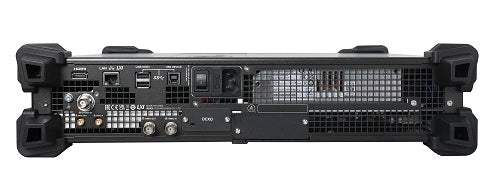
| 10 MHz IN (External Frequency Reference Input) | 50 Ω (nom.), BNC female |
| 10 MHz OUT (External Frequency Reference Output) | 50 Ω (nom.), BNC female |
| 4.8 GHz IN (Sync Reference Clock Input) | 50 Ω (nom.), SMA female |
| 4.8 GHz OUT (Sync Reference Clock Output) | 50 Ω (nom.), SMA female |
| USB 3.0 HOST | A plug, Protocol 3.0, Qty. 4 (2 on the front panel and 2 on the rear panel) |
| USB 3.0 DEVICE | B plug, Supports TMC protocol |
| LAN | RJ-45, 10/100/1000Base-T, LXI-C |
| HDMI | A plug, HDMI 1.4 |
| Display Type | TFT LCD |
| Display Resolution | 480 × 320 |
| Display Dimensions | 3.5-inch |
| Display Extension | Supports HDMI display extension |
| Mass Storage | Flash non-volatile memory (internal); USB storage device (not supplied) |
| Internal Data Storage | 10 GB (nom.) |
| EMC | EMC Directive 2014/30/EU; IEC 61326-1: 2013 / EN 61326-1: 2013, EN IEC 61000-3-2:2019+A1, EN 61000-3-3:2013+A1:2019; CISPR 11:2009+A1 Class A; EN IEC 61000-3-2:2019+A1 harmonic Class A; EN 61000-3-3:2013+A1:2019 Voltage Flickers; EN61000-4-2:2009 (±4.0 kV contact / ±8.0 kV air); EN61000-4-3:2006+A1+A2 (10 V/m 80 MHz–1 GHz, 3 V/m 1.4–6 GHz); EN61000-4-4:2004+A1 (2 kV power line); EN61000-4-5:2006 (1 kV / 2 kV / 2 kV); EN61000-4-6:2009 (10 V, 0.15–80 MHz); EN61000-4-11:2004 (voltage dips and short interruptions) |
| Safety | EN 61010-1:2010+A1:2019; IEC 61010-1:2010+A1:2016; UL 61010-1: 2012 R7.19; CAN/CSA-C22.2 No. 61010-1-12 + GI1 + GI2 (R2017) + A1 |
| Input Voltage Range, AC | 100 V to 240 V (nom.) |
| AC Frequency Range | 45 Hz to 440 Hz |
| Power Consumption (with all options working) | <650 W |
| Operating Temperature Range | 0℃ to +50℃ |
| Storage Temperature Range | -20℃ to +70℃ |
| Humidity Range | ≤90% RH (0–30℃), ≤75% RH (30–40℃), ≤45% RH (40–50℃) |
| Operating Altitude | below 3,000 m |
| Dimensions (W × H × D) | 435 mm × 88 mm × 486.3 mm (without pads, with the connector); 459 mm × 112 mm × 511 mm (with pads) |
| Weight (Package Excluded) | <14 kg |
| Recommended Calibration Interval | 18 months |
| Warranty Period | Three years for the mainframe, excluding the accessories |
This webpage was written by a human with an A.I. "Intern", which may contain errors. Please review the Manufacturers Data Sheet to verify published specifications. Feedback on this webpage is always welcome, please reach out to your Test Architect at any time for questions or concerns. Thank you, we truly appreciate you being our customer.
Model No
DSG5202
Condition
New
Manufacturer
Rigol
Frequency
9 kHz to 20 GHz


30+ Years in Business

Secure Payments

Sell Test Equipments

Knowledgeable Staff

On-site Lab
30+ Years in Business
Secure Payments
Sell Test Equipments
Knowledgeable Staff
On-site Lab
Request A Quote