Chat Live
 Contact Us
 sales@valuetronics.com


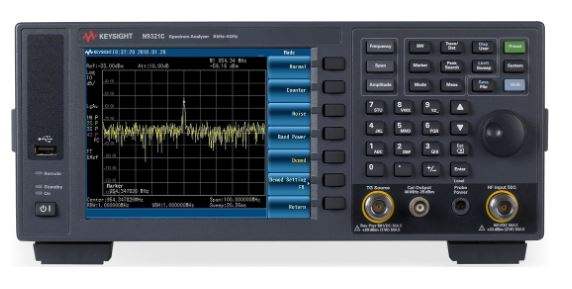
The Keysight N9321C is a basic spectrum analyzer covering a frequency range of 9 kHz to 4 GHz, AC coupled. It provides swept and FFT spectrum measurement with a frequency resolution of 1 Hz, four trace memories, and a 6.5-inch 640 x 480 display, presenting amplitude across frequency for general-purpose RF measurement on the bench or in production.
A spectrum analyzer displays the amplitude of signals across a frequency range, letting an engineer see signal levels, harmonics, distortion products, and noise in the frequency domain. On the N9321C, that core capability extends through installable options into EMI bandwidths for CISPR-compliant measurement (Option EMC), AM/FM modulation analysis (Option AMA), ASK/FSK modulation analysis (Option DMA), channel scanning (Option SCN), and reflection, return-loss, VSWR, and distance-to-fault measurement (Option RM4, which requires the Option TG4 tracking generator).
ValueTronics supports every N9321C order from its own 20,000-square-foot secure warehouse at 1675 Cambridge Drive in Elgin, Illinois, where we stock and hold our inventory.
Keysight Technologies traces its measurement heritage to Hewlett-Packard, whose test-and-measurement business was spun off as Agilent Technologies in 1999. Agilent's electronic measurement division was then established as Keysight Technologies in 2014, the brand under which this instrument is produced today.
| Specification | Value |
|---|---|
| Frequency | |
| Frequency range | 9 kHz to 4 GHz, AC coupled |
| Resolution | 1 Hz |
| Frequency Reference | |
| Nominal frequency | 10 MHz (Option PFR and Standard) |
| Aging rate | ± 1 × 10⁻⁷/Year (Option PFR); ± 1 × 10⁻⁶/Year (Standard) |
| Temperature stability (20 °C to 30 °C) | ± 1.5 × 10⁻⁸ (Option PFR) |
| Temperature stability (5 °C to 45 °C) | ± 5 × 10⁻⁸ (Option PFR); ± 1 × 10⁻⁶ (Standard) |
| Achievable initial calibration accuracy | ± 4 × 10⁻⁸ (Option PFR); ± 1 × 10⁻⁶ (Standard) |
| Frequency Readout Accuracy (start, stop, center, marker) | |
| Marker resolution | (frequency span)/(number of sweep point − 1) |
| Uncertainty | ± (freq indication × freq reference uncertainty + 1% × span + 20% × resolution bandwidth + marker resolution + 1 Hz) |
| Sweep point | 461, fixed |
| Marker Frequency Counter | |
| Resolution | 1 Hz |
| Accuracy | ± [(marker freq × freq reference uncertainty) + (counter resolution)], RBW/Span ≥ 0.02, marker level to displayed noise level > 25 dB, frequency offset = 0 Hz |
| Frequency Span (FFT and swept mode) | |
| Range | 0 Hz (zero span), 50 Hz to 4 GHz |
| Resolution | 1 Hz |
| Accuracy | ± (0.22% × span + span/(sweep point − 1)), nominal |
| Sweep Time and Triggering | |
| Range | 2 ms to 1000 s (Span ≥ 100 Hz); 600 ns to 1000 s (Span = 0 Hz, minimum resolution = 600 ns when RBW ≥ 30 kHz) |
| Mode | Continuous, Single |
| Sweep time rule | Accuracy or Speed |
| Trigger | Free run, video, external, RF burst |
| Trigger slope | Selectable positive or negative edge |
| Trigger delay | ± 12 ms to ± 12 s, nominal (Span = 0 Hz) |
| Time Gated Sweep (Option TMG) | |
| Gate sources | External; Periodic timer (sync sources include free and external, period 0 to 20 s, offset −5 to +5 s) |
| Gate delay range | 12 μs to 10 s (resolution = 200 ns) |
| Gate length range | 84 μs to 10 s (resolution = 200 ns) |
| RBW range | ≥ 1 kHz (VBW is fixed and equal to RBW for efficiency) |
| Resolution Bandwidth (RBW) | |
| Range (−3 dB bandwidth) | 10 Hz to 3 MHz, in 1-3-10 sequence |
| Accuracy | ± 5%, nominal; < 10% when RBW = 3 MHz |
| Resolution filter shape factor | < 5:1, nominal (60 dB/3 dB bandwidth ratio, digital, Gaussian-like) |
| EMI bandwidth (CISPR compliant) | 200 Hz, 9 kHz, 120 kHz, 1 MHz (Option EMC required) |
| EMI bandwidth accuracy | ± 10%, nominal |
| EMI resolution filter shape factor | < 5:1, nominal (−60 dB/−6 dB bandwidth ratio) |
| Video Bandwidth (VBW) | |
| Range | 1 Hz to 3 MHz, in 1-3-10 sequence |
| Accuracy | ± 10%, nominal (VBW = 1 Hz to 1 MHz) |
| Measurement Range | |
| 100 kHz to 1 MHz | Displayed average noise level (DANL) to +10 dBm, preamp off |
| 1 MHz to 4 GHz | Displayed average noise level (DANL) to +20 dBm |
| Input attenuator range | 0 to 50 dB, in 1 dB steps |
| Maximum Damage Level | |
| Average continuous power | +33 dBm, 3 minutes maximum (input attn ≥ 20 dB, 2 MHz to 4 GHz) |
| DC voltage | ± 50 VDC maximum |
| Level Display Range | |
| Scale units | dBm, dBmV, dBμV, W, V, dBmV EMF, dBμV EMF, V EMF |
| Marker level readout (Log scale) | 0.01 dB |
| Marker level readout (Linear scale) | < 1% of signal level |
| Number of traces | 4 |
| Detectors | Normal, positive peak, sample, negative peak, average (video, RMS, voltage), quasi-peak (option EMC required) |
| Trace function | Clear/write, maximum hold, minimum hold, average |
| Frequency Response (20 to 30 °C, 30% to 70% RH, attenuation 20 dB, reference frequency 50 MHz) | |
| 9 to 100 kHz (preamp off) | ± 0.5 dB nominal |
| 100 kHz to 3 GHz (preamp off) | ± 0.7 dB |
| 3 to 4 GHz (preamp off) | ± 0.85 dB |
| 100 kHz to 3 GHz (preamp on) | ± 0.7 dB |
| 3 to 4 GHz (preamp on) | ± 0.9 dB |
| Input Attenuation Switching Uncertainty at 50 MHz | |
| 1 to 50 dB attenuation | ± 0.2 dB, typical (relative to 20 dB reference setting) |
| Resolution Bandwidth Switching Uncertainty | |
| 10 Hz to 3 MHz RBW | +0.1 dB, nominal |
| Total Absolute Amplitude Accuracy (20 to 30 °C, 30% to 70% RH, peak detector, RBW 1 kHz, VBW 300 Hz, sweep time Accuracy, input signal −50 to 0 dBm, attenuation 20 dB; add ± 0.3 dB when sweep time rule set to Speed) | |
| At 50 MHz (preamp off) | ± 0.3 dB |
| At all frequencies (preamp off) | ± (0.3 dB + frequency response) |
| 100 kHz to 3 GHz (preamp off) | ± 0.60 dB, 95th percentile |
| 3 to 4 GHz (preamp off) | ± 0.65 dB, 95th percentile |
| At 50 MHz (preamp on) | ± 0.4 dB |
| At all frequencies (preamp on) | ± (0.4 dB + frequency response) |
| 100 kHz to 3 GHz (preamp on) | ± 0.60 dB, 95th percentile |
| 3 to 4 GHz (preamp on) | ± 0.65 dB, 95th percentile |
| Preamplifier (Option P04) | |
| Frequency range | 9 kHz to 4 GHz |
| Gain (100 kHz to 4 GHz) | 25 dB, nominal |
| Gain (9 to 100 kHz) | 15 dB, nominal |
| 1 dB Gain Compression (20 to 30 °C, frequency ≥ 50 MHz, Ref level > −20 dBm, nominal) | |
| 50 to 200 MHz (preamp off) | +2 dBm |
| 200 to 500 MHz (preamp off) | +4 dBm |
| 500 MHz to 4 GHz (preamp off) | +7 dBm |
| Preamp on | > −32 dBm, total power at the preamp |
| Displayed Average Noise Level — Preamp Off (20 to 30 °C, input terminated 50 Ω, 0 dB input attenuation, RBW = 1 kHz, RMS detector, average ≥ 40) | |
| 9 to 100 kHz | −100 dBm, nominal (normalized to 1 Hz); −90 dBm, nominal (minimum RBW) |
| 100 kHz to 1 MHz | −108 dBm, typical −127 dBm (normalized to 1 Hz); −98 dBm, typical −117 dBm (minimum RBW) |
| 1 to 10 MHz | −128 dBm, typical −146 dBm (normalized to 1 Hz); −118 dBm, typical −136 dBm (minimum RBW) |
| 10 to 500 MHz | −142 dBm, typical −146 dBm (normalized to 1 Hz); −132 dBm, typical −136 dBm (minimum RBW) |
| 500 MHz to 2.5 GHz | −141 dBm, typical −145 dBm (normalized to 1 Hz); −131 dBm, typical −135 dBm (minimum RBW) |
| 2.5 to 4 GHz | −140 dBm, typical −144 dBm (normalized to 1 Hz); −130 dBm, typical −134 dBm (minimum RBW) |
| Displayed Average Noise Level — Preamp On | |
| 9 to 100 kHz | −110 dBm, nominal (normalized to 1 Hz); −100 dBm, nominal (minimum RBW) |
| 100 kHz to 1 MHz | −131 dBm, typical −150 dBm (normalized to 1 Hz); −121 dBm, typical −140 dBm (minimum RBW) |
| 1 to 10 MHz | −148 dBm, typical −163 dBm (normalized to 1 Hz); −138 dBm, typical −153 dBm (minimum RBW) |
| 10 to 500 MHz | −161 dBm, typical −164 dBm (normalized to 1 Hz); −151 dBm, typical −154 dBm (minimum RBW) |
| 500 MHz to 2.5 GHz | −159 dBm, typical −162 dBm (normalized to 1 Hz); −149 dBm, typical −152 dBm (minimum RBW) |
| 2.5 to 4 GHz | −158 dBm, typical −161 dBm (normalized to 1 Hz); −148 dBm, typical −151 dBm (minimum RBW) |
Important: Maximum damage level: +33 dBm average continuous power (3 minutes maximum, input attenuation ≥ 20 dB, 2 MHz to 4 GHz) and ±50 VDC at the RF input.
Important: The analyzer meets its specifications only when it is within its calibration cycle, has been turned on at least 30 minutes, and has been stored at an ambient temperature within the allowed operating range for at least two hours before being turned on.
Important: The N9321C spectrum analyzer is supplied with a five-year warranty.
Important: The recommended calibration cycle is one year; calibration services are available through Keysight service centers.
Recommended pairing: with Option PWM, the N9321C supports the Keysight U2000 Series USB power sensor, covering 9 kHz to 24 GHz for power measurement.
This is a brand-new, factory-sealed unit, supplied exactly as it arrives from the manufacturer and backed by the full manufacturer warranty. For the exact configuration, available options, included accessories, or current lead time for your application, our Test Architects can confirm the details before you order.
ValueTronics supplies both new and used test and measurement equipment. New units ship factory-sealed, exactly as received from the manufacturer; every used unit is inspected and functionally verified in-house at our 20,000 sq ft secure facility in Elgin, Illinois before it ships. Our Test Architects can help you select the condition, calibration, and configuration that fit your application.
Please review the Manufacturer's Data Sheet to verify published specifications. Feedback on this webpage is always welcome — please reach out to your Test Architect at any time for questions or concerns. Thank you, we truly appreciate you being our customer.
Model No
Keysight
Condition
Factory New
Manufacturer
Keysight Technologies
Spec_ana_freq
9 kHz to 4 GHz
Y1820A
Hard transit case
Y1822A
Rack mount kit with handle
Y1821A
Rack mount kit


30+ Years in Business

Secure Payments

Sell Test Equipments

Knowledgeable Staff

On-site Lab
30+ Years in Business
Secure Payments
Sell Test Equipments
Knowledgeable Staff
On-site Lab
Request A Quote